

What Causes Hoarding Disorder & How CBT Can Help

What Causes Hoarding Disorder & How CBT Can HelpWhat we can help with?

Hoarding disorder is more than having a messy home or holding on to too many things. It is a recognised mental health condition involving persistent difficulty discarding possessions, strong urges to save them, and clutter that begins to affect daily life.

For some people, hoarding is mainly about the distress of throwing things away. For others, it is also bound up with acquiring, postponing decisions, shame, secrecy, or feeling deeply attached to possessions. That is why the causes of hoarding disorder are usually better understood as a mix of emotional, cognitive, and behavioural patterns rather than one simple explanation. Below, we look at hoarding from a CBT perspective, including symptoms, beliefs, emotional patterns, and what therapy usually explores. If hoarding is affecting your life, speak to us about CBT for hoarding.

What Is Hoarding Disorder?

What hoarding disorder is

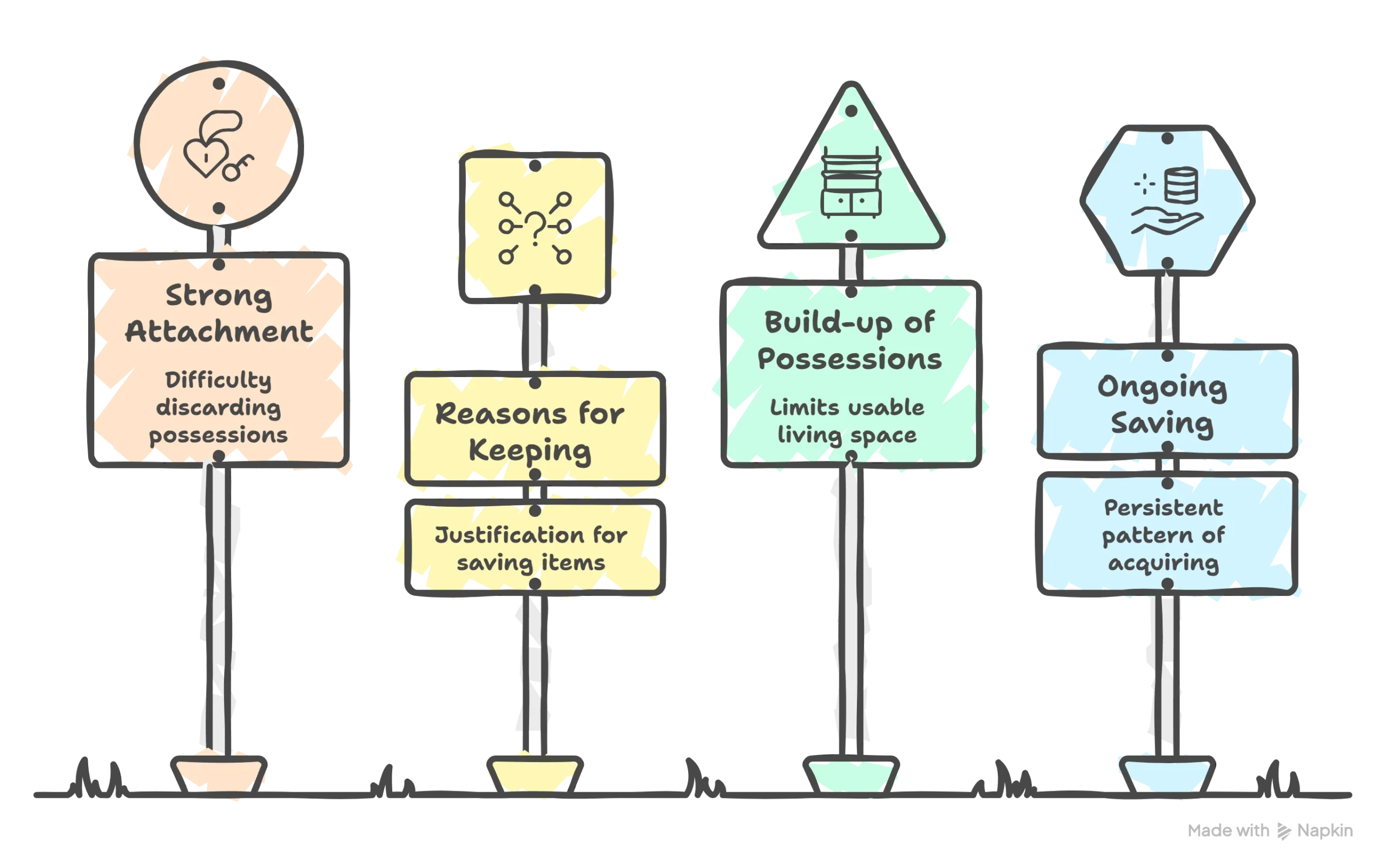
Hoarding disorder is a pattern of difficulty discarding or parting with possessions, even when those items appear to have little practical value to other people. The NHS overview of hoarding disorder explains that it can involve saving large numbers of items and finding it very hard to get rid of them, even when this causes serious problems at home. The problem is not simply about being untidy or disorganised. It involves distress around letting things go, strong reasons for keeping them, and a build-up of possessions that begins to limit how living spaces are used.

Hoarding vs clutter

Clutter on its own does not necessarily mean hoarding disorder. Some people have busy homes, collect lots of things, or go through periods when their environment feels disorganised. Hoarding disorder is different because the clutter is usually driven by persistent saving, strong emotional or practical attachment to possessions, and difficulty discarding, rather than lack of time, preference, or poor organisation alone. For a closer look at that distinction, read why hoarding clutter happens and how CBT helps.

What counts as hoarding

What counts as hoarding is not decided by a single type of item. People may save paperwork, clothing, containers, electrical items, sentimental objects, household goods, or things other people see as having little value. What matters is the pattern. When keeping and acquiring possessions becomes hard to control and begins to affect rooms, routines, relationships, or well-being, it moves beyond ordinary clutter.

infographic illustrating What Is Hoarding Disorder

Common Signs and Symptoms of Hoarding

Common signs of a hoarding problem

The signs of a hoarding problem often build gradually. A person may struggle to throw items away, save things for future use, keep objects because they feel meaningful or potentially important, or feel highly distressed when discarding is suggested. Rooms may become harder to use in the way they were intended, and sorting decisions may be repeatedly delayed.

Difficulty discarding possessions

One of the clearest features of hoarding disorder is persistent difficulty getting rid of possessions. This difficulty is often not about laziness or stubbornness. It is usually tied to emotional distress, fear of making the wrong decision, concern about waste, or a feeling that the item might still be needed.

Acquiring and saving

Hoarding is not always only about discarding. For some people, acquiring is also part of the pattern. This may involve buying, collecting free items, picking things up because they might be useful, or holding on to objects that others would easily let go of. Saving can feel practical, responsible, or protective, even when it is contributing to growing clutter.

When clutter starts to affect everyday life

The NHS notes that hoarding disorder can lead to everyday problems such as difficulty cooking, cleaning, or using rooms normally, as well as disagreements with family or friends about possessions. When clutter starts to limit normal use of space or regularly interferes with daily functioning, that points to something more significant than simple untidiness.

Why Hoarding Feels So Difficult

Why possessions can feel so important

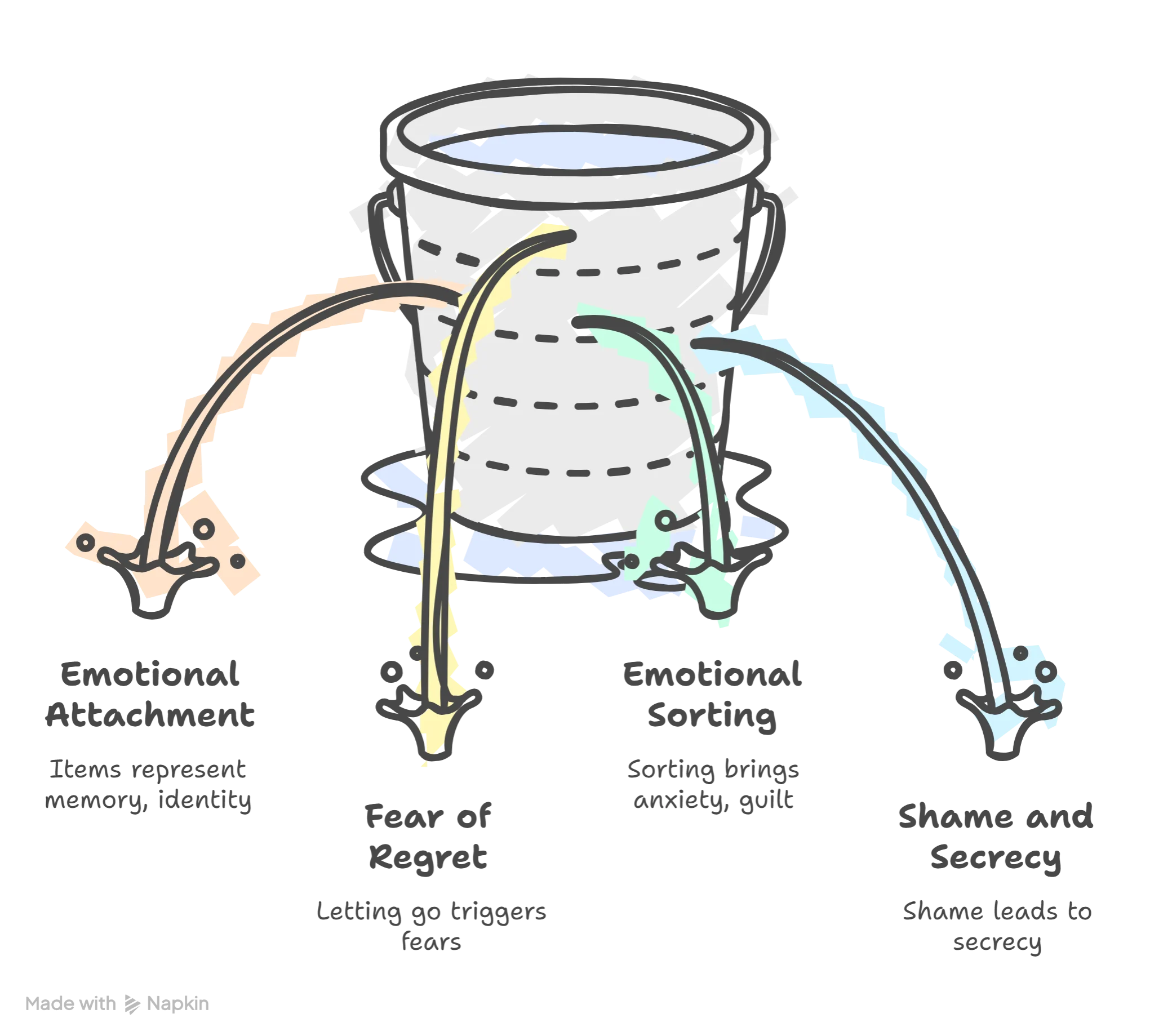
Possessions can carry far more than practical value. They may feel linked with memory, identity, comfort, responsibility, preparedness, or safety. An item that looks unimportant from the outside may feel emotionally loaded to the person keeping it.

Why discarding feels so difficult

Discarding can trigger a strong sense of loss, regret, or uncertainty. A person may worry that they will need the item later, waste something useful, forget something important, or lose part of their history. The decision can feel much bigger than the object itself.

The emotional side of hoarding

Hoarding is often tied to powerful emotions. Sorting can bring anxiety, tension, guilt, sadness, or overwhelm. These feelings can make decisions feel exhausting and can lead to further avoidance.

Shame and secrecy in hoarding

Many people feel deeply ashamed about the state of their home or about the fact that discarding feels so hard. Shame can make it difficult to talk openly, ask for help, or let others see how things have developed. Secrecy can then become part of what keeps the problem hidden and stuck.

Why Hoarding Feels So Difficult visual selection

The Cognitive Characteristics of Hoarding

Difficulty making decisions

Decision-making is often unusually hard in hoarding. A person may find it difficult to decide what is important, what should be kept, what can be discarded, or whether a decision will later prove to be a mistake. This can make even small choices feel draining.

Perfectionism and fear of making the wrong choice

For some people, the problem is not only that decisions are hard, but that they have to feel exactly right. If there is a fear of making the wrong choice, doing something irreversible, or failing to use something wisely, it can feel safer to postpone the decision altogether.

Beliefs about usefulness, waste, and responsibility

The causes of hoarding disorder are not reduced to one single explanation, but certain beliefs often play a major part. A person may believe it is irresponsible to waste anything, that useful items should always be saved, or that getting rid of something is careless if there is even a small chance it could matter later. These beliefs can make discarding feel morally difficult as well as emotionally hard.

Emotional attachment to possessions

Some possessions may feel tied to identity, memory, relationships, or security. The object is no longer only an object. It may feel like a record of who someone is, what they have lived through, or what they might need in the future.

What Keeps Hoarding Going?

Avoidance and postponing decisions

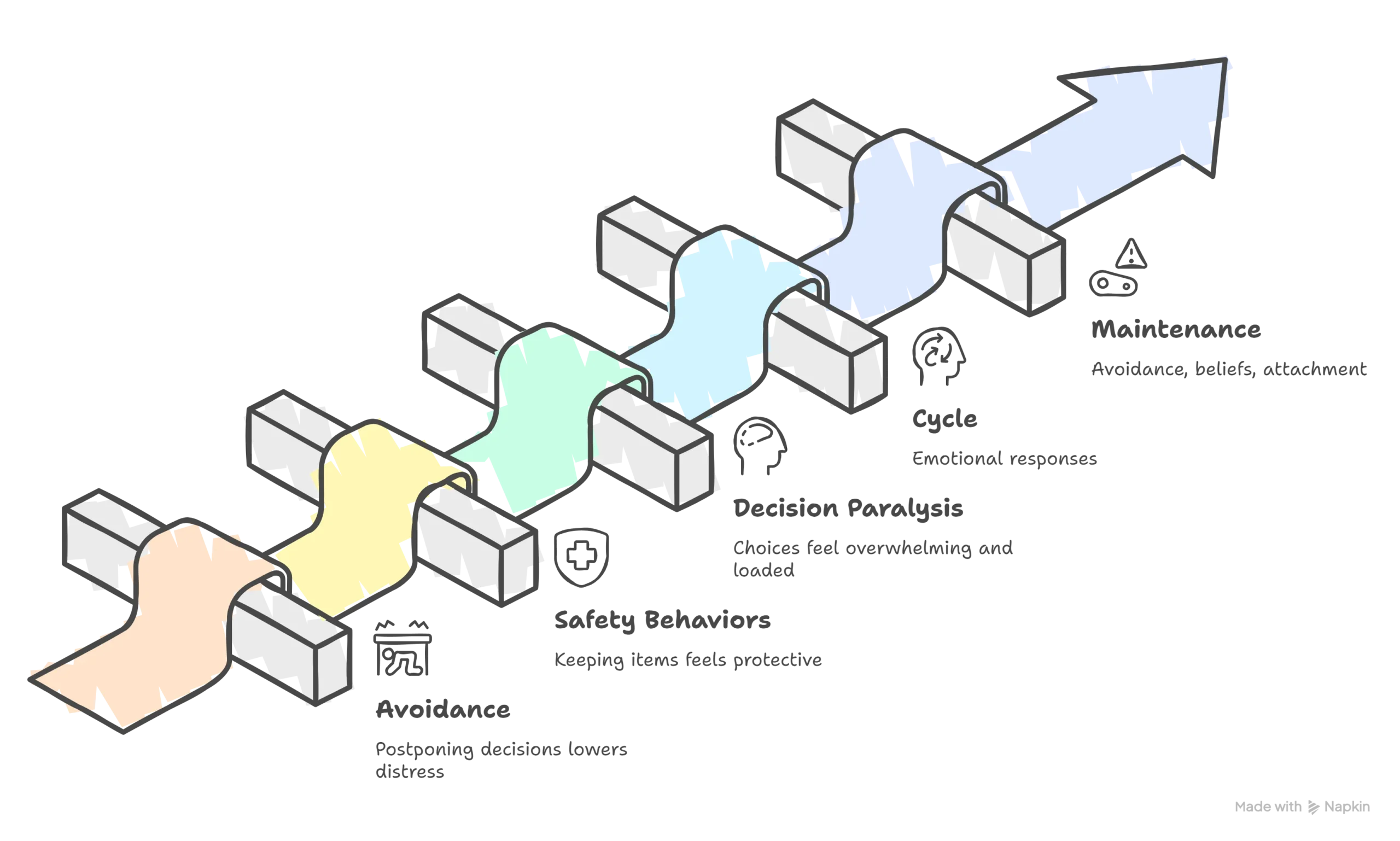
From a CBT perspective, avoidance is one of the main processes that keeps hoarding going. Putting off decisions reduces distress in the short term, but it also means the same difficult choices return later, often with even more pressure attached.

Safety behaviours in hoarding

Safety behaviours are actions that seem to reduce risk or anxiety in the moment. In hoarding, this can include keeping things just in case, leaving items visible so they are not forgotten, delaying sorting until the “right” time, or refusing to discard anything without complete certainty. These responses make sense emotionally, but they can keep the cycle active.

Decision paralysis

As possessions build up, decision-making can become more overwhelming. The number of choices grows, the emotional weight of each choice increases, and the whole task begins to feel unmanageable. This often leads to further freezing and postponement.

The hoarding cycle in CBT

CBT understands hoarding as a cycle involving thoughts, feelings, possessions, and behaviour. An object triggers a belief or emotional response, distress rises, discarding is avoided, and the immediate relief from not deciding makes the same pattern more likely to happen again.

What maintains hoarding over time

Over time, avoidance, strong beliefs, emotional attachment, and repeated relief from postponing decisions all work together. This is why hoarding disorder can persist even when the person feels frustrated, ashamed, or desperate for things to change.

What Keeps Hoarding Going visual selection scaled

Hoarding vs Other Problems

Hoarding vs collecting

Collecting is usually more organised, more selective, and less impairing than hoarding. A collection may take up space, but it is often purposeful and contained. In hoarding, the saving is usually broader, more difficult to control, and more likely to interfere with normal use of the home.

Hoarding vs OCD

Hoarding and OCD can overlap, but they are not the same thing. Some people with OCD save items because of obsessional fears, while hoarding disorder is more strongly centred on attachment, responsibility, decision-making difficulty, and distress around discarding. The American Psychiatric Association’s overview of hoarding disorder describes it as a distinct condition involving persistent difficulty parting with possessions and clutter that disrupts normal use of living spaces.

Hoarding and anxiety

Hoarding is often linked with anxiety, especially around loss, mistakes, waste, or uncertainty. Anxiety may rise sharply during sorting or discarding, but hoarding is not explained by anxiety alone.

Hoarding and depression

Depression can make organisation, energy, concentration, and decision-making harder, which can add to clutter or make change feel overwhelming. Hoarding disorder, however, involves a more specific pattern of saving, attachment, and difficulty discarding.

How Hoarding Affects Daily Life

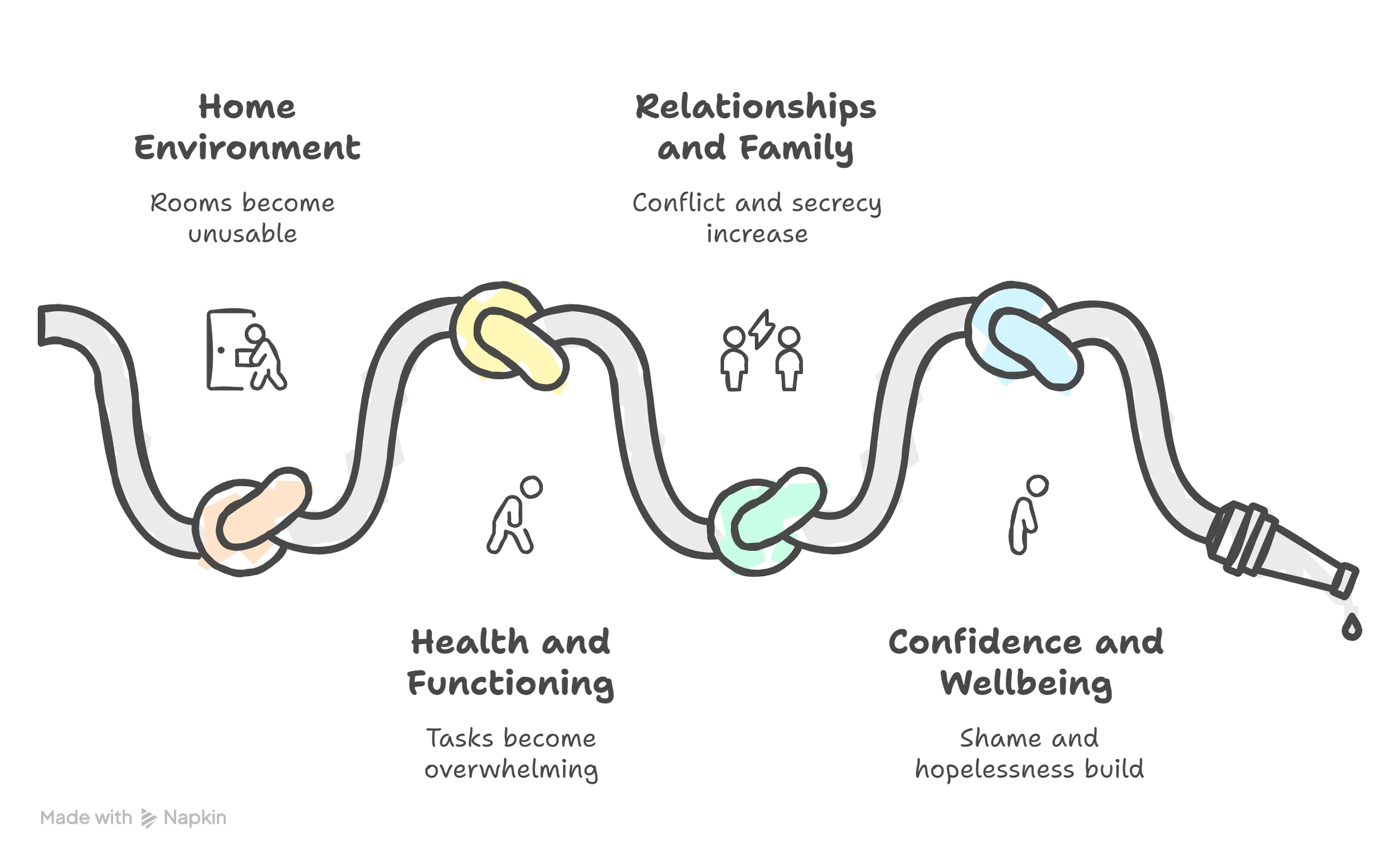
How hoarding affects the home environment

Hoarding can affect how rooms are used and whether spaces still work for cooking, sleeping, washing, relaxing, or moving around easily. The issue is not only visual clutter. It is the way possessions begin to shape how the home functions.

How hoarding affects health and daily functioning

As the home becomes harder to manage, ordinary tasks can feel more complicated and more tiring. People may struggle with routines, feel overwhelmed by their environment, or find that the effort of making decisions spills into other areas of life.

How hoarding affects relationships and family life

Hoarding often affects the people around the individual as well. Family members may feel worried, frustrated, confused, or shut out. The person experiencing hoarding may feel judged, pressured, or misunderstood, which can lead to more secrecy or conflict.

How hoarding affects confidence and wellbeing

Living with hoarding can have a heavy effect on confidence. Shame, embarrassment, self-criticism, and hopelessness can build over time, especially when the person feels stuck in a pattern they do not fully understand.

How Hoarding Affects Daily Life visual selection

What Assessment Usually Explores

Acquiring and saving patterns

Assessment often looks at what kinds of items are saved, how often acquiring happens, and what tends to trigger the urge to keep things. This helps build a clearer picture of the overall pattern.

Discarding difficulties

A clinician will usually want to understand what makes discarding hard. This may include emotional distress, beliefs about usefulness or waste, uncertainty, or a fear of regretting the decision later.

Beliefs about possessions

Assessment also explores what possessions mean to the person. Items may be linked with memory, responsibility, identity, safety, or a sense of preparedness.

Emotional responses to sorting and discarding

Sorting and discarding can bring up strong emotional responses, and these reactions are often central to the problem. A brief structured measure or hoarding disorder scale may sometimes be used to help understand the severity and impact of the difficulties, but the wider clinical picture still matters most.

Impact on daily life

Assessment usually considers how the problem affects the home, routines, relationships, emotional well-being, and day-to-day functioning. The aim is to understand not just the clutter, but the full pattern behind it.

How CBT Understands Hoarding

The CBT model of hoarding

CBT sees hoarding as more than a storage problem. It looks at how beliefs, emotions, attention, and behaviour all interact around possessions.

How thoughts, emotions, and behaviours interact

A possession may trigger a thought such as “I might need this,” “It would be wasteful to throw this away,” or “I cannot risk making the wrong decision.” That thought can trigger anxiety or guilt, which then leads to saving or postponing the decision.

Why hoarding-specific CBT matters

Hoarding-specific CBT matters because the problem has its own pattern. It is not only about clutter. It is about attachment, decision-making, avoidance, and the meanings attached to possessions.

Insight and readiness for change

People vary in how they understand the problem and how ready they feel to face it. Therapy often needs to take account of this, especially where shame, overwhelm, or ambivalence are strong.

How CBT Understands Hoarding visual selection

How CBT for Hoarding Works

What CBT for hoarding typically focuses on

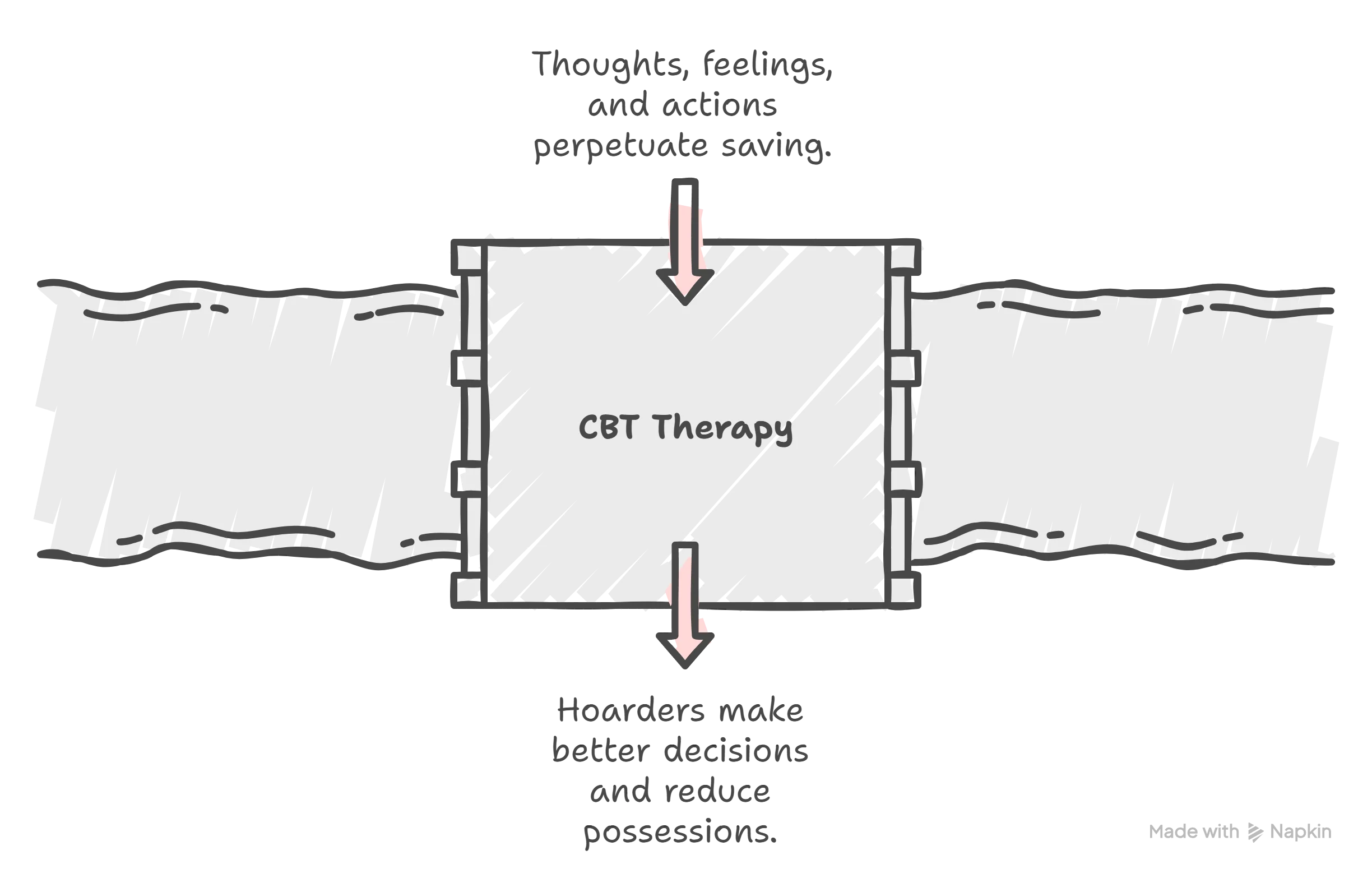
CBT for hoarding usually focuses on the thoughts, feelings, and behaviours that keep saving and discarding difficulties in place. It is concerned with how possessions are understood, what triggers distress, and what happens when decisions are postponed.

Decision-making and behavioural change in therapy

Therapy often pays close attention to decision-making, because this is such a central difficulty in hoarding. The work is not about forcing rapid change. It is about understanding the patterns that make decisions so hard and helping new ways of responding develop over time.

Reducing avoidance and maintaining patterns

Another focus of therapy is the avoidance that keeps the problem going. In CBT, this is approached in a planned and collaborative way with a therapist, rather than as simple decluttering advice.

How therapy is adapted for hoarding

The NHS describes CBT as the main talking treatment for hoarding disorder. In practice, therapy often needs to be adapted to the person’s pace, their level of insight, and the specific meanings attached to possessions. You can read more about how these patterns show up in How to Recognise and Improve a Hoarding Problem.

Is Hoarding Long-term?

How hoarding develops over time

Hoarding often develops gradually rather than all at once. Patterns of saving, postponing decisions, and becoming more attached to possessions may build slowly over many years.

Why hoarding can become longstanding

The problem can become longstanding because the same patterns that reduce distress in the short term also keep it going. Avoidance, attachment, and repeated postponement can make change feel harder over time.

How change happens over time in CBT

From a CBT perspective, change usually happens through understanding the pattern more clearly and working with the thoughts, emotions, and behaviours that maintain it. That is why progress is often better understood as gradual rather than immediate.

Looking Ahead

Hoarding disorder involves much more than clutter. It is shaped by beliefs about possessions, emotional attachment, anxiety around discarding, and repeated patterns of avoidance and postponement.

CBT looks at hoarding in a structured way, with attention to how thoughts, feelings, and behaviours keep the problem active over time. Seeing hoarding disorder through that lens can make the pattern feel clearer and less confusing.

FAQs

Clutter on its own does not necessarily mean a hoarding disorder. Hoarding involves a more persistent pattern of saving, difficulty discarding, and disruption to daily life or the normal use of living spaces.

Yes, hoarding is often linked with anxiety, especially around waste, loss, mistakes, or needing something in the future. Anxiety is part of the picture, but it does not explain the whole problem on its own.

Throwing things away can trigger strong emotions such as guilt, distress, uncertainty, or fear of regret. For many people, the item feels tied to responsibility, memory, usefulness, or safety.

No. Hoarding and OCD can overlap, but hoarding disorder has its own pattern involving possessions, attachment, decision-making difficulty, and distress around discarding. That is one reason it is now recognised as a distinct condition.

CBT can help by looking at the beliefs, emotions, avoidance, and decision-making patterns that keep hoarding going. In hoarding-focused CBT, this work is done in a structured and therapist-guided way rather than through general decluttering advice.

Author Bio

James Hicks

Disclaimer

This page is for general information and education. It is not personalised advice, diagnosis, or a substitute for professional assessment.

CBT Bristol

Take the First Step Towards Change

NOSA CBT offers evidence-based therapy for OCD, hoarding help, phobias, health anxiety, social anxiety, PTSD, panic disorder, and generalised anxiety disorder. We also provide a specialist OCD clinic, professional CBT supervision training, and CBT training and teaching for mental health professionals.

Get in touch today to find out how we can help.