
CBT Cycles Explained: Anxiety, Vicious Cycles and Maintenance Cycles

CBT Cycles Explained: Anxiety, Vicious Cycles and Maintenance CyclesWhat we can help with?

Anxiety can feel confusing when it arrives quickly, repeats itself and pulls you into familiar reactions. CBT cycles, used in Cognitive Behavioural Therapy (CBT), are a way of understanding the links between what you think, how you feel, what happens in your body and what you do next.

In simple terms, a CBT cycle shows how anxiety can become stuck. A trigger leads to a thought or meaning, which creates emotional and physical anxiety, followed by a response such as avoidance, checking, overthinking or reassurance-seeking. The response may reduce anxiety for a short time, but it can also keep the pattern active.

This article explains how anxiety cycles, vicious cycles and maintenance cycles work in CBT. It also looks at why short-term relief can sometimes keep anxiety going, and how therapists use these patterns to understand what may be maintaining the problem.

For a wider explanation of the therapy itself, you can read our guide explaining Cognitive Behavioural Therapy. At NOSA, we also offer CBT therapy for anxiety and related difficulties, both in person and online.

Key Takeaways

  • A CBT cycle makes anxiety easier to map: A CBT cycle shows the links between a trigger, thoughts, emotions, body sensations and behaviours. It gives shape to an experience that can otherwise feel messy or hard to explain.
  • Short-term relief can keep anxiety active: Avoidance, checking or reassurance may calm anxiety briefly. Over time, the mind may learn that those responses are needed before you can feel safe or move on.
  • A vicious cycle is not a blame model: A CBT vicious cycle does not mean you are doing anything wrong. It describes how one part of the pattern feeds the next.
  • A maintenance cycle focuses on the present pattern: CBT does not only ask where anxiety came from. It also looks at what keeps it going now.
  • Changing one part of the pattern can help the whole cycle shift: CBT helps people understand the pattern, then test new responses that allow different learning to take place.

What Is a CBT Cycle?

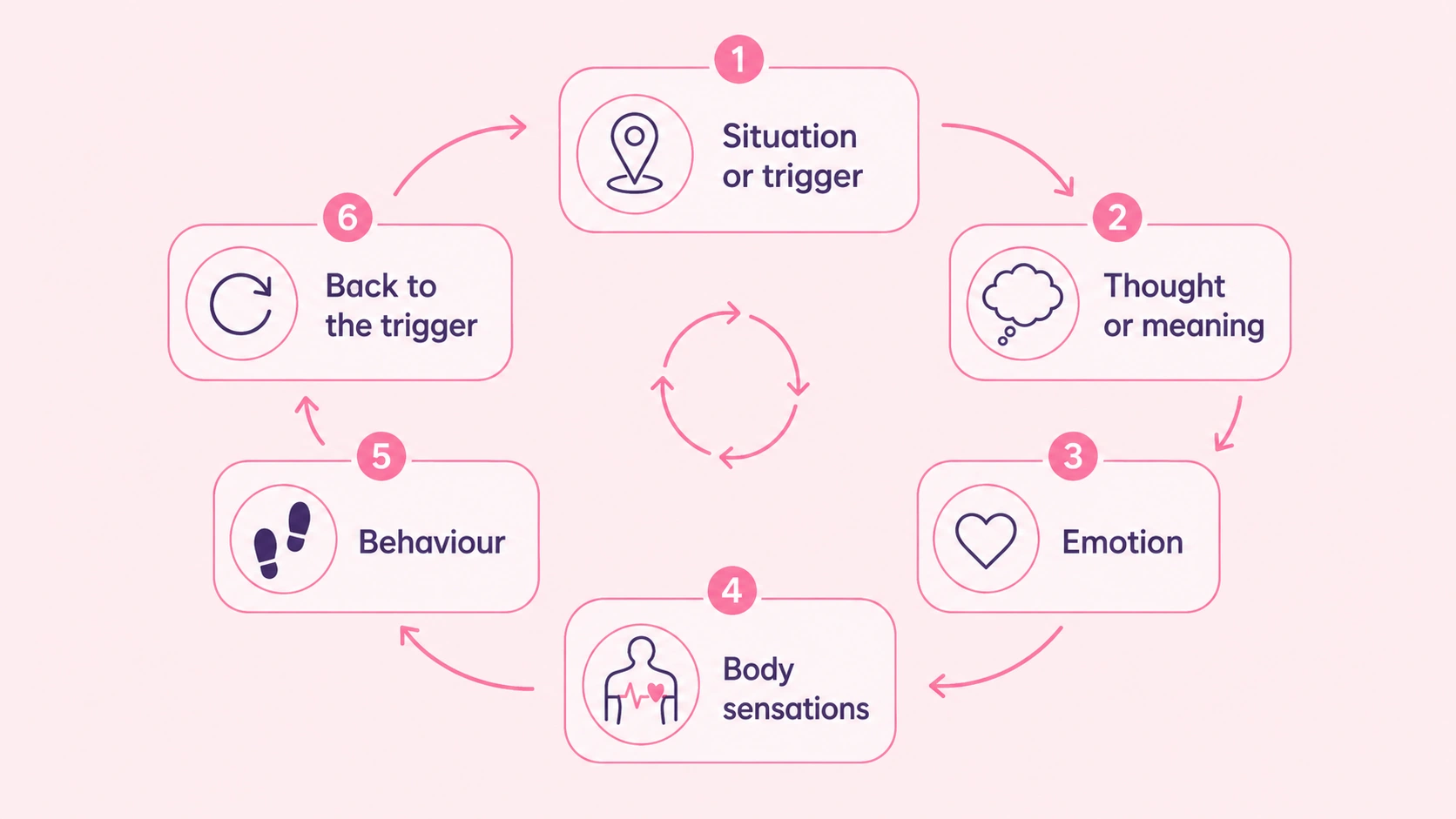
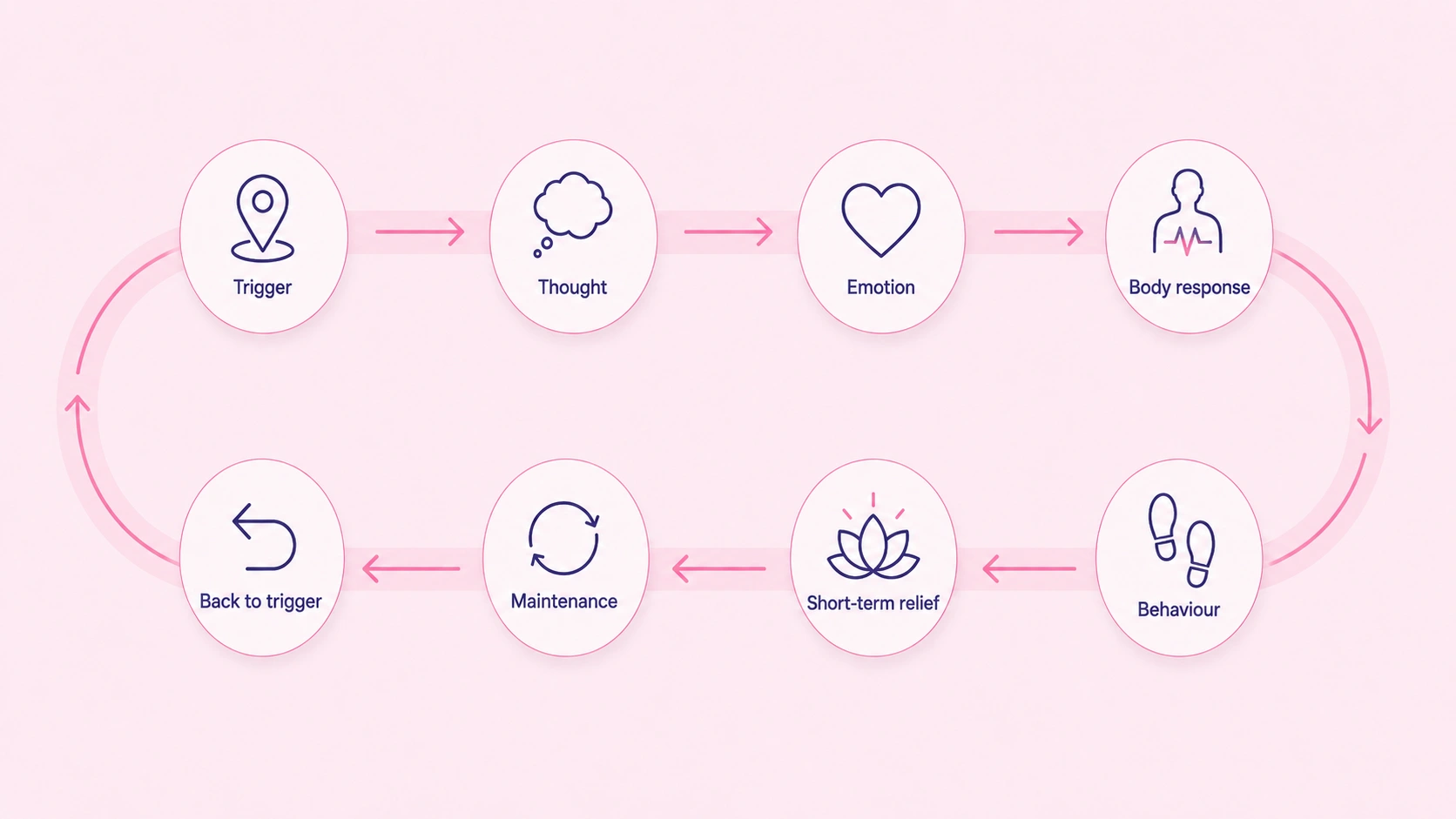
A CBT cycle is a structured way of understanding how distress builds and repeats. It usually includes a situation or trigger, the meaning you give to it, the emotion that follows, the physical sensations that come with that emotion and the action you take next.

The NHS describes CBT as a talking therapy that can help people manage problems by changing the way they think and behave. That is why cycles are useful in CBT. They show how thoughts and actions can become linked with emotional distress.

A cycle does not need to begin with a major event. It might start with an ordinary moment, such as seeing a message on your phone, noticing a sensation in your chest or remembering something you said earlier in the day. What matters in CBT is not only the event itself, but what the event seems to mean.

The Situation

The situation is the starting point. It might be something outside you, such as a work meeting, a text message, a crowded place or a conversation. It might also be something inside you, such as a memory, image, thought or physical sensation.

Triggers Can Be Internal or External

Many people describe anxiety as though it appears from nowhere. In CBT, this can often make sense once internal triggers are considered.

An external trigger might be an email from your manager. An internal trigger might be the thought, “What if I’ve made a mistake?” or the feeling of your heart beating quickly. Both can start the same anxiety pattern.

This can feel reassuring because it means the cycle can still be mapped, even when the trigger is not obvious at first.

The Meaning You Give It

CBT pays close attention to meaning. Two people can experience the same situation but respond differently because they interpret it in different ways.

For example, one person might see a short reply to a message and think, “They are busy.” Another person might think, “They are annoyed with me.” The situation is the same, but the meaning changes the emotional response.

The Emotional and Physical Response

Once the situation feels threatening, anxiety can rise. You might feel dread, worry, fear, guilt, embarrassment or uncertainty.

The body may respond too. You may notice tension, restlessness, a tight chest, a racing heart, a dry mouth or difficulty concentrating. These sensations can feel unsettling, especially when they seem to confirm that something is wrong.

The Behavioural Response

Behaviour is what you do next. You might avoid something, check repeatedly, ask for reassurance, replay events in your mind or over-prepare.

These responses often make sense in the moment. They are attempts to reduce discomfort. The difficulty is that they can prevent you from learning that you could cope in a different way.

infographic illustrating What Is a CBT Cycle

CBT Cycle, Vicious Cycle and Maintenance Cycle: What’s the Difference?

These terms are closely related, but they are not exactly the same. A simple comparison can make the topic easier to follow.

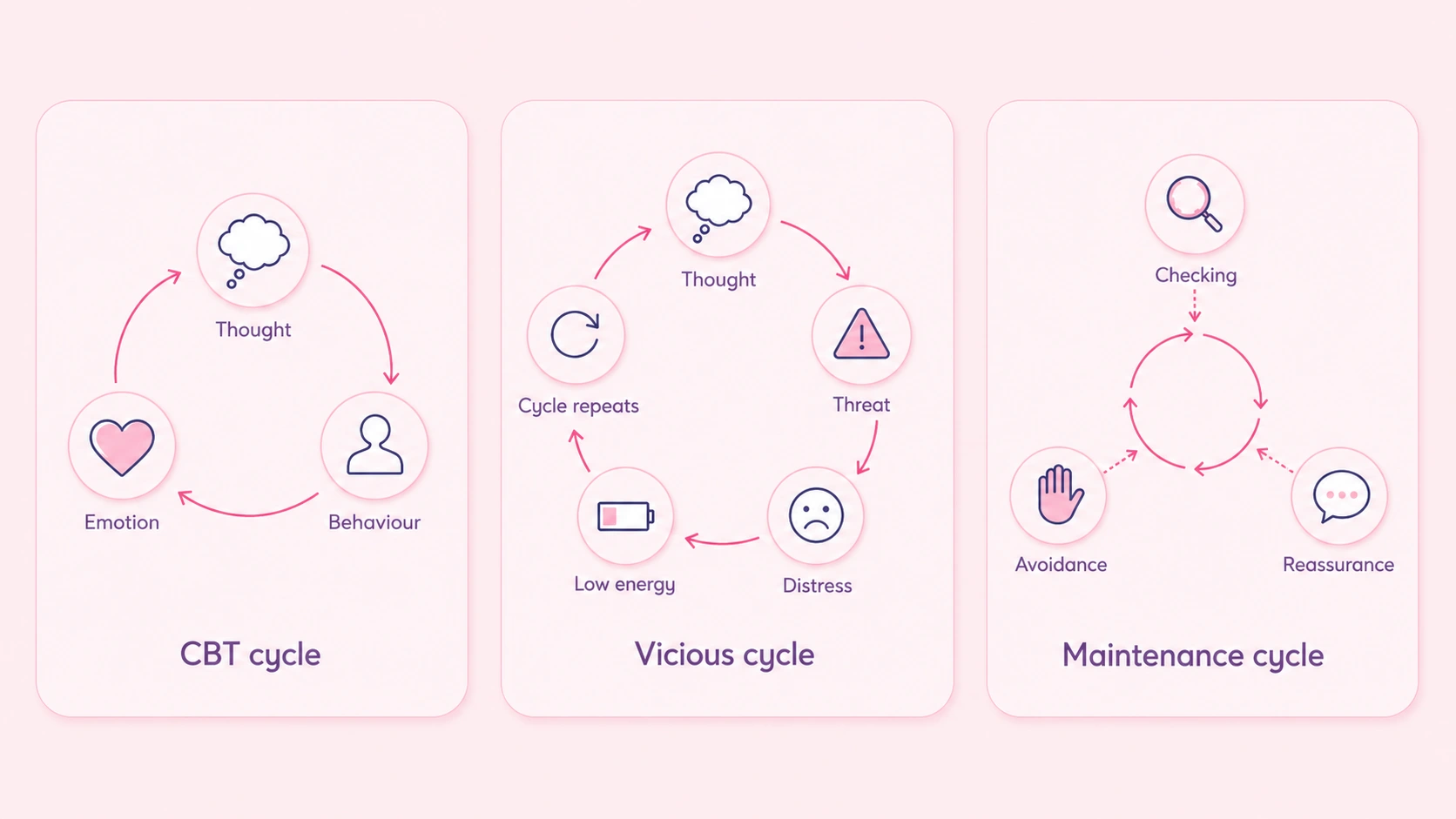
A CBT cycle describes the parts of the pattern. It shows what happens and in what order.

A vicious cycle describes how the pattern feeds itself. For example, you feel anxious, avoid the situation, feel calmer for a short time and then feel more anxious when the situation appears again.

A maintenance cycle focuses on what keeps anxiety active now. It does not ignore the past, but it helps the therapist and client look at the current pattern that may be keeping distress in place.

infographic illustrating the difference between CBT Cycle, Vicious Cycle and Maintenance Cycle

Why CBT Cycles Matter in Anxiety

Anxiety can feel as though it is only about fear, worry or physical discomfort. In CBT, the pattern around the anxiety is just as useful to understand. The cycle shows how anxiety is maintained, not only how it began.

This distinction matters because a person may know what first triggered their anxiety, but still feel unsure why it keeps returning. CBT asks practical, present-day questions. What happens when anxiety appears? What response follows? What does that response teach the mind over time?

The NHS Every Mind Matters CBT guidance explains that thoughts, feelings and behaviour are closely linked, and that unhelpful thoughts and feelings can lead to behaviour that becomes part of a vicious cycle. This is the foundation of how CBT makes sense of anxiety patterns.

Anxiety Can Become Self-Reinforcing

A response that reduces anxiety quickly can be very tempting. If you avoid a meeting and feel calmer, your brain may learn that avoiding the meeting was necessary. If you ask for reassurance and feel calmer, your brain may learn that certainty from someone else is needed before you can move on.

This is not a personal failing. It is a learning process. CBT helps people notice the learning that has taken place and test whether a different response is possible.

The Pattern Can Feel Automatic

When a cycle has repeated many times, it can feel automatic. You may move from trigger to worry, then to checking, before you have had time to pause.

Mapping the pattern can create space. It allows you to see the sequence more clearly, which can make the anxiety feel less random.

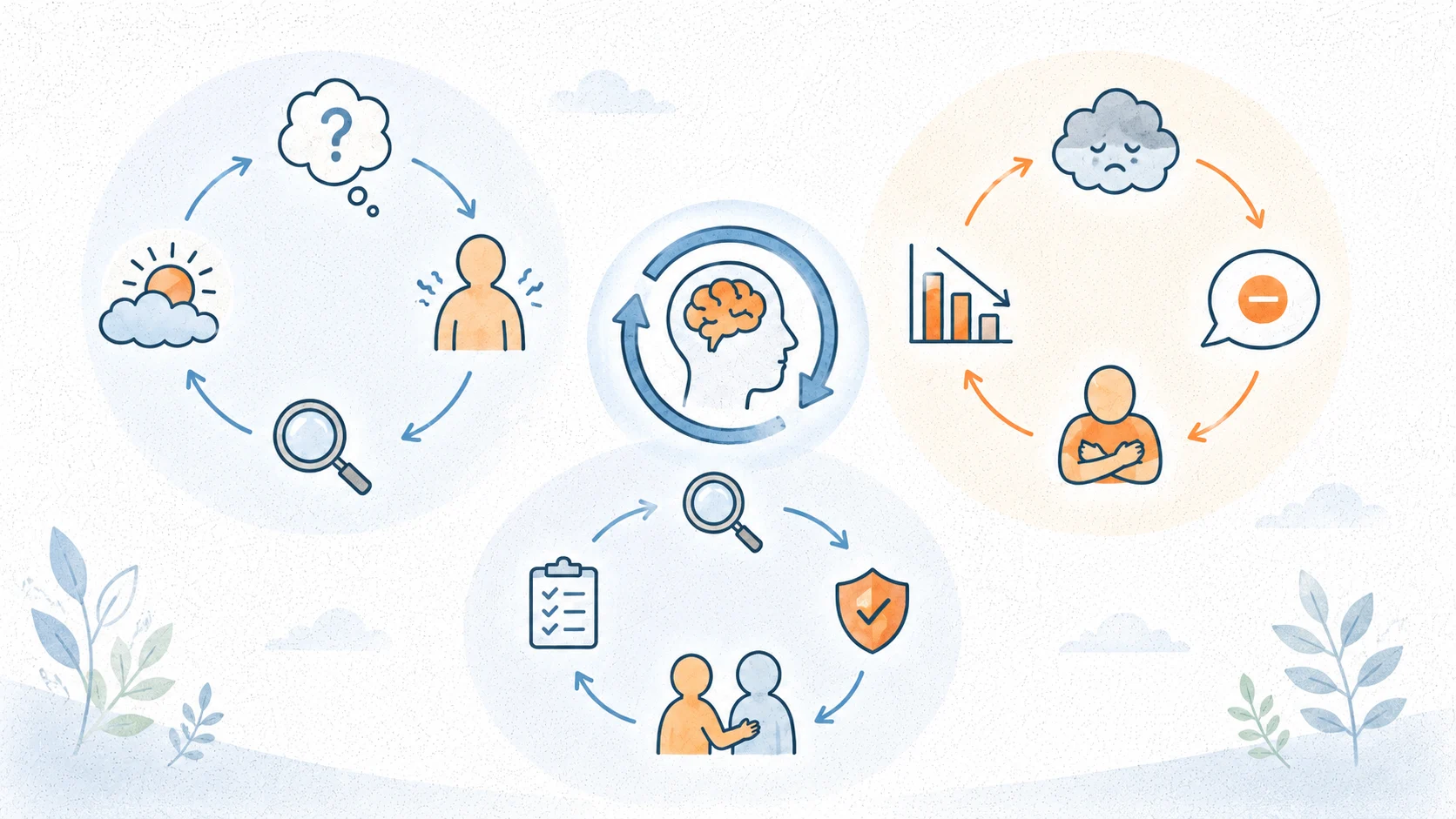
The CBT Anxiety Cycle Explained Step by Step

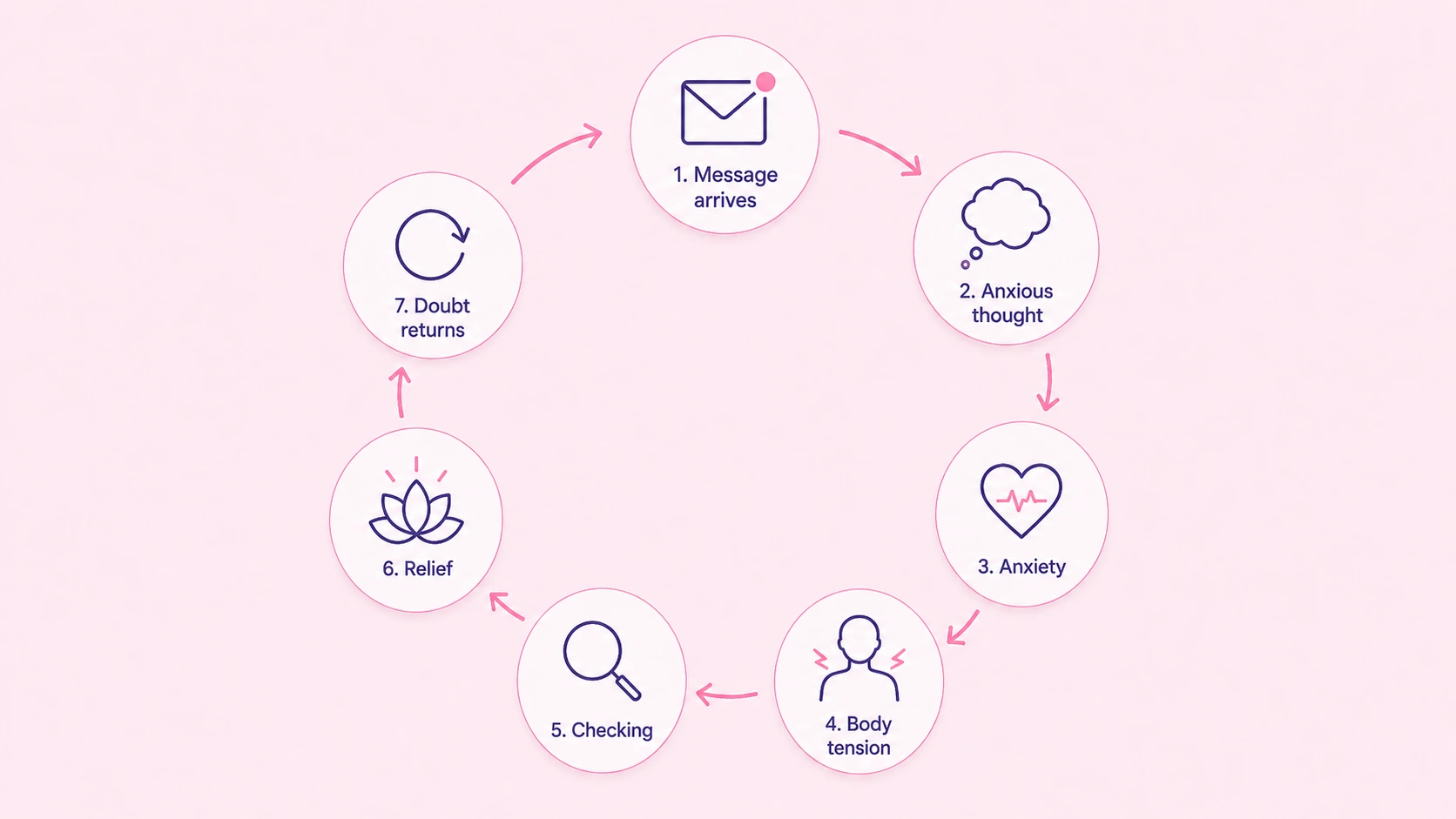
A CBT anxiety cycle can be easier to understand through a simple example. Imagine someone receives a short message from a friend saying, “Can we talk later?” There is no clear sign that anything is wrong, but the uncertainty triggers anxiety.

At first, the behaviour seems helpful. Re-reading the message may feel like being careful. Asking someone else what they think may feel sensible. Looking back over the conversation may feel like problem-solving.

The issue is not that any of these actions are wrong in every situation. The issue is repetition and dependency. If the person feels unable to move on without checking or reassurance, the behaviour becomes part of the anxiety cycle.

infographic illustrating The CBT Anxiety Cycle Explained Step by Step

Why Short-Term Relief Can Keep Anxiety Going

Short-term relief teaches the mind that the safety behaviour worked. The person may think, “I only calmed down because I checked,” or “I only felt better because someone reassured me.”

The next time uncertainty appears, the urge to repeat the same behaviour can become stronger.

Why the Fear Can Grow Over Time

When someone avoids uncertainty again and again, they may have fewer chances to learn that they can cope with it. They may also miss the chance to discover that the feared outcome may not happen, or that they can manage even if something feels uncomfortable.

Over time, ordinary uncertainty can begin to feel more threatening than it really is.

What Is a CBT Vicious Cycle?

A CBT vicious cycle is a repeating pattern where each part of the experience feeds into the next. The word “vicious” can sound harsh, but in CBT it does not mean the person is at fault. It simply means the cycle keeps itself going.

For example, someone may worry about a meeting. They imagine stumbling over their words or being judged. Their body becomes tense and alert. They over-prepare for hours, avoid speaking where possible and then replay the meeting afterwards.

The over-preparation may reduce anxiety before the meeting. The avoidance may reduce discomfort during it. The replaying may feel like an attempt to learn from the experience. Together, though, these responses can keep the fear alive.

Example of a CBT Vicious Cycle

A person feels anxious before a presentation. The thought is, “If I pause or lose my words, everyone will think I’m incompetent.” They feel tense and self-conscious. They rehearse far beyond what is needed, avoid eye contact during the presentation and then spend the evening reviewing every sentence.

The next time they have to present, the anxiety returns earlier. Their mind remembers the event as dangerous, not because it truly was, but because the whole cycle treated it like a threat.

Why Naming the Cycle Can Reduce Confusion

Naming the cycle can help the person step back from it. Instead of seeing anxiety as a mystery, they can begin to see a pattern.

This does not remove distress on its own. It makes the next stage of CBT more focused, because the therapist and client can look at which part of the cycle may need to change.

Maintenance Cycle CBT: What Keeps the Problem Going?

Maintenance cycle CBT refers to the present-day pattern that keeps a problem active. It asks, “What is maintaining this anxiety now?” rather than only asking, “Where did this anxiety come from?”

This is a central idea in CBT formulation. A therapist may explore early experiences, beliefs and past events where relevant, but the maintenance cycle helps identify what is happening in daily life now.

The goal is not to criticise these behaviours. Most of them develop because they seem protective. The question is whether they are helping in the long term, or whether they are keeping the anxiety cycle alive.

Avoidance

Avoidance can bring quick relief. If someone avoids a phone call, cancels a plan or delays a task, anxiety may drop for a while.

The problem is that avoidance can prevent new learning. The person does not get the chance to discover that the situation may have been manageable, or that anxiety can rise and fall without needing escape.

Safety Behaviours

Safety behaviours are actions people use to feel safer. They are not always obvious. They may look practical from the outside, but inside the cycle, they can become a way of trying to remove uncertainty.

A safety behaviour is not defined by the action alone. It is defined by its function. Checking an important form once may be reasonable. Checking it many times because you feel unable to tolerate doubt may be part of the maintenance cycle.

Rumination and Worry

Rumination and worry can feel like problem-solving. The person may think, “If I keep going over this, I’ll find the answer.”

In practice, repeated mental review can keep the threat active. It brings the feared situation back into focus, giving the body more chances to react as though danger is present.

Reduced Confidence

Over time, maintenance behaviours can reduce confidence. If someone always checks, avoids or seeks reassurance, they may start to believe they cannot cope without those responses.

This is one reason CBT often focuses on careful behavioural change. The person needs opportunities to discover what they can manage when the old protective response is reduced in a planned way.

How Anxiety Patterns Can Look Different

The same CBT model can apply across different anxiety problems, but CBT cycles may look different from person to person. The trigger, feared outcome and behaviour can vary, even when the cycle has a similar structure.

The NICE guideline for generalised anxiety disorder and panic disorder in adults covers care and treatment for adults with chronic anxiety and panic disorder in a UK clinical context. This supports the wider point that CBT concepts are often used to understand anxiety-related problems, while still needing to be tailored to the person.

General Anxiety

In general anxiety, the trigger may be uncertainty. A person might worry about work, family, health, money or the future. The thought might be, “If I don’t think this through, something will go wrong.”

The behaviour may involve repeated planning, reassurance-seeking or mentally preparing for every possible outcome. This can leave the person feeling tired, but still not certain enough to relax.

Panic

In panic, the trigger may be a body sensation, such as a racing heart or dizziness. The person may interpret the sensation as dangerous and begin monitoring their body closely.

This monitoring can increase fear, which can increase physical symptoms, which then seems to confirm the original fear. Avoiding places where panic has happened before can then become part of the cycle.

Social Anxiety

In social anxiety, the trigger may be a conversation, meeting or social event. The thought might be, “I’ll say something stupid,” or “People will notice I’m anxious.”

The person may rehearse what to say, avoid eye contact, speak less or replay the interaction afterwards. These responses can prevent them from learning that others may not be judging them as harshly as they fear.

Health Anxiety

In health anxiety, the trigger may be a body sensation, a news story or a thought about illness. The person may check symptoms, search online or ask for reassurance.

These behaviours may reduce anxiety briefly, but the doubt often returns. The cycle then begins again, sometimes with even more attention on the body.

CBT Vicious Cycle Diagram

infographic illustrating CBT Vicious Cycle Diagram

How Therapists Use These Patterns in Sessions

In CBT sessions, cycles are usually explored through recent examples. Rather than talking only in broad terms, the therapist may ask about a specific moment when anxiety appeared.

This might include questions such as: What was happening? What went through your mind? What did you feel in your body? What did you do next? What happened to the anxiety afterwards?

The purpose is not to interrogate the person. It is to build a shared map of the pattern.

Mapping the Pattern Together

A therapist and client may take one recent anxiety episode and break it down into parts. This can help the client see links they may not have noticed before.

For example, they may notice that anxiety rises after a particular thought, or that reassurance brings relief for only a short time. These small details can be very useful.

Testing the Pattern Carefully

Once the pattern is clear, CBT may involve testing predictions and trying different responses. This is usually planned in a structured way, rather than left to chance.

For example, if a client believes they must check a message repeatedly to prevent a mistake, the therapist may help them design a careful experiment around reducing checking and reviewing what happens.

Reviewing What Changes

CBT involves review. The therapist and client look at what happened, what was learned and whether the original prediction was accurate.

Change is not only measured by whether anxiety disappears. It may also be seen in greater tolerance of uncertainty, reduced avoidance, fewer safety behaviours or more trust in personal judgement.

NOSA Case Study to Understand a General Anxiety Maintenance Cycle

The following anonymised case study is written from a therapist’s perspective. The client’s name has been changed to John to protect privacy, but it reflects the kind of general anxiety maintenance cycle that may be explored with a NOSA client in CBT.

The Client’s Condition When They First Made Contact With NOSA

When John first made contact with NOSA, he described feeling anxious most days. His worries moved between work, family responsibilities and the fear of letting people down.

He was managing daily life, but it felt exhausting. At work, he checked emails repeatedly before sending them. At home, he found it difficult to switch off because his mind kept returning to unfinished tasks. He also asked his partner for reassurance about decisions, even when part of him knew there was no clear danger.

From John’s point of view, the anxiety felt constant. He described it as a background noise that became louder whenever uncertainty appeared.

The CBT Method That Was Used

In the early sessions, we used CBT formulation to map John’s anxiety maintenance cycle. We focused on recent examples rather than trying to explain everything at once.

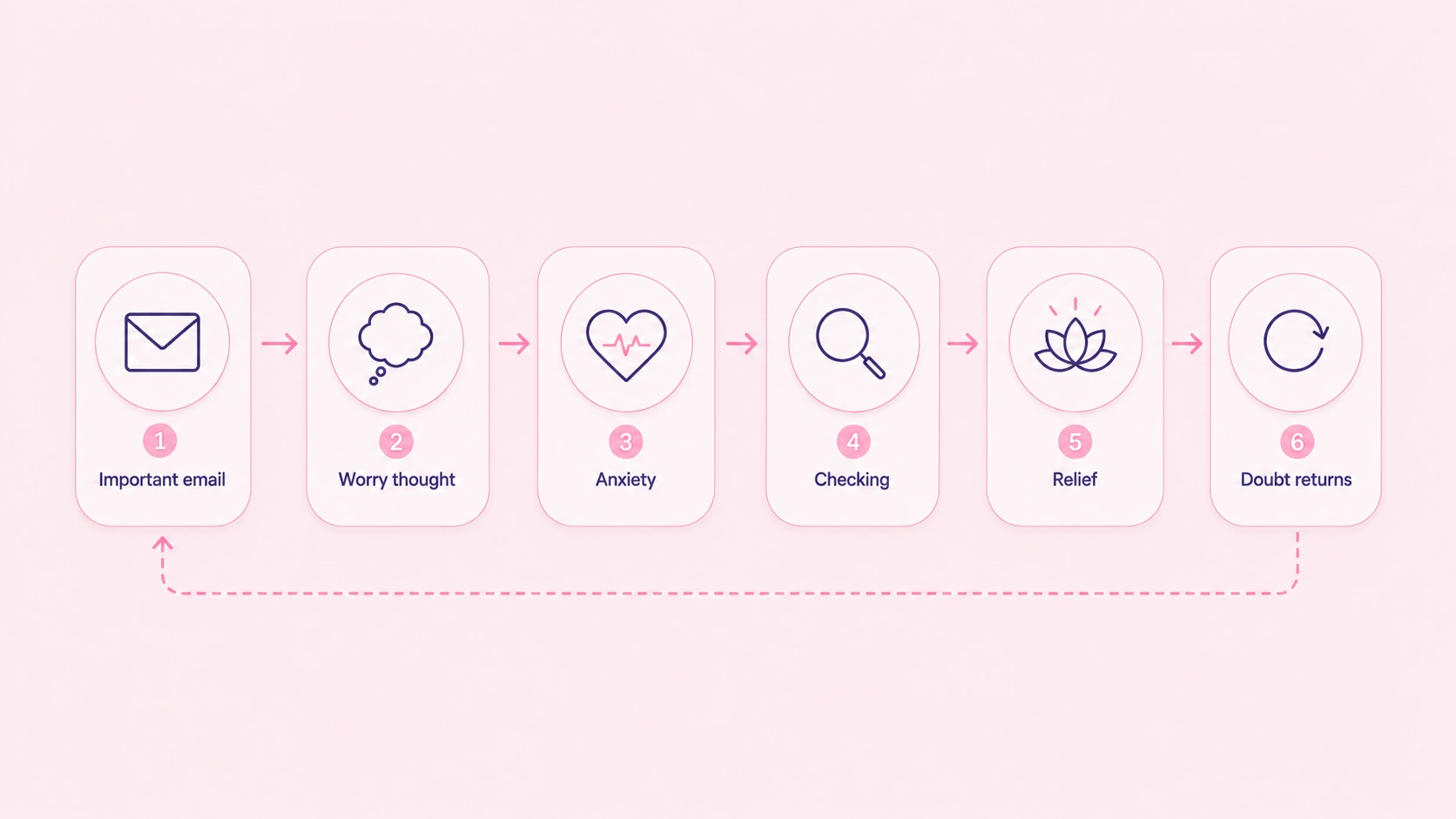
One example involved sending an important email. The trigger was the email itself. The thought was, “If I make a mistake, people will think I’m careless.” The emotion was anxiety and the body response included tension, restlessness and difficulty concentrating.

The behaviour was repeated checking. John read the email many times, changed small details, asked a colleague for reassurance and delayed sending it. When they finally sent it, they felt relief, but the relief did not last. The next email felt just as difficult.

Together, we explored how checking reduced anxiety in the short term but maintained the belief that he could not trust his own judgement. We then planned small, realistic changes to the checking pattern.

The Successful Results

Over time, John became better at spotting the cycle earlier. They began to notice the difference between careful checking and anxiety-driven checking.

He practised sending lower-risk emails after a planned number of checks. At first, this felt uncomfortable. However, reviewing the results helped him see that the feared outcomes rarely happened, and that he could cope with the uncertainty that remained.

John did not become free from every anxious thought. That was not the aim. The progress was more practical and more meaningful. He felt less trapped by the cycle, relied less on reassurance and began to rebuild trust in his own judgement.

infographic illustrating NOSA Case Study to Understand a General Anxiety Maintenance Cycle

Common Misunderstandings About These Cycles

These anxiety maps can be very helpful, but they are sometimes misunderstood. A cycle is not a label, a criticism or a rigid formula. It is a way of making sense of distress with more clarity.

A Cycle Is Not a Blame Model

A cycle does not mean the person is causing their anxiety on purpose. Anxiety responses often develop because they seem protective.

CBT looks at these responses with curiosity and care. The aim is to understand what is happening, not to blame the person for struggling.

A Cycle Is Not the Same for Everyone

Two people can both describe anxiety, but their cycles may look very different. One person may avoid situations. Another may check repeatedly. Another may overthink conversations long after they have ended.

This is why formulation matters. It allows CBT to focus on the person’s own pattern rather than using a one-size-fits-all explanation.

The Aim Is Not to Control Every Thought

CBT is not about forcing every anxious thought away. Trying to remove thoughts completely can sometimes create more pressure.

Instead, CBT often helps people look at thoughts differently, respond to them differently and reduce the behaviours that keep anxiety active.

How CBT Helps Change Anxiety Cycles

CBT not only help people understand the pattern. It helps them change one or more parts of the pattern so new learning can happen.

This is why the behavioural part of the cycle matters so much. Thoughts and feelings are important, but what a person does in response to anxiety can either maintain the problem or create an opportunity for change.

Noticing the Pattern Earlier

The first step is often noticing the pattern earlier. Someone might begin to recognise, “This is the moment where I usually check,” or “This is the point where I start asking for reassurance.”

That pause can be meaningful. It creates a chance to respond differently, even in a small way.

Changing the Behavioural Response

Changing behaviour does not mean forcing yourself into overwhelming situations. In CBT, changes are usually planned, reviewed and matched to the person’s formulation.

For example, someone might reduce checking gradually, delay reassurance-seeking or test a prediction in a situation that feels manageable. The purpose is to gather new evidence, not to prove anything through pressure.

Re-evaluating the Meaning

CBT also helps people examine the meaning they give to a trigger. A thought such as, “If I feel anxious, I won’t cope,” may be explored carefully.

The therapist and client may look at the evidence for and against that thought, consider other explanations and review what actually happens when the person responds differently.

Building Confidence Through Practice

Confidence often grows through repeated experience. If someone repeatedly learns that they can tolerate uncertainty, reduce safety behaviours and manage discomfort, the cycle can begin to shift.

This change is usually gradual. It is not about becoming a person who never feels anxious. It is about becoming less controlled by the old pattern.

Final Thoughts

Understanding CBT cycles can make anxiety feel less confusing and more workable. When you can see the links between triggers, thoughts, feelings, body sensations and behaviours, the pattern becomes easier to discuss and review. A cycle is not a sign of weakness, and it is not a life sentence. It is a map of what may be keeping anxiety active. With CBT, that map can help identify where change may be possible, one planned step at a time.

FAQs

These patterns show how thoughts, feelings, body sensations and behaviours can influence each other. In CBT, mapping the pattern can help explain why distress repeats and what may be keeping it active.

The CBT cycle of anxiety describes how a trigger can lead to an anxious thought, emotional distress, physical symptoms and a behaviour such as avoidance or checking. That behaviour may bring short-term relief, but it can also make the anxiety more likely to return.

A vicious cycle describes a repeating pattern where each part feeds into the next. A maintenance cycle focuses more specifically on what keeps the problem going in the present, such as avoidance, reassurance-seeking or repeated checking.

Safety behaviours can reduce anxiety for a short time, which makes them feel helpful. The difficulty is that they may stop the person from learning that they can cope without the behaviour, so doubt and fear return again.

A CBT vicious cycle diagram should include the trigger, thought or meaning, emotion, body sensations, behaviour, short-term relief and longer-term maintenance. A clear circular diagram can help show how the pattern loops back and repeats.

Author Bio

James Hicks

Disclaimer

This page is for general information and education. It is not personalised advice, diagnosis, or a substitute for professional assessment.

CBT Bristol

Take the First Step Towards Change

NOSA CBT offers evidence-based therapy for OCD, hoarding help, phobias, health anxiety, social anxiety, PTSD, panic disorder, and generalised anxiety disorder. We also provide a specialist OCD clinic, professional CBT supervision training, and CBT training and teaching for mental health professionals.

Get in touch today to find out how we can help.