

Graded Exposure Hierarchy and How CBT Orders Fears from Easier to Harder

Graded Exposure Hierarchy and How CBT Orders Fears from Easier to HarderWhat we can help with?

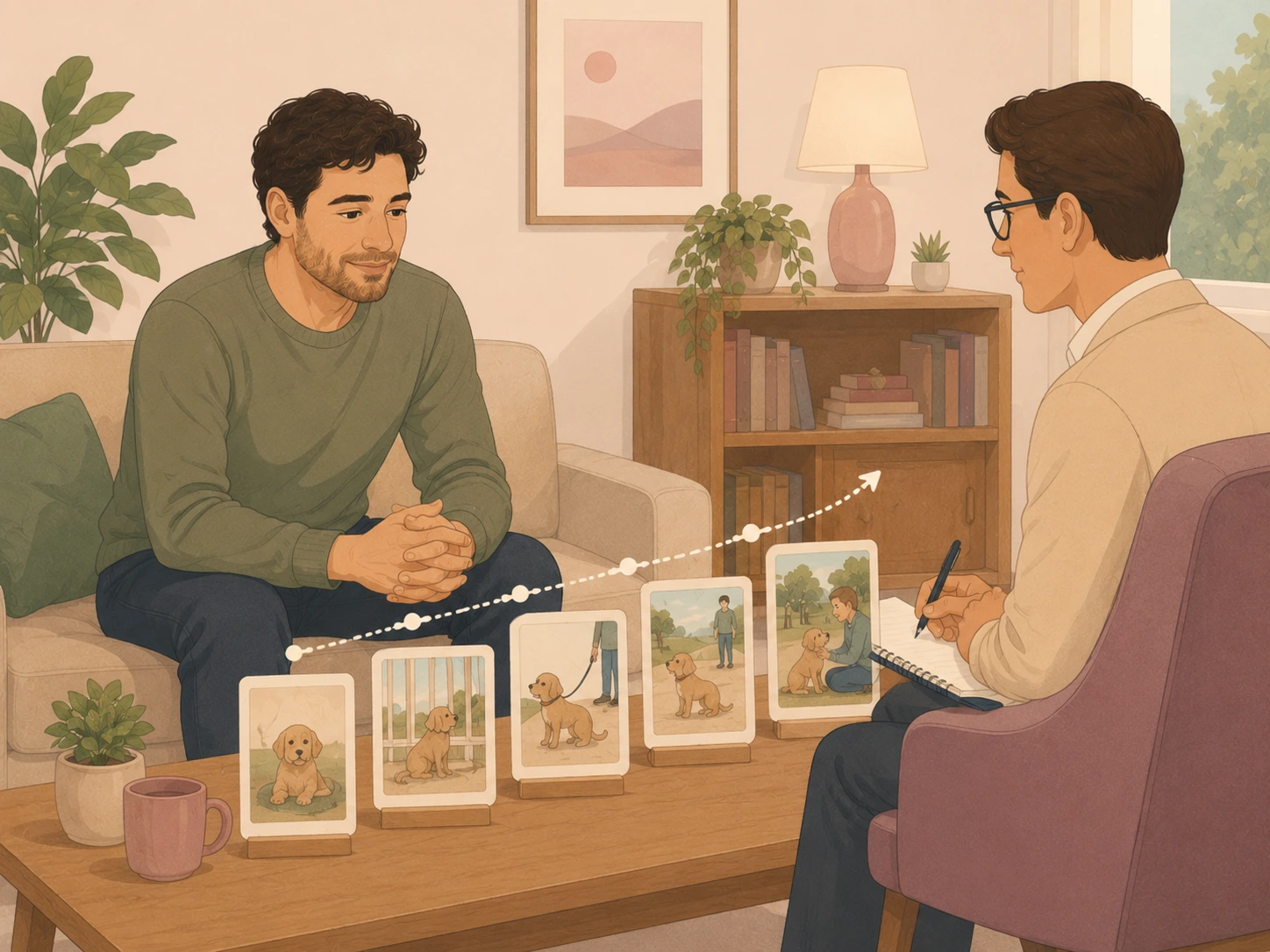
A graded exposure hierarchy is a way of organising feared situations according to how difficult they feel, so exposure work can be planned in manageable stages rather than approached all at once.

For someone with a phobia, that order can matter. Seeing a dog across a park may feel very different from passing one on a narrow path. Looking at a photograph of a dog may feel manageable for one person and extremely difficult for another. The hierarchy is built around the individual fear, not around what someone else thinks should be easy.

Within CBT, the aim is not simply to work through a list as quickly as possible. A hierarchy helps therapist and client understand what is being avoided, what the person expects will happen and where there may be opportunities for new learning. Our guide to understanding phobias explains how avoidance, fearful predictions and safety behaviours can all become part of the wider phobia cycle.

Key Takeaways

A graded exposure hierarchy arranges feared situations according to how challenging they feel for the individual.

“Easier” does not mean easy. Early stages can still bring genuine anxiety.

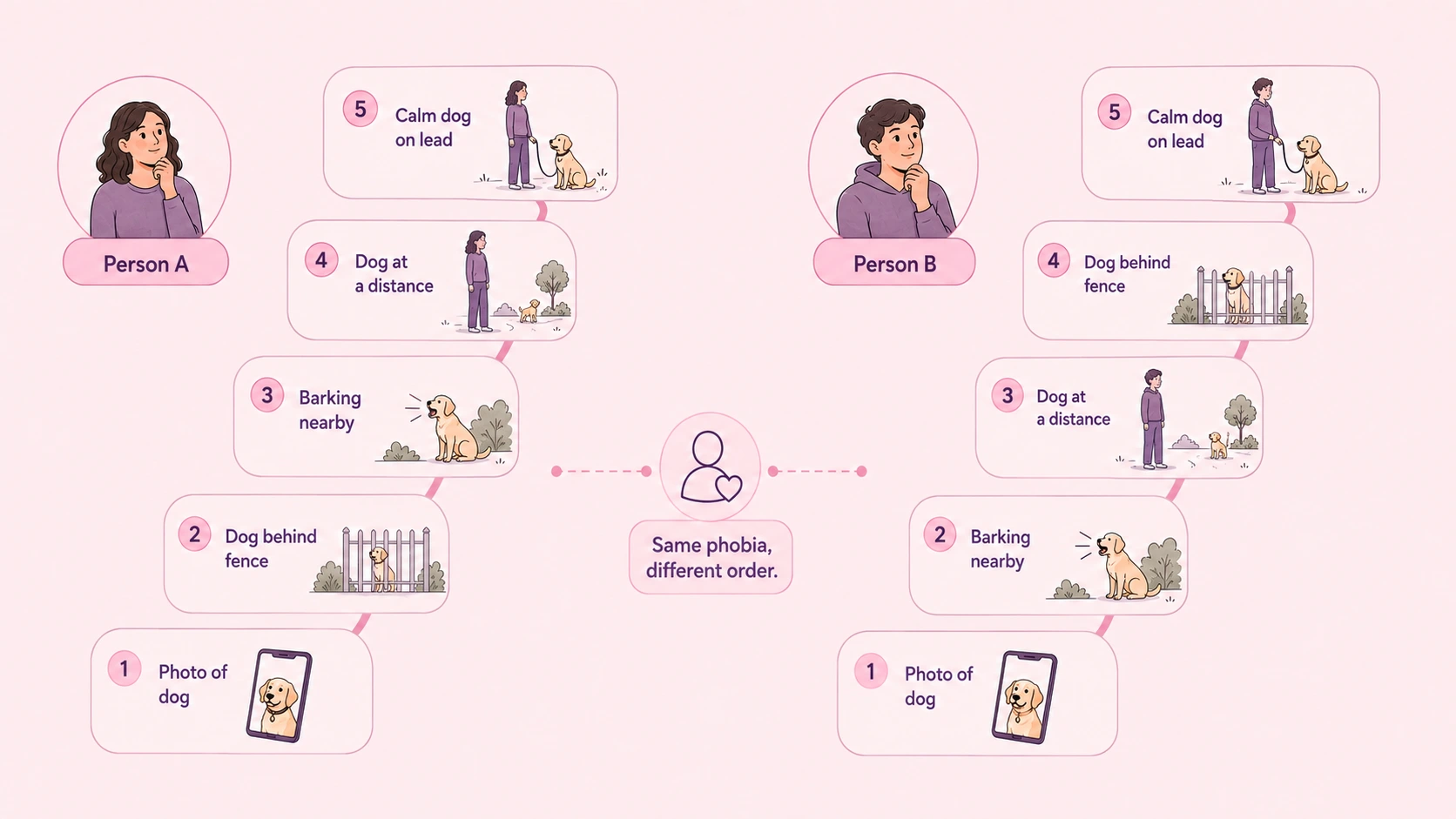
Two people with the same phobia may need very different hierarchies.

Avoidance can bring short-term relief while making feared situations harder to approach over time.

Exposure is planned around the person’s predictions, avoidance and safety behaviours, not only the feared object or situation.

Progress does not always move neatly from one stage to the next. Steps may be repeated or adjusted.

The aim is useful learning and greater flexibility, rather than reaching the top of a hierarchy as quickly as possible.

How a graded exposure hierarchy works in CBT

Exposure involves approaching something that has become strongly associated with fear rather than continuing to organise life around avoiding it.

The NHS guidance on facing fears describes gradually approaching feared situations and ordering them according to how difficult they feel. In CBT for a phobia, this kind of structure can help make exposure more focused and easier to review.

The hierarchy itself is not the treatment. It is a way of organising the work.

Why fears are ordered rather than approached all at once

Someone with a dog phobia may avoid dogs in many different situations. They may cross the road when they see one, avoid parks, decline visits to homes with dogs or become anxious when they hear barking nearby.

Those situations do not necessarily feel equally difficult.

A hierarchy helps identify where the fear changes. Distance might matter. The dog’s size or movement might matter. Whether the dog is on a lead may make a difference. For another person, barking may be more important than distance.

Breaking the fear down in this way gives therapy something more specific to work with.

It also avoids the idea that exposure means immediately confronting the most difficult version of the fear.

“Easier” does not mean easy

The lower end of a hierarchy should not be confused with being comfortable.

A person may still feel nervous when approaching an earlier stage. The difference is that the situation feels more manageable than something further up their hierarchy.

This matters because useful exposure involves contact with the fear. If there is no anxiety at all, the situation may offer little opportunity to learn anything new. If the situation feels overwhelming, it may be difficult for the person to remain engaged with what is happening.

The aim is to find a useful starting point within the individual formulation.

The hierarchy belongs to the individual

There is no standard dog-phobia hierarchy that applies to everyone who fears dogs.

One person may find photographs easy but struggle with the sound of barking. Another may be comfortable seeing a dog behind a fence but become highly anxious if the dog is moving freely.

The same principle applies across specific phobias.

An emetophobia exposure hierarchy, for example, may look very different from a hierarchy for animal or situational phobias because the feared situations, predictions and safety behaviours will not be the same.

The therapist needs to understand what the person fears will happen, rather than assuming that the trigger itself tells the whole story.

infographic illustrating How a graded exposure hierarchy works in CBT

Why avoidance can make a phobia harder to change

Avoidance is understandable. If something creates strong fear, moving away from it can bring immediate relief.

The problem is what the person gets the chance to learn.

The NHS notes that avoiding feared situations may help in the short term but can make them harder to face over time. Gradual exposure gives the person an opportunity to approach what has been avoided rather than relying only on escape.

Short-term relief can strengthen avoidance

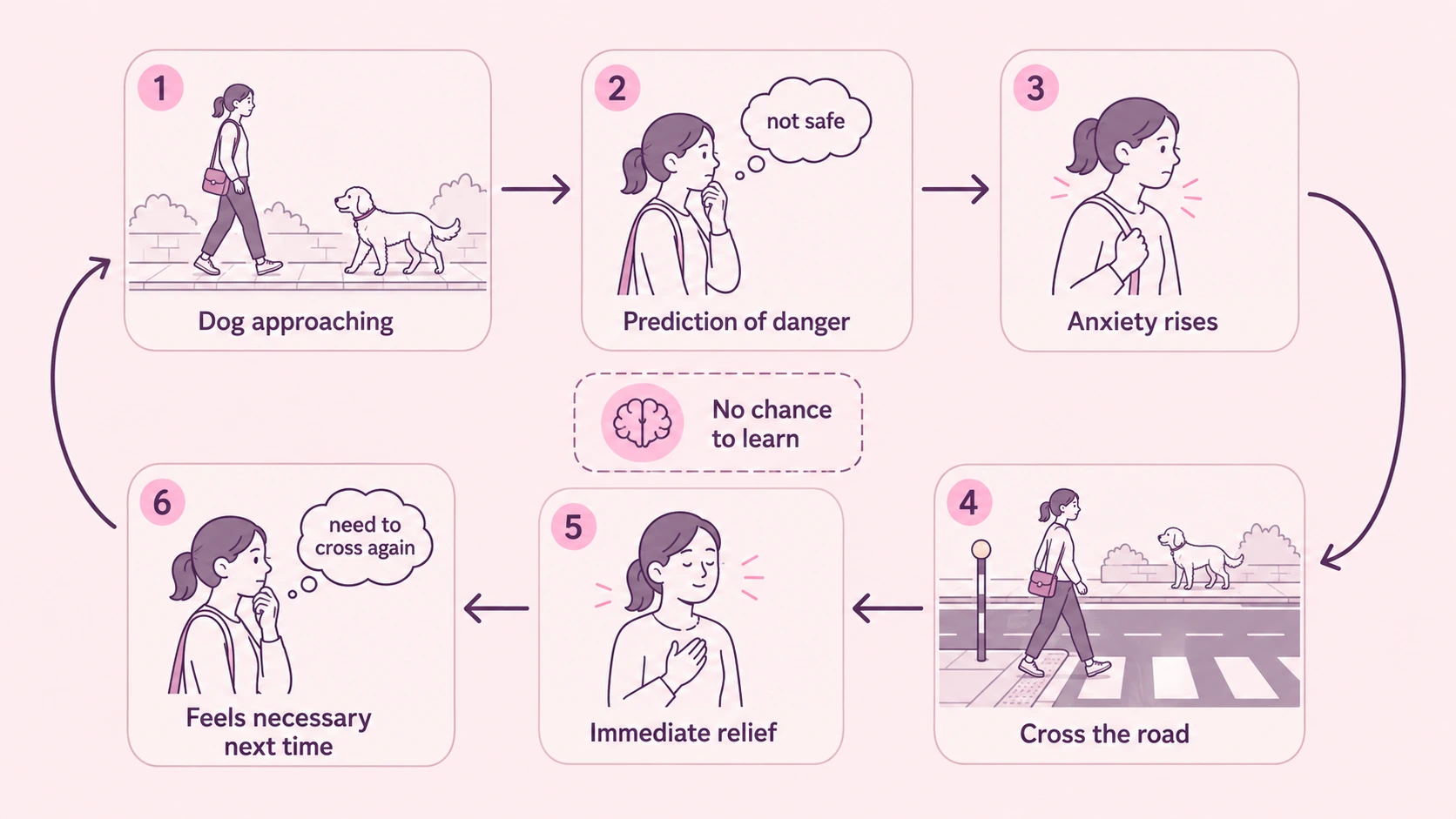
Imagine someone with a dog phobia sees a dog approaching on the same pavement.

They cross the road.

Their anxiety drops.

From their point of view, crossing the road worked. The feared situation ended and they felt safer.

What they do not get to discover is what might have happened if they had stayed where they were. The relief can therefore strengthen the urge to cross the road again next time.

Over time, the person may start changing routes before they even see a dog or avoiding places where dogs are likely to be present.

The fear begins to shape more of everyday life.

infographic illustrating Why avoidance can make a phobia harder to change

Safety behaviours can affect the hierarchy too

Avoidance is not always obvious.

Someone may still enter a park but constantly scan ahead for dogs. They may only go with another person, stay close to an exit or change direction whenever they see an animal in the distance.

These behaviours can help the person feel safer enough to stay in the situation.

They can also affect what the person learns. If nothing difficult happens, they may conclude that this was because they kept watching carefully, stayed far enough away or had someone with them.

Our animal phobia therapy page explains how CBT looks at the fear cycle, predictions, avoidance and safety behaviours alongside graded exposure.

Exposure creates an opportunity for new learning

Exposure gives the person a chance to find out what happens when the usual pattern changes.

That does not mean proving that nothing unpleasant can ever happen. Dogs can bark. A dog may move unexpectedly. Fear may rise.

The useful learning may be that the person can remain in the situation for longer than expected, that anxiety changes without immediate escape or that the feared outcome is different from what they predicted.

This connects with the learning processes discussed in our article on classical conditioning and phobias. A fear association can become stronger through avoidance, while new experiences can gradually provide different information.

How a hierarchy is built around the fear

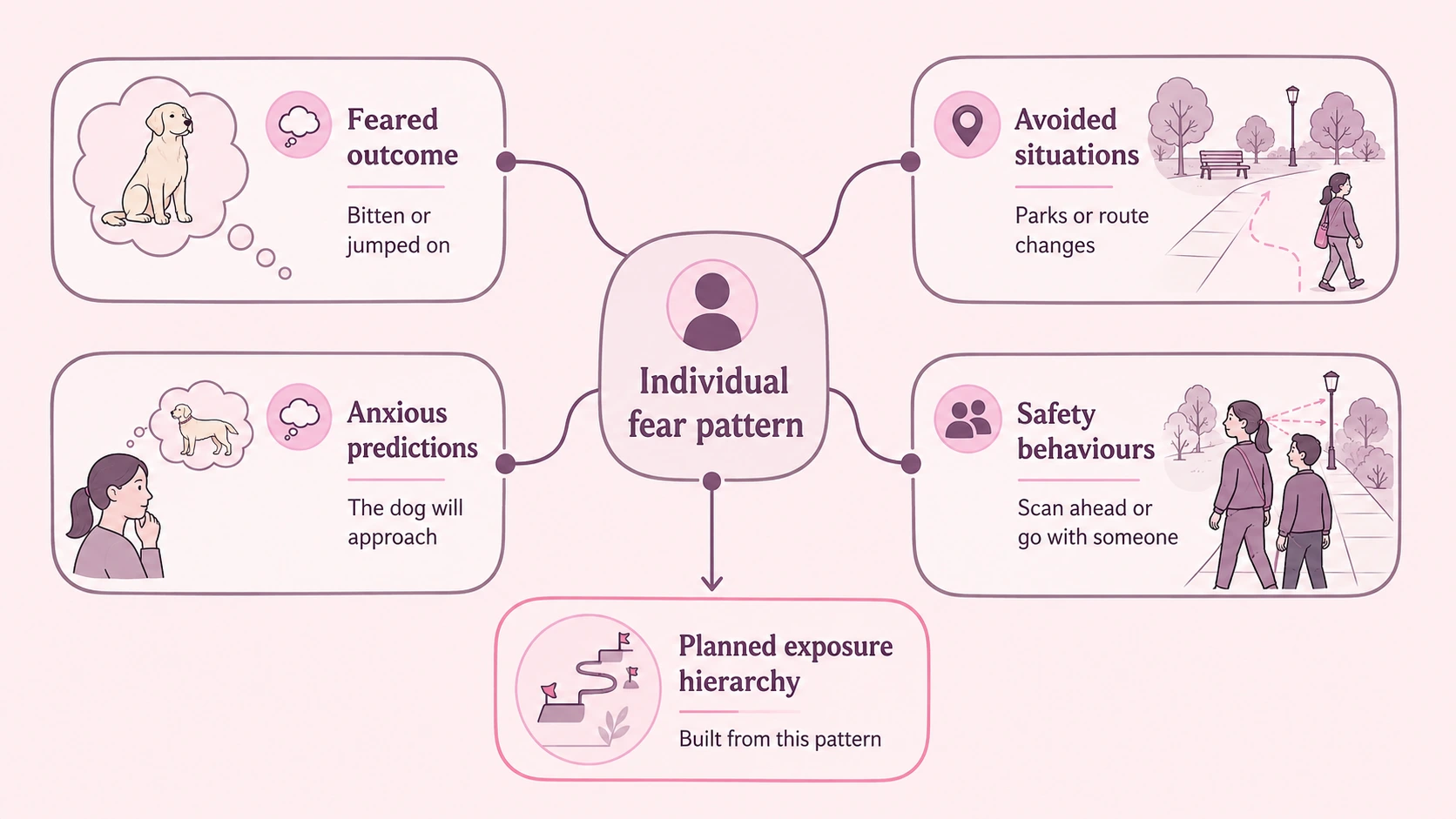
A useful hierarchy needs more detail than a simple list of objects or situations.

Two people may both say they have a dog phobia while fearing very different outcomes.

One may fear being bitten. Another may fear a dog jumping up at them. Someone else may mainly fear becoming visibly distressed and feeling unable to control their reaction.

Understanding that difference shapes the hierarchy.

A graded exposure hierarchy is most useful when it reflects the person’s actual fear rather than a standard list of situations that may look similar from the outside.

Start with the feared outcome

CBT looks closely at what the person expects will happen.

If someone fears being bitten, distance, whether the dog is on a lead and how quickly it is moving may strongly affect anxiety.

If the main fear is losing control, the person’s own physical anxiety may become just as important as the dog.

This is one reason exposure work needs to be linked with the person’s wider formulation.

The feared situation only makes sense when you also understand the prediction attached to it.

Look at the situations being avoided

The therapist and client can then look at where the fear appears in everyday life.

For a dog phobia, this might include seeing photographs, hearing barking, seeing dogs at different distances, passing dogs on a lead or spending time in places where dogs are likely to be present.

These examples are not a standard sequence to follow. They simply show how one fear can appear across several different situations.

An animal phobia hierarchy would also look different from one developed for heights, flying, enclosed spaces or another specific phobia.

Consider predictions and safety behaviours

The hierarchy also needs to reflect what the person normally does to cope.

Someone who can walk past a dog only while holding another person’s arm may appear to have completed the situation, but the safety behaviour may still be central to how they made sense of it.

Likewise, someone may remain in a park while continuously monitoring every dog nearby.

CBT therefore looks not just at whether the person entered the situation, but at the prediction they were testing and how they responded while they were there.

Our article on the cognitive characteristics of phobias looks more closely at how threat predictions and attention to danger can shape phobic fear.

infographic illustrating How a hierarchy is built around the fear

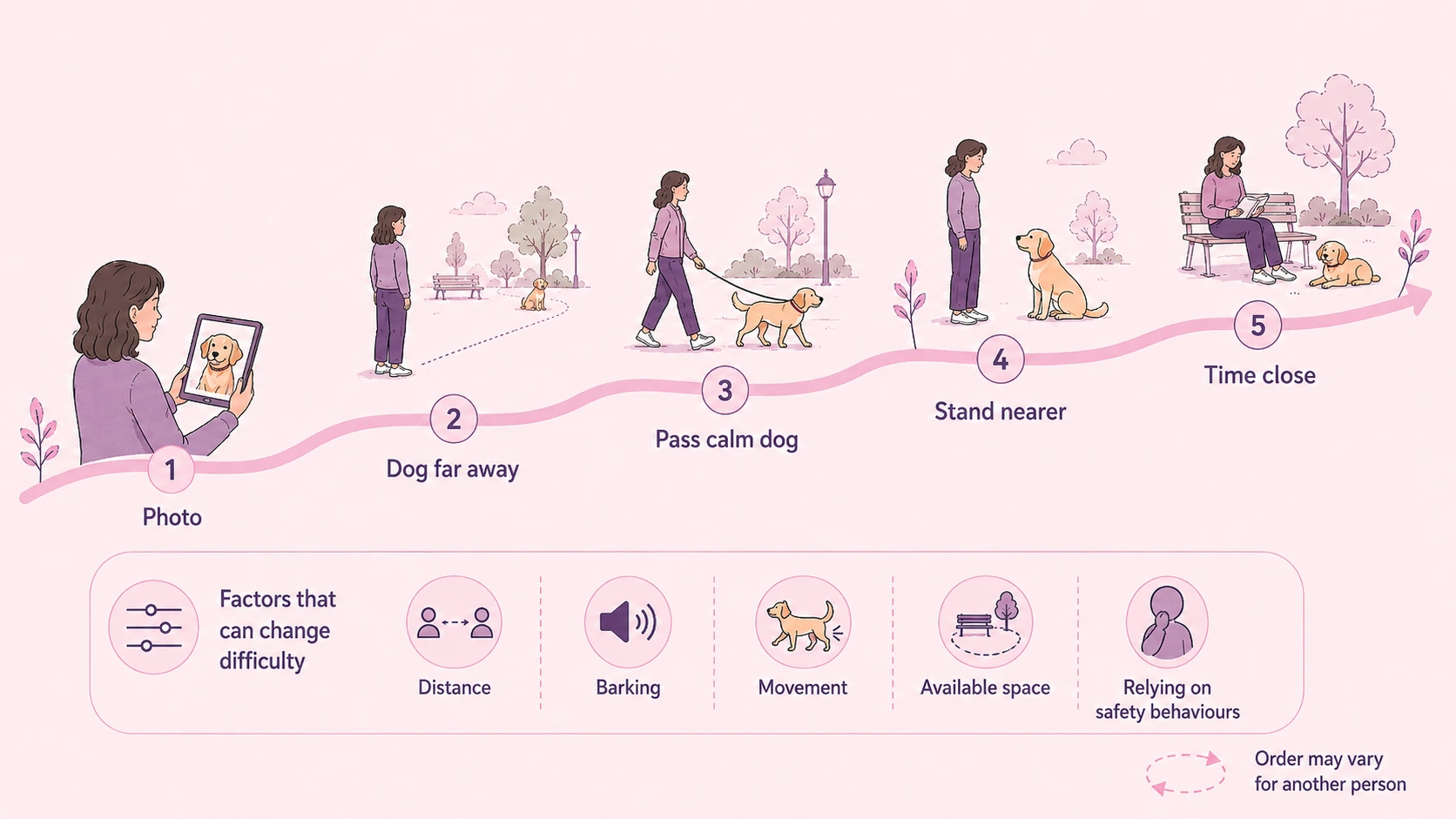
A simple dog phobia hierarchy example

A hierarchy can help organise several versions of the same fear.

For illustration, someone with a dog phobia might identify situations such as these:

This is only an example. Another person may put these situations in a completely different order.

A photograph might feel easy for one person but difficult for someone whose fear is triggered strongly by images. A barking dog at a distance may feel harder than a quiet dog nearby. A small dog may feel more difficult than a large one because of a previous experience.

The hierarchy is therefore not a universal scale of fear.

Its purpose is to map the person’s own pattern.

Camden and Islington NHS Talking Therapies describes graded exposure for some phobias as gradually approaching the feared thing or place in a planned and collaborative way. That collaborative element is important because the exposure needs to relate to the individual’s fear rather than a generic set of steps.

infographic illustrating A simple dog phobia hierarchy example

Why the order of exposure steps can change

A hierarchy gives therapy structure, but it should not become rigid.

Fear can change according to context, and the person may learn something during one exposure that changes what makes sense to work on next.

Fear does not always follow a neat scale

A situation that looks easier on paper may feel harder when it happens.

For example, standing several metres from a quiet dog may feel manageable, while a smaller dog barking unexpectedly from further away creates much stronger fear.

That does not mean the hierarchy was wrong.

It provides new information about what matters to the person.

Perhaps barking is a stronger trigger than distance. Perhaps unexpected movement is more important than the size of the dog.

The hierarchy can then be adjusted to reflect that.

This flexibility is an important part of a graded exposure hierarchy, because the order can change as therapy reveals more about what the person finds difficult and why.

Progress does not need to move in a straight line

Exposure work may involve repeating a situation several times, changing part of it or returning to something that previously felt manageable.

Progress can also vary from day to day.

A difficult week, poor sleep or an unexpected experience may affect how challenging something feels. That does not erase previous learning.

The hierarchy is there to support the therapy rather than judge whether the person is progressing quickly enough.

The goal is learning, not reaching the top quickly

Completing the final item on a list is not the only measure of progress.

Someone may become less likely to cross the road every time they see a dog. They may spend more time in parks, rely less on another person or stop scanning continuously for animals.

These changes may have a meaningful effect on daily life even before the most difficult situations have been approached.

The important question is what the person is learning about the fear, their predictions and their ability to respond differently.

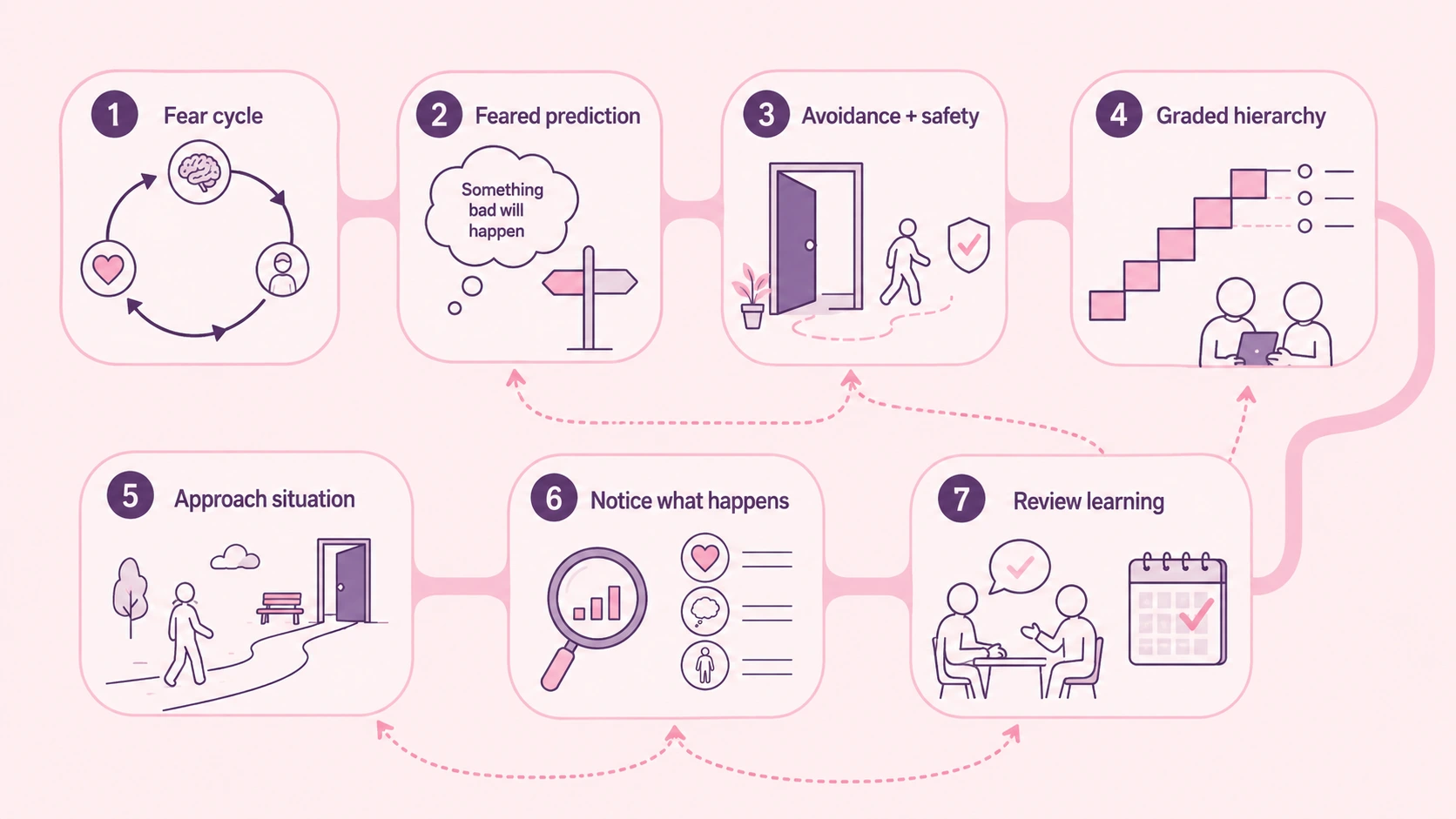
How exposure hierarchies fit into wider CBT for phobias

The NHS phobias guidance lists CBT among the treatments used for phobias. Exposure sits within that wider work rather than operating as an isolated exercise.

CBT may first look at how the fear developed, what triggers it now and what the person predicts will happen.

It also considers what keeps the pattern going.

Understanding the fear cycle first

A phobia usually involves more than fear when the trigger is physically present.

Someone may worry beforehand, scan for danger, avoid particular places or use rules designed to prevent contact with the trigger.

These patterns help explain why the phobia continues to affect everyday life.

Linking exposure with fearful predictions

Exposure becomes more useful when the person knows what they are expecting to happen.

If the prediction is that a dog will immediately attack, the learning is different from someone whose main prediction is that they will panic and embarrass themselves.

The external situation may look similar, but the CBT work is not identical.

This is why the hierarchy needs to be connected with the person’s thoughts rather than based only on physical distance from the feared object.

New learning can weaken an old fear pattern

Exposure creates opportunities to gather information that avoidance cannot provide.

The person may discover that they can stay near a feared situation for longer, that their anxiety changes, or that the feared outcome does not unfold in the way they predicted.

That learning can gradually compete with the older fear pattern.

The hierarchy helps organise those opportunities, while the therapist and client review what was learned and decide what makes sense to work on next.

infographic illustrating How exposure hierarchies fit into wider CBT for phobias

Our Case Study

We have anonymised the following example for privacy reasons. Identifying details have been changed.

The problem the client had when they first contacted NOSA

One client came to NOSA with a longstanding fear of dogs.

They avoided parks, crossed the road when they saw a dog approaching and often asked someone else to walk with them in places where dogs might be present.

The fear had gradually started to affect routes, social plans and everyday activities.

The method used to understand and work with the problem

In therapy, we looked at what the client feared would happen, the situations they avoided and the safety behaviours they relied on.

We then developed an individual hierarchy based on those patterns. Rather than using a standard dog-phobia ladder, the order reflected what the client actually found more or less difficult.

Exposure was reviewed as the work progressed, and some stages were adjusted when we learned more about the parts of the fear that mattered most.

The progress made

Over time, the client became less likely to change route automatically when a dog was nearby and more able to remain in places where dogs might be present.

They also relied less on scanning and having another person with them.

The fear had not disappeared completely, but it had less influence over everyday choices.

Final Thoughts

A phobia can make avoidance feel like the safest option, particularly when the feared outcome feels immediate and convincing. The difficulty is that avoiding the trigger can leave the original fear largely untested.

A graded exposure hierarchy gives CBT a structured way to organise feared situations around the individual person. It considers what they fear, what they avoid, the safety behaviours they use and what they predict will happen.

The aim is not to rush towards the most difficult situation. It is to create opportunities for new learning so the phobia has less control over everyday life.

FAQs

A graded exposure hierarchy is a way of arranging feared situations according to how challenging they feel for one person. It helps therapist and client plan exposure in stages rather than treating every version of the fear as equally difficult.

The order is based on the individual’s experience of fear, their predictions and the details that make each situation more or less difficult. Distance, movement, noise, uncertainty and safety behaviours may all affect where a situation sits on the hierarchy.

It often begins with a situation that feels more manageable than the person’s most difficult fear, but “easier” does not mean comfortable. The starting point should still be relevant enough to provide useful learning.

The therapist and client can review what made the situation harder than expected and adjust the plan. A hierarchy is not fixed, and changing or repeating a stage can provide useful information about the fear rather than representing a failure.

No. Two people with the same phobia may fear different outcomes and find different situations challenging. Their exposure hierarchies may therefore look very different even when the general trigger is the same.

Author Bio

James Hicks

Disclaimer

This page is for general information and education. It is not personalised advice, diagnosis, or a substitute for professional assessment.

CBT Bristol

Take the First Step Towards Change

NOSA CBT offers evidence-based therapy for OCD, hoarding help, phobias, health anxiety, social anxiety, PTSD, panic disorder, and generalised anxiety disorder. We also provide a specialist OCD clinic, professional CBT supervision training, and CBT training and teaching for mental health professionals.

Get in touch today to find out how we can help.