


How CBT Formulation Helps Make Sense of Anxiety

infographic illustrating cbt formulationWhat we can help with?

CBT formulation is a shared map that helps you and your therapist understand how your anxiety developed, what keeps it going now, and what could help it change. In simple terms, it turns a confusing experience into something easier to work with.

A formulation is one of the ways CBT becomes personal to you. It looks beyond symptoms and explores how anxiety works in your day-to-day life. This can be especially helpful when the same worries, behaviours and emotional responses appear across different situations.

For a deeper understanding, our guide to cognitive behavioural therapy explains how CBT looks at the links between thoughts, feelings, body sensations and behaviour.

Key Takeaways

  • Formulation is built together: The client brings lived experience, while the therapist brings CBT knowledge. The aim is to create a shared understanding that feels useful and accurate.
  • It looks at patterns, not blame: The aim is not to criticise how someone thinks or behaves. It is to understand how anxiety has become stuck and where change may begin.
  • It focuses on maintaining factors: In anxiety work, CBT often looks at avoidance, checking, reassurance-seeking and worry because these can keep the problem active.
  • It guides therapy: Once the formulation is clearer, therapy can focus on the parts of the problem that are most useful to work on first.
  • It can change over time: A formulation is a working map. It can be reviewed and refined as therapy develops.

What Is CBT Formulation?

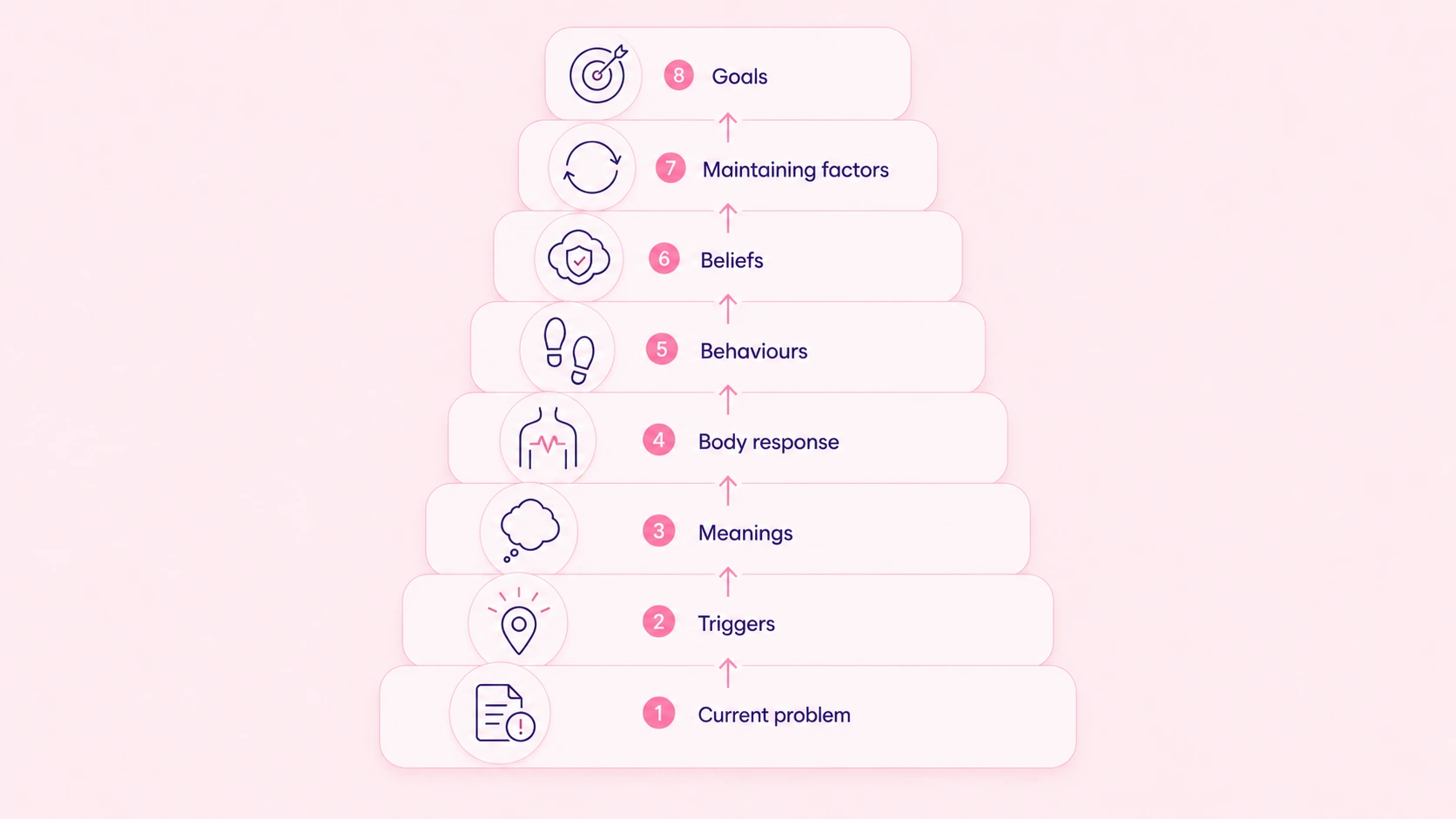
CBT formulation is a working explanation of a person’s difficulties. It brings together details such as triggers, thoughts, emotions, body sensations, behaviours, beliefs, life experiences and maintaining factors. Guidance from BABCP on Cognitive Behavioural Therapy describes CBT as being concerned with personal meanings, emotions, behaviours, physical reactions and the wider context of a person’s life, which fits closely with how formulation is used in practice.

It is not the same as a diagnosis. A diagnosis may name a condition, such as generalised anxiety disorder or panic disorder. A formulation explains how the difficulty works in daily life and why it may continue even when the person wants it to stop.

A Formulation Is a Shared Map

A formulation is usually built together in therapy. The therapist brings knowledge of CBT models, while the client brings their own lived experience. This matters because the personal detail of the problem belongs to the person experiencing it.

A good formulation should feel respectful and recognisable. It may not explain everything straight away, but it should offer enough clarity to guide the work.

A Formulation Is Not Fixed

A formulation is a working map, not a final verdict. It can change as more information becomes clear. For example, a person may first describe their anxiety as being about work performance, but later notice that the deeper fear is letting people down.

This flexibility means therapy can respond to what is learned over time, rather than forcing the person into a rigid explanation.

A Formulation Connects the Past and Present

A formulation may include earlier experiences if they seem relevant. For example, someone who grew up with high expectations may have learned to treat mistakes as dangerous. However, CBT also pays close attention to the present. It looks at what keeps the anxiety active now.

This balance can help therapy feel grounded. The past may explain why a pattern developed, while the present often shows where change can begin.

infographic illustrating What Is CBT Formulation

CBT Case Formulation: What Information Does a Therapist Look At?

A CBT case formulation brings together the main details that explain a person’s difficulty. It is more than a list of symptoms because it shows how different parts of the problem connect. Psychology Tools on case formulation describes formulation as helping therapists and clients understand the origin, current status and maintenance of a problem.

In anxiety work, this can include the situations that trigger anxiety, the meanings attached to those situations, the physical response, the behaviours used to cope, and the beliefs that sit underneath the pattern. A therapist may also look at strengths and goals, because the formulation should support progress, not simply describe distress.

Current Difficulties

Formulation often begins with what the person is finding difficult now, such as worry, panic, avoidance, repeated checking or feeling unable to switch off. Starting here helps keep the conversation practical.

Triggers and Meanings

CBT looks at both the situation and the meaning attached to it. For example, receiving a short message from a manager may be neutral in itself. However, if the person reads it as “I have done something wrong,” anxiety may rise quickly.

Maintaining Factors

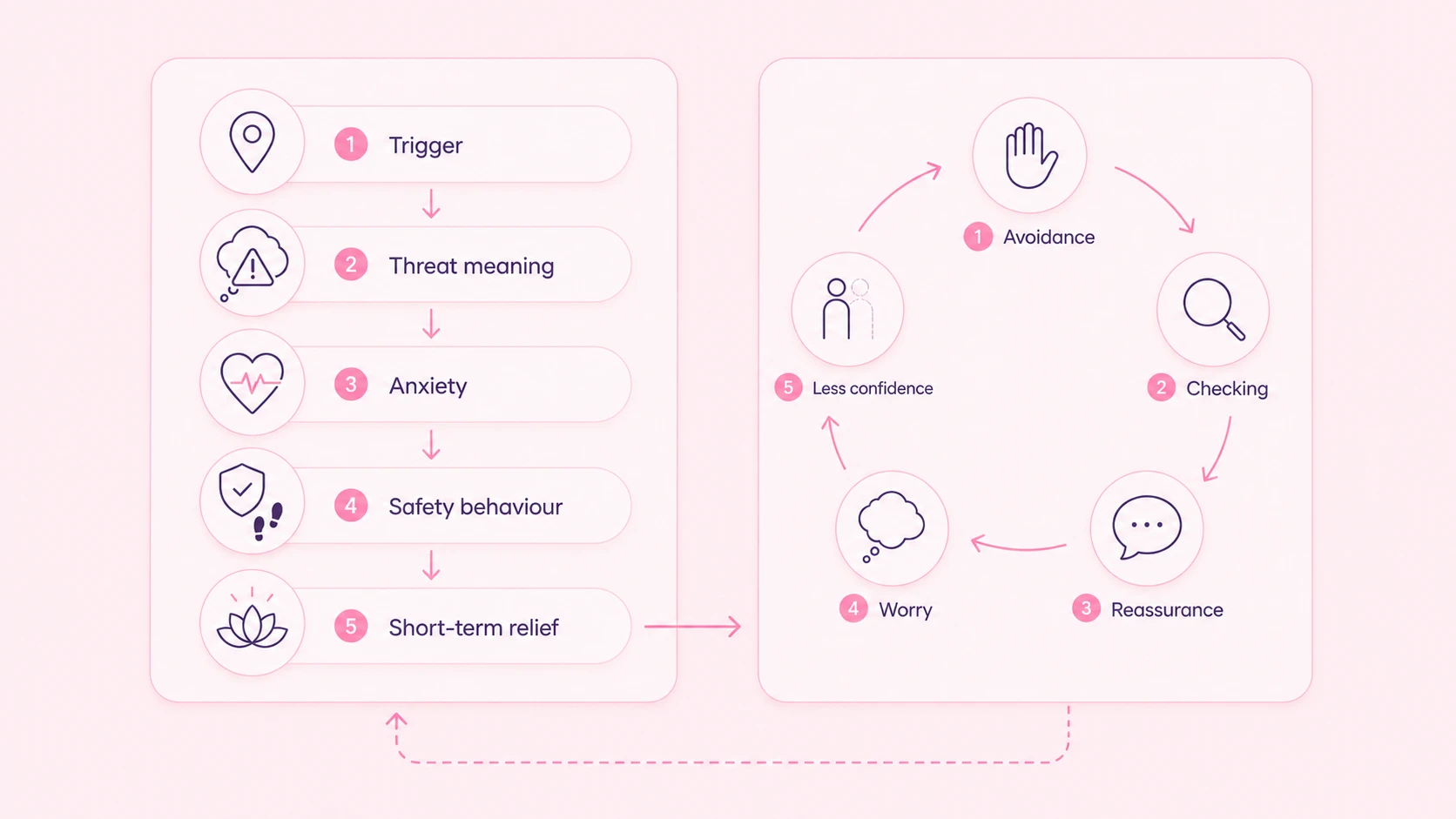
Maintaining factors are central to the formulation. These are the responses that may reduce anxiety in the short term but keep it going over time. With anxiety, common examples include avoidance, checking, over-preparing, reassurance-seeking and repeated mental review.

infographic illustrating CBT Case Formulation

How CBT Anxiety Formulation Understands Anxiety Patterns

CBT anxiety formulation looks at how someone detects threat, responds to uncertainty and tries to feel safer. This is not about blame. Anxiety is often trying to protect the person, even when the protective response has become tiring or limiting.

In anxiety formulation, CBT ideas are applied to the person’s own pattern. The focus is not only on what anxiety feels like, but on how the person interprets threat, responds to uncertainty and learns to feel safe.

The Perceived Threat

Anxiety often grows around what a situation seems to mean. The threat may be social judgement, making a mistake, losing control, becoming ill, disappointing others or being unable to cope.

For one person, a missed call may mean “something bad has happened.” For another, it may mean “someone is angry with me.” The event is similar, but the meaning changes the emotional response.

The Protective Response

When anxiety rises, people often respond in ways that feel protective. They may check repeatedly, avoid a situation, ask for reassurance, over-prepare, mentally rehearse or delay decisions until they feel more certain.

These responses are understandable. They are often attempts to reduce distress or prevent a feared outcome. The difficulty is that they can block new learning.

The Maintaining Loop

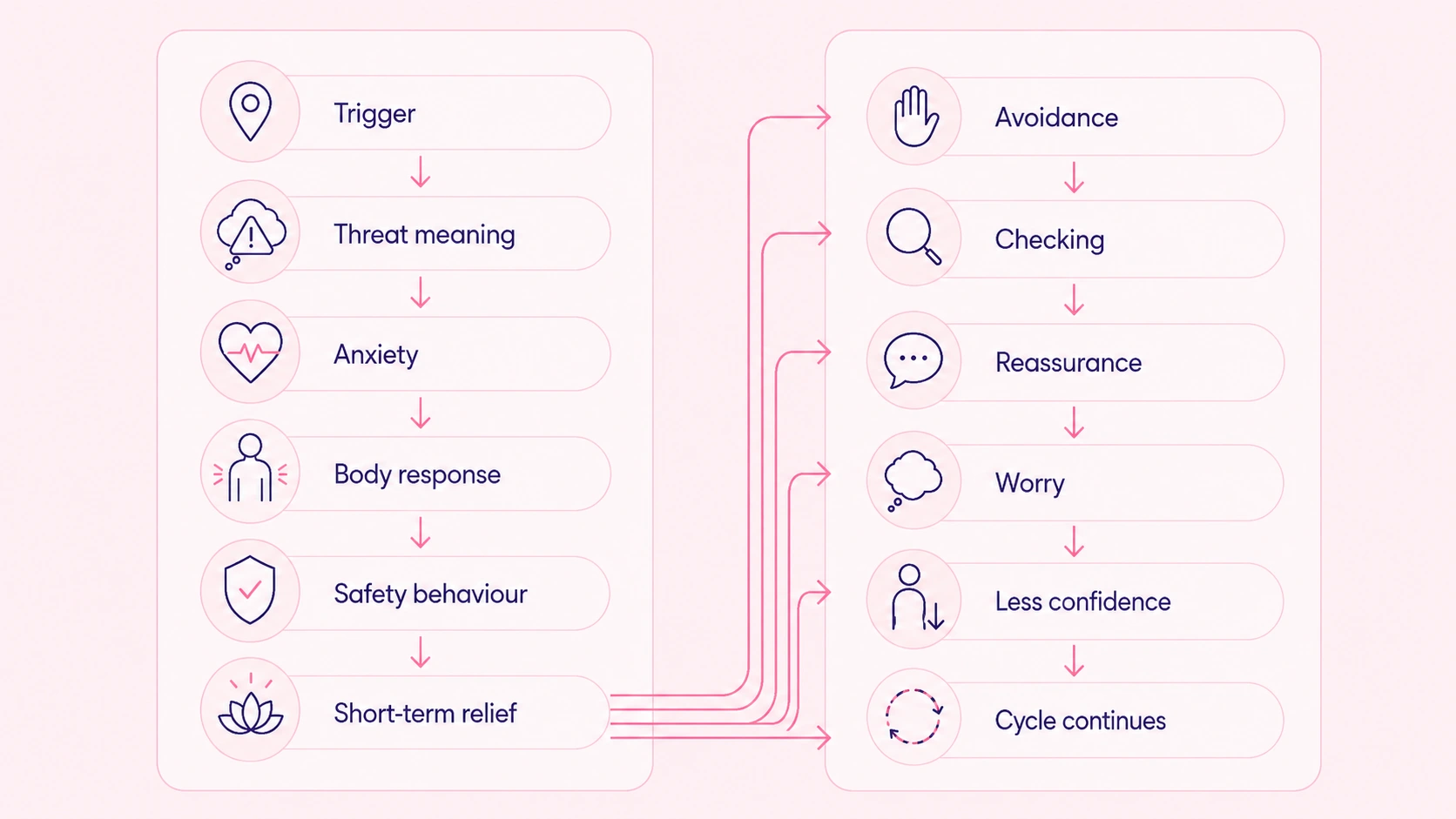
The maintaining loop is where anxiety can become stuck. The person feels anxious, uses a protective response, feels relief, and then relies on the same response next time.

The relief is real, but it may also teach the mind that the behaviour was needed. Over time, the feared situation can feel harder to face without it.

infographic illustrating How CBT Anxiety Formulation Understands Anxiety Patterns

The Difference Between a CBT Cycle and a CBT Formulation

A CBT cycle usually shows one repeated pattern, such as receiving an email, feeling anxious, checking repeatedly and feeling temporary relief. This makes the immediate pattern easier to see.

A formulation is broader. It looks at the wider picture behind that pattern, including repeated themes, beliefs, assumptions, earlier learning, current stressors, strengths, goals and maintaining factors.

The two ideas often work together. A cycle gives detail, while a formulation gives the wider map. For example, the cycle may show that someone checks work repeatedly after feeling anxious. The formulation may show that this is linked to a belief such as “I must not make mistakes.”

Why Both Can Be Useful

A cycle can help someone understand what happens in a specific moment. A formulation can explain why similar moments keep appearing across different parts of life.

This is helpful when anxiety feels spread out. It gives the therapist and client a way to see the common thread between work worries, relationship worries, decision-making and physical anxiety symptoms.

What a Formulation May Include for Anxiety

An anxiety formulation may include several connected parts. These help the therapist and client understand what the person fears and what keeps the problem active.

Triggers

Triggers can be external situations, such as a meeting, email, social event or health appointment. They can also be internal experiences, such as a thought, image, memory or body sensation.

Anxiety does not always begin with something obvious. Sometimes the trigger is a brief sensation in the chest, a memory of a past mistake or a sudden image of something going wrong.

Predictions

Anxiety often includes a prediction about what might happen. The person may think, “I will fail,” “I will lose control,” “People will judge me,” “I will not cope,” or “Something bad will happen if I do not check.”

These predictions can feel convincing, especially when the body is already tense or alert. A formulation brings them into the open so they can be understood and worked with.

Beliefs and Assumptions

Some anxiety patterns are influenced by deeper beliefs or rules. These might include “I must not make mistakes,” “I need certainty before I can relax,” “If I say no, people will be upset,” or “I am only safe if I stay in control.”

These beliefs are not chosen on purpose. They often develop because they once seemed helpful or protective. In therapy, they can be explored carefully rather than judged.

Behaviours and Safety Strategies

Behaviour is a key part of anxiety formulation. This includes what the person does to manage anxiety, avoid discomfort or feel safer.

Examples include checking, avoiding, over-preparing, seeking reassurance, delaying tasks, scanning for danger or mentally reviewing conversations. These behaviours may make sense, but they can also keep anxiety active.

What Maintains the Problem

The formulation brings these details together to identify what maintains the problem. Instead of trying to change everything at once, the therapist and client can look at which part of the pattern may be most useful to work on first.

A Simple CBT Formulation Example

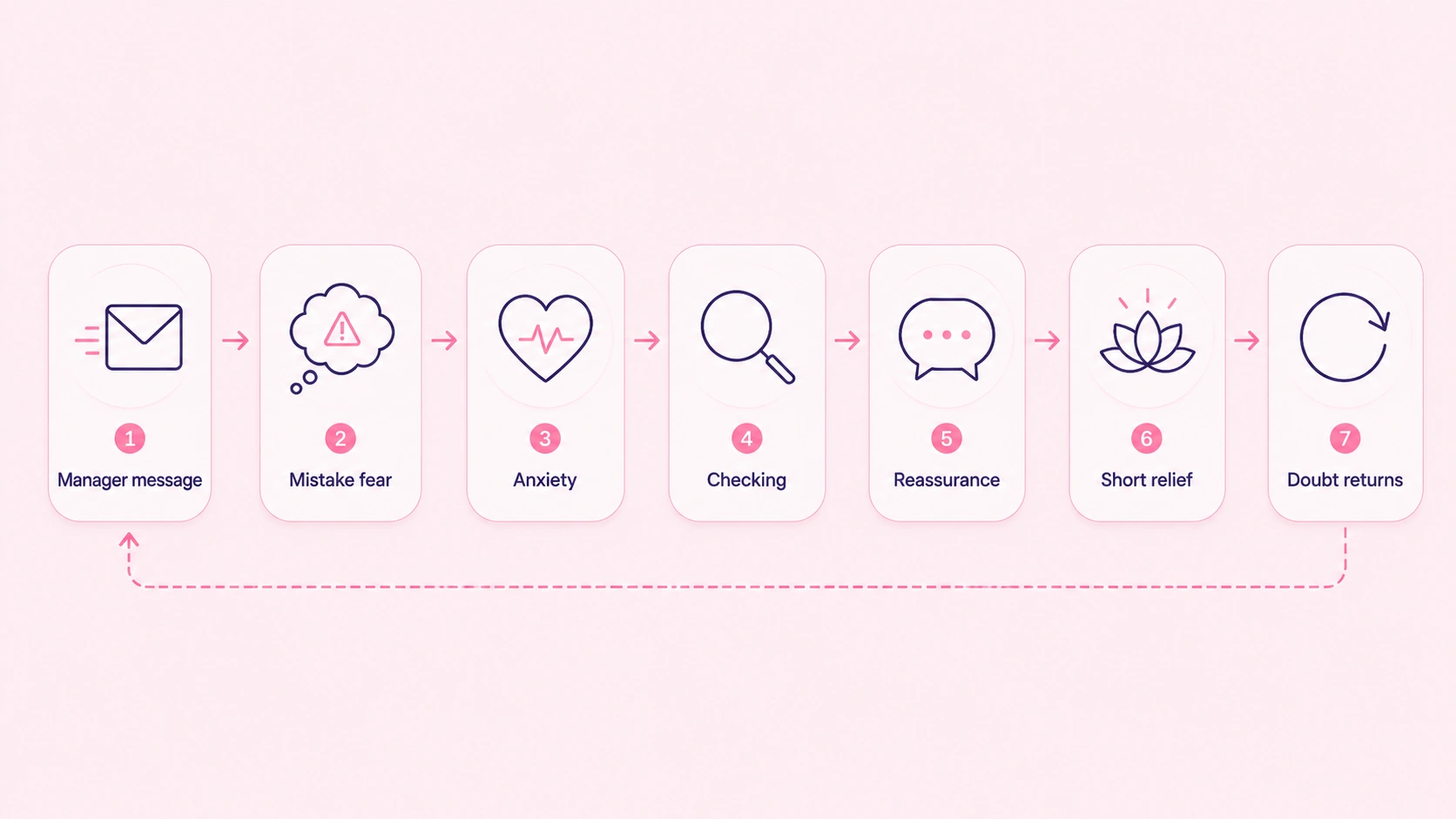
Imagine someone receives a brief message from their manager saying, “Can we talk later?” The trigger is the message. The meaning they attach to it is, “I must have done something wrong.” Their anxiety rises, their chest feels tight and they find it difficult to focus.

To feel safer, they re-read recent emails, check their work, ask a colleague whether everything seems fine and spend the next hour mentally reviewing what they may have done wrong. These responses bring some short-term relief, but they also keep the fear active.

A formulation might show that the person has a deeper belief: “I must not make mistakes.” It may also show that checking and reassurance-seeking reduce anxiety briefly, but prevent the person from learning that uncertainty can be tolerated.

This example shows how formulation works. The aim is not only to name the anxiety, but to understand the pattern that keeps pulling the person back into it.

infographic illustrating A Simple CBT Formulation Example

Why Formulation Is Collaborative

Formulation is not something a therapist imposes on a client. It is built together. The therapist may suggest possible links, but the client is invited to check whether those links feel accurate.

This matters because anxiety can already make people feel judged, misunderstood or out of control. A shared formulation should feel like a way of making sense of the problem, not a way of labelling the person.

The formulation can also be questioned. A client might say, “That part fits, but I think the fear is more about disappointing people than being criticised.” This kind of feedback is useful. It helps make the map more personal and more helpful.

A good formulation should be accurate enough to guide therapy and flexible enough to change as new understanding develops.

How a Therapist Builds a Formulation in Sessions

A therapist will usually build a formulation gradually. It does not need to be completed in one conversation. Often, the clearest understanding comes from recent examples.

Starting With Recent Examples

Therapists often begin with a recent situation rather than trying to explain the whole problem at once. For example, they may ask about a moment when anxiety rose during the week.

This keeps the conversation specific. Instead of talking about anxiety in general, the therapist and client can look at what happened, what it meant, how the body responded and what the person did next.

Asking Structured Questions

The therapist may ask questions such as: What happened? What went through your mind? What did you feel in your body? What did you do to cope? What happened afterwards?

These questions are not asked to interrogate the person. They are used to slow the pattern down.

Looking for Repeated Themes

Over time, the therapist and client may notice repeated themes. The person may fear making mistakes, upsetting others, losing control or being unable to cope. They may also notice repeated behaviours, such as checking, avoidance or reassurance-seeking.

These themes help shape the formulation and show how different situations may be linked by the same underlying pattern.

Agreeing a Working Map

Once enough information has been gathered, the therapist and client agree a working map. This map does not need to be perfect. It needs to be useful.

The formulation can then guide therapy by showing what may be keeping anxiety active and where change could begin.

How Formulation Guides Therapy

Formulation is not only an explanation. It helps guide the therapy itself, which is one reason CBT can feel structured and personal at the same time.

Beck Institute on case formulation-driven CBT describes formulation as a way to help therapists make clinical decisions and guide treatment beyond a standard model. In practice, formulation helps the therapist and client decide how to apply CBT ideas to this person’s specific pattern.

Choosing What to Work on First

A formulation can help identify which maintaining factor to address first. For one person, reassurance-seeking may be the key pattern. For another, it may be avoidance, repeated checking or over-preparing.

Anxiety can feel like one large problem. Formulation helps break it down into parts that can be understood and worked on.

Planning Behavioural Experiments

CBT may include behavioural experiments, where the client tests an anxious prediction in a planned and careful way. For example, someone who fears that one small mistake will lead to serious criticism may test what happens when they reduce checking in a lower-risk task.

The experiment is guided by the formulation. It is chosen because it relates to the person’s specific fears, beliefs and maintaining behaviours.

Reviewing Progress

The formulation can be revisited during therapy. The therapist and client can ask: Is this still accurate? What has changed? Which behaviours are reducing? Which beliefs still feel strong?

This helps therapy stay focused and allows progress to be understood in a more personal way than symptom reduction alone.

Our Case Study: Building a Formulation for General Anxiety

The following anonymised case study is written from a therapist’s perspective. The client’s name has been changed to Michael to protect privacy, but it reflects the kind of general anxiety formulation that may be explored with a client.

The Client’s Condition When They First Made Contact

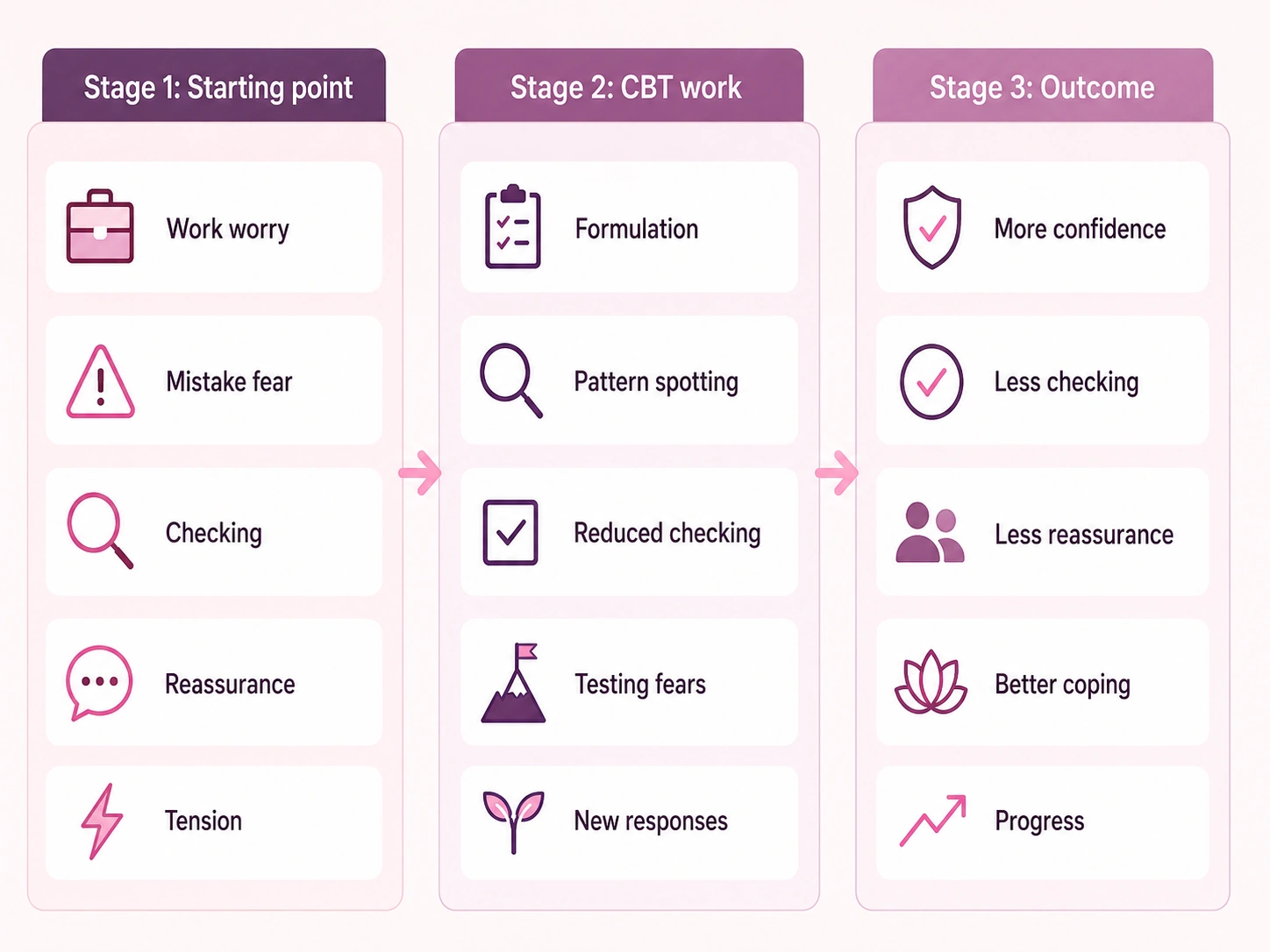
When Michael first made contact, he described feeling anxious most days. He worried about work, family responsibilities and whether he was letting people down. He often checked emails several times before sending them and found it difficult to switch off in the evenings.

Michael knew some of the checking was excessive, but stopping it felt risky. Reassurance from others helped briefly, then the doubt returned.

The Formulation That Was Developed

In therapy, we began with a recent example: Michael receiving a brief message from his manager. The trigger was the message. The meaning was, “I have made a mistake and I am going to be criticised.”

This led to anxiety, tension and repeated checking. As we built the formulation, a deeper belief became clearer: “If I make a mistake, people will think I am careless.” This helped explain why uncertainty felt so difficult and why checking seemed necessary.

How the Formulation Guided the CBT Work

The formulation helped us focus on the checking and reassurance cycle. Michael practised reducing checks in lower-risk situations and tested what happened when he sent an email after a planned number of reviews.

Each experiment was reviewed against the formulation, so the work felt structured rather than random.

The Successful Results

Over time, Michael became better at spotting the pattern earlier. He still experienced anxious thoughts, but he felt less pulled into repeated checking and relied less on reassurance from others.

The progress was realistic rather than perfect. Michael did not become free from anxiety, but he understood it more clearly and felt more able to trust his judgement.

infographic illustrating Our cbt formulation Case Study

Common Misunderstandings About Formulation

Formulation can sound technical at first, so it helps to clear up a few common misunderstandings.

A Formulation Is Not a Label

A formulation is not another way of labelling someone. It is a shared explanation of a pattern, based on what the person has experienced, what they fear, how they respond and what keeps the difficulty going.

A Formulation Is Not About Blame

Formulation does not mean the person has caused their anxiety. It means there are understandable links between experiences, beliefs, emotions and behaviours.

Many anxiety responses begin as attempts to cope. The formulation helps explore whether those responses are still helping or keeping the problem active.

A Formulation Is Not the Same for Everyone

Two people can both experience general anxiety but have different formulations. One person may be driven by fear of mistakes. Another may be driven by fear of conflict, illness or uncertainty.

This is why formulation is useful. It moves therapy beyond a general explanation and towards the person’s own pattern.

A Formulation Is Not a Perfect Answer

A formulation is a working map. It does not need to explain every detail to be useful. As therapy develops, the map can be refined.

This can be reassuring because the client and therapist do not need to get everything right immediately. They can learn from the work as it unfolds.

Why Formulation Can Feel Reassuring

Anxiety can feel frightening when it seems random. A clear formulation can give shape to the experience and help someone see that their anxiety follows a pattern.

It Gives Shape to the Problem

When anxiety is mapped clearly, it may feel less mysterious. The person can begin to understand what triggers it, what meaning they attach to it, how they respond and what keeps it active.

It Supports a Personalised Plan

A formulation also supports a more personal therapy plan. The therapist is not applying a generic method in the same way to every client. The work is based on the person’s pattern, fears, strengths and goals.

Final thoughts

CBT formulation gives anxiety a clearer structure. Instead of treating worry, checking, avoidance or reassurance-seeking as separate problems, it helps show how they may be connected. This can make therapy feel more focused, because the work is guided by the person’s own pattern rather than a general explanation of anxiety. The aim is not to make every anxious thought disappear, but to understand what keeps the problem going and where meaningful change can begin.

FAQs

CBT formulation is a shared map of how a person’s difficulty developed and what may be keeping it going now. It brings together triggers, thoughts, feelings, body sensations, behaviours, beliefs and maintaining factors.

CBT case formulation is a structured way of understanding an individual person’s difficulties. Instead of using a generic explanation, it looks at the person’s own experiences, beliefs and coping responses.

CBT anxiety formulation looks at how anxiety works for a specific person. It may include triggers, threat meanings, physical sensations, safety behaviours, avoidance and reassurance-seeking.

Diagnosis names a condition or difficulty. Formulation explains how that difficulty works for the individual person and what may help it change.

Yes. A formulation is a working map, so it can change as therapy develops. As the therapist and client learn more, they can refine the formulation and use it to guide the next steps.

Author Bio

James Hicks

Disclaimer

This page is for general information and education. It is not personalised advice, diagnosis, or a substitute for professional assessment.

CBT Bristol

Take the First Step Towards Change

NOSA CBT offers evidence-based therapy for OCD, hoarding help, phobias, health anxiety, social anxiety, PTSD, panic disorder, and generalised anxiety disorder. We also provide a specialist OCD clinic, professional CBT supervision training, and CBT training and teaching for mental health professionals.

Get in touch today to find out how we can help.