

Opens in a new tab

How to Help a Hoarder Without Taking Control

How to Help a Hoarder Without Taking ControlWhat we can help with?

Knowing how to help a hoarder can be difficult when you are worried about someone you care about, but every conversation about their possessions seems to end in frustration.

You may see rooms becoming harder to use, belongings continuing to accumulate, or everyday tasks becoming more difficult. From the outside, clearing some of the possessions may seem like the obvious solution. For the person who hoards, however, those items may carry emotional meaning, feel potentially useful or be connected with fears about waste, responsibility or making the wrong decision.

This is why helping is not the same as taking control. Support is usually more constructive when the person remains involved in decisions and feels listened to rather than pressured.

Our guide to hoarding disorder explains the wider patterns behind acquiring, saving and difficulty discarding. Here, we focus specifically on how partners, relatives and friends can offer support while protecting trust and their own boundaries.

Key Takeaways

Supporting someone who hoards usually works better when they remain involved in decisions about their possessions.

Criticism, shame and forced clear-outs can make conversations about hoarding more difficult.

Possessions may have emotional or practical meaning that is not obvious to other people.

Asking what support would feel useful can be more productive than immediately telling someone what they need to change.

Family members can offer support without becoming responsible for solving the entire problem.

CBT for hoarding focuses on the beliefs, emotions, avoidance and decision-making patterns behind the clutter rather than simply clearing possessions.

What helping someone who hoards really means

When someone you care about is struggling with hoarding, it is understandable to focus on the visible problem.

You may be worried that rooms are becoming difficult to use, that possessions are continuing to build up or that the problem is placing strain on the relationship.

The person who hoards may be focused on something very different.

Start with the person, not the possessions

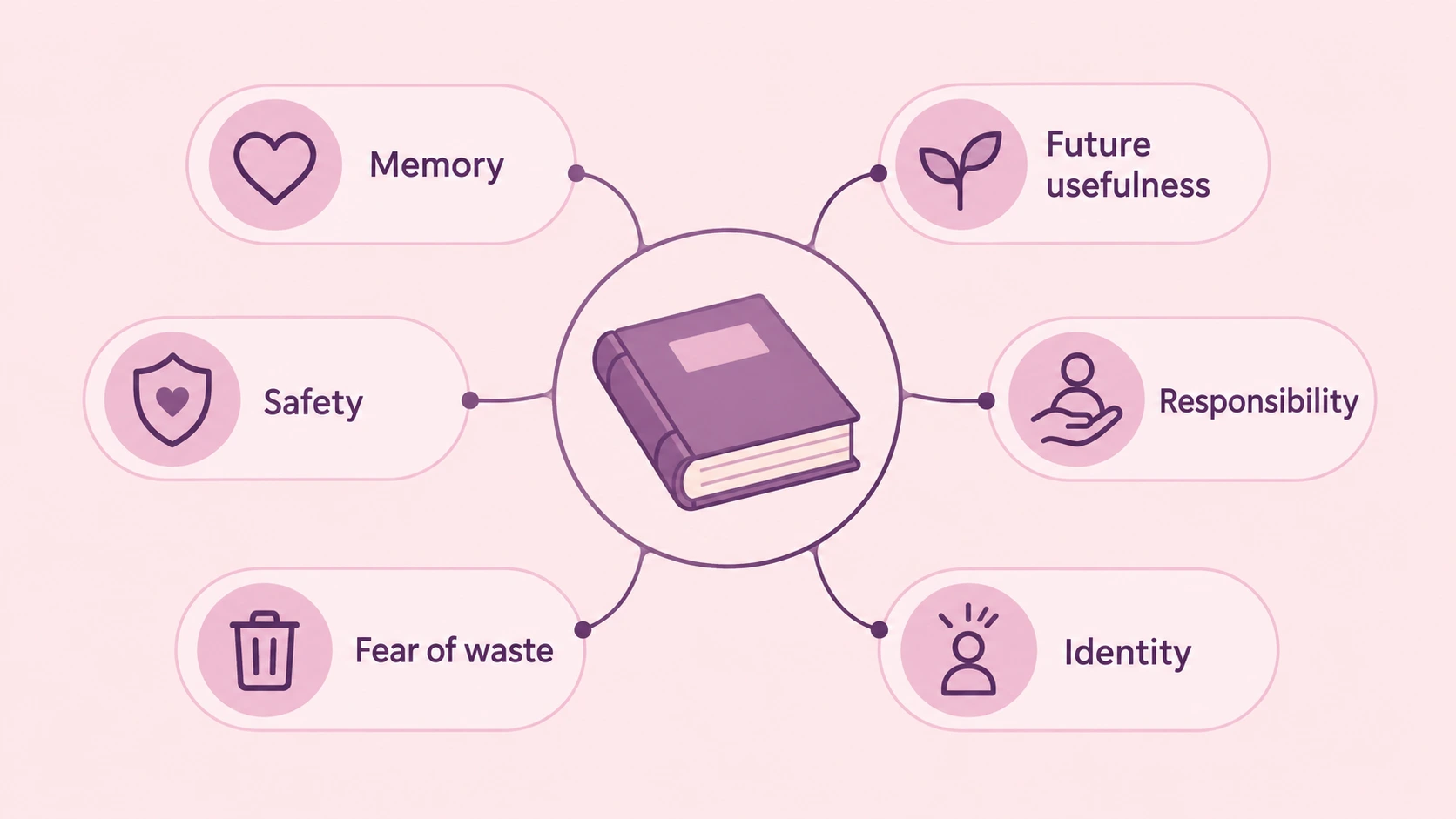
An item that looks unimportant to you may carry a very different meaning for the person who owns it.

They may believe they will need it in the future, feel responsible for preventing waste, associate it with an important memory or worry that discarding it will lead to regret.

This does not mean that every possession needs to remain.

It does mean that simply judging whether an object appears useful from the outside may not tell you why it feels difficult to let go.

Understanding that difference can change the conversation.

Instead of beginning with what needs to disappear from the home, it becomes possible to ask what makes particular decisions difficult.

infographic illustrating Start with the person, not the possessions about hoarding

You may see the problem differently

A relative may feel that something needs to change urgently.

The person who hoards may not see the situation in the same way, or they may recognise the problem but feel overwhelmed by the idea of dealing with it.

That difference can quickly become a source of conflict.

One person pushes for change. The other feels criticised or controlled. The pressure increases, and eventually conversations about the home become difficult to have at all.

The first useful step may therefore be creating a conversation that both people can remain part of.

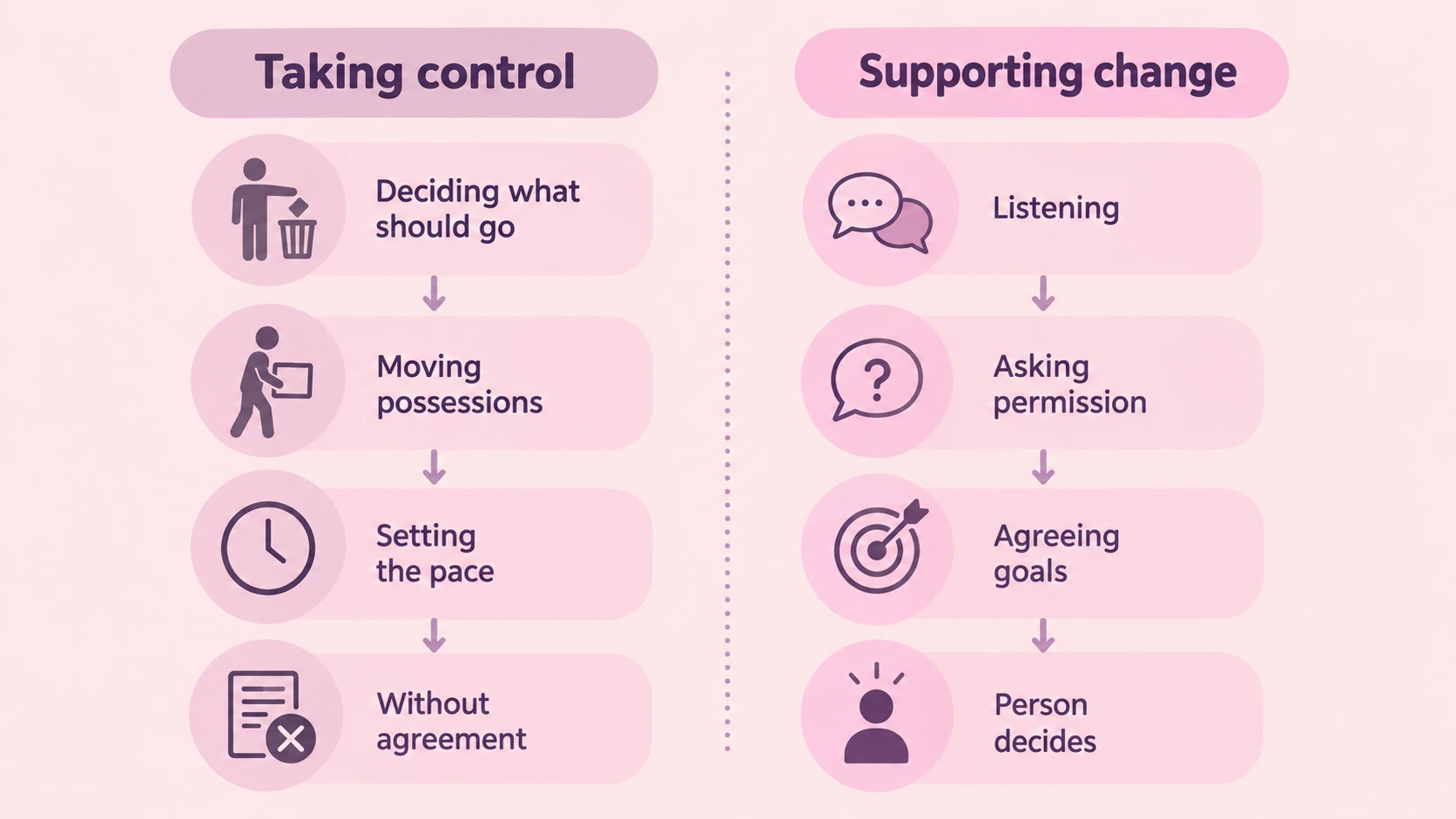
Helping does not mean taking over

Support can take many forms.

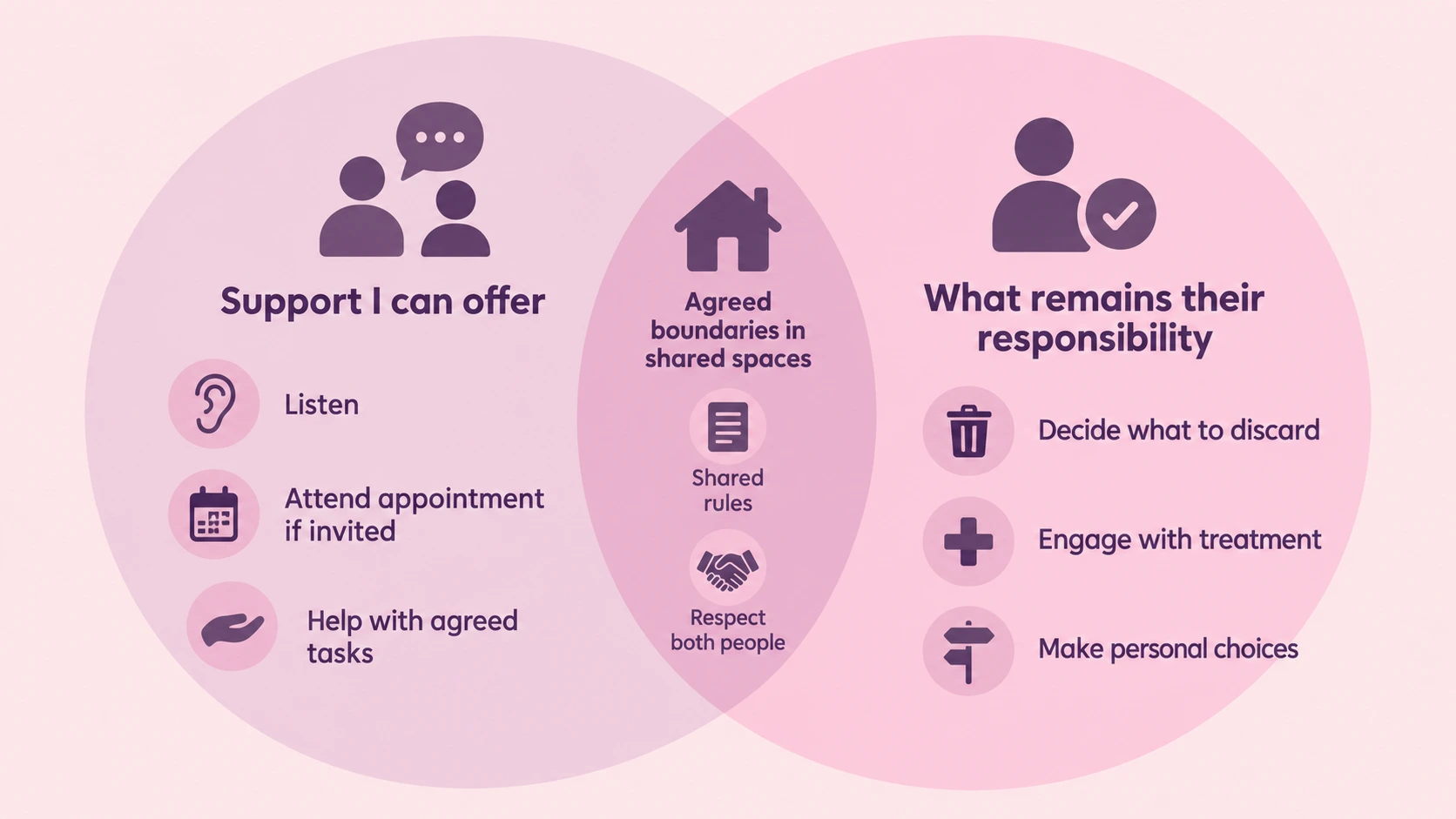
You might listen, help someone find professional support, accompany them to an appointment if they want you there, or help with a task they have chosen.

What support does not automatically mean is deciding which possessions should go or taking responsibility for changing the entire home.

The person needs to remain involved in decisions that affect their belongings and their treatment.

infographic illustrating What helping someone who hoards really means

How to help a hoarder without damaging trust

The way concerns are raised can have a major effect on whether someone feels able to talk about the problem.

This does not mean avoiding difficult subjects.

It means discussing them without turning the conversation into a battle over possessions.

Use respectful language

Words such as rubbish, junk or useless may seem like simple descriptions, but they can feel very different to the person who owns the items.

If someone feels judged or embarrassed, they may become more protective of their possessions or less willing to discuss the problem.

Mind’s guidance on supporting someone who hoards recommends listening to what the person wants, respecting their choices and avoiding moving or throwing away possessions without permission.

Respectful language does not mean pretending there is no problem.

It means talking about the difficulty without reducing the person to the condition or dismissing the meaning their belongings have for them.

Ask rather than instruct

If every conversation begins with instructions, the person may quickly feel that they are being told what to do.

Questions can create more room for discussion.

You might ask what they find most difficult about the situation, whether there are parts of the home they would like to use differently or what kind of support would feel manageable.

You do not have to agree with every answer.

The purpose is to understand what the person is experiencing before deciding what support might actually be useful.

Focus on shared concerns

Arguments often become stuck on individual possessions.

One person says an item is worthless. The other explains why it needs to stay. Neither person changes their mind.

It can sometimes be more useful to step away from debating the value of each object and focus on a shared concern.

Perhaps both people want to make it easier to sit together in the living room, prepare food in the kitchen or reduce the amount of conflict at home.

A shared goal can make the conversation feel less like one person is trying to win.

Why forced clear-outs can make things worse

When clutter is severe, family members may understandably feel that the quickest solution is simply to remove it.

The visible improvement can be immediate.

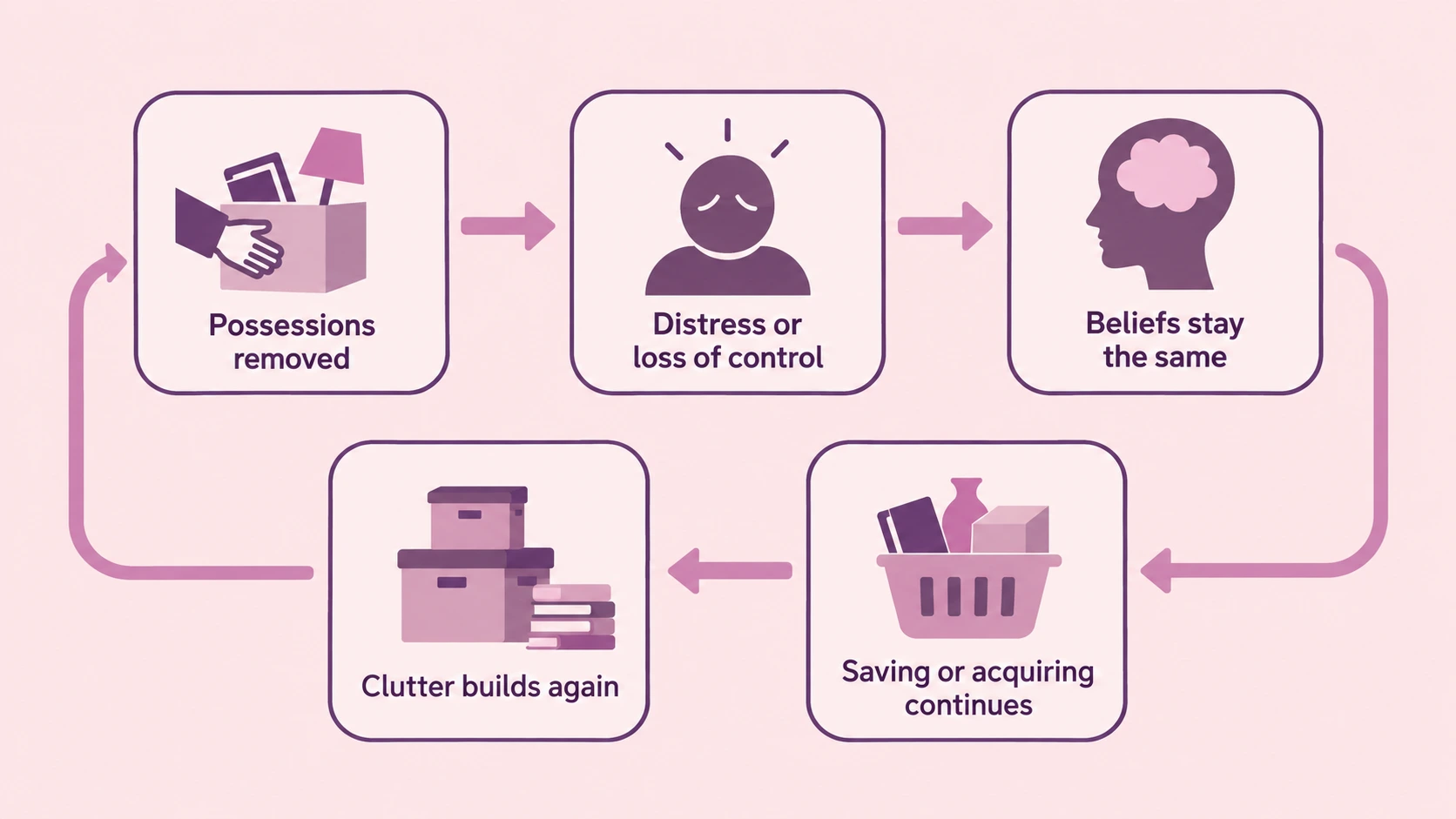
The underlying difficulty may remain unchanged.

Removing possessions does not remove the underlying problem

Hoarding is not simply the presence of too many belongings.

The difficulty can involve beliefs about possessions, emotional attachment, decision-making, acquiring, avoidance and fears about what might happen after something is discarded.

South London and Maudsley NHS Foundation Trust explains in its guidance on hoarding disorder that simply clearing possessions or creating additional storage does not address the underlying problem.

If those patterns remain unchanged, removing the clutter alone may not lead to lasting change.

Losing control can increase distress

Imagine discovering that someone has thrown away possessions while you were out of the house.

Even if the other person believed they were helping, the experience may increase the feeling that your belongings are not safe.

Someone may then become more watchful, more reluctant to let relatives into the home or less willing to talk openly about what they own.

This can make future support more difficult.

Trust matters for longer-term change

Family members may understandably want visible progress.

But progress that comes at the cost of trust can create another problem.

Someone who feels criticised, pressured or overruled may become less willing to engage with relatives or professional support.

Longer-term change is more likely to require the person to participate in decisions rather than have decisions made for them.

infographic illustrating Why forced clear-outs for a hoarder can make things worse

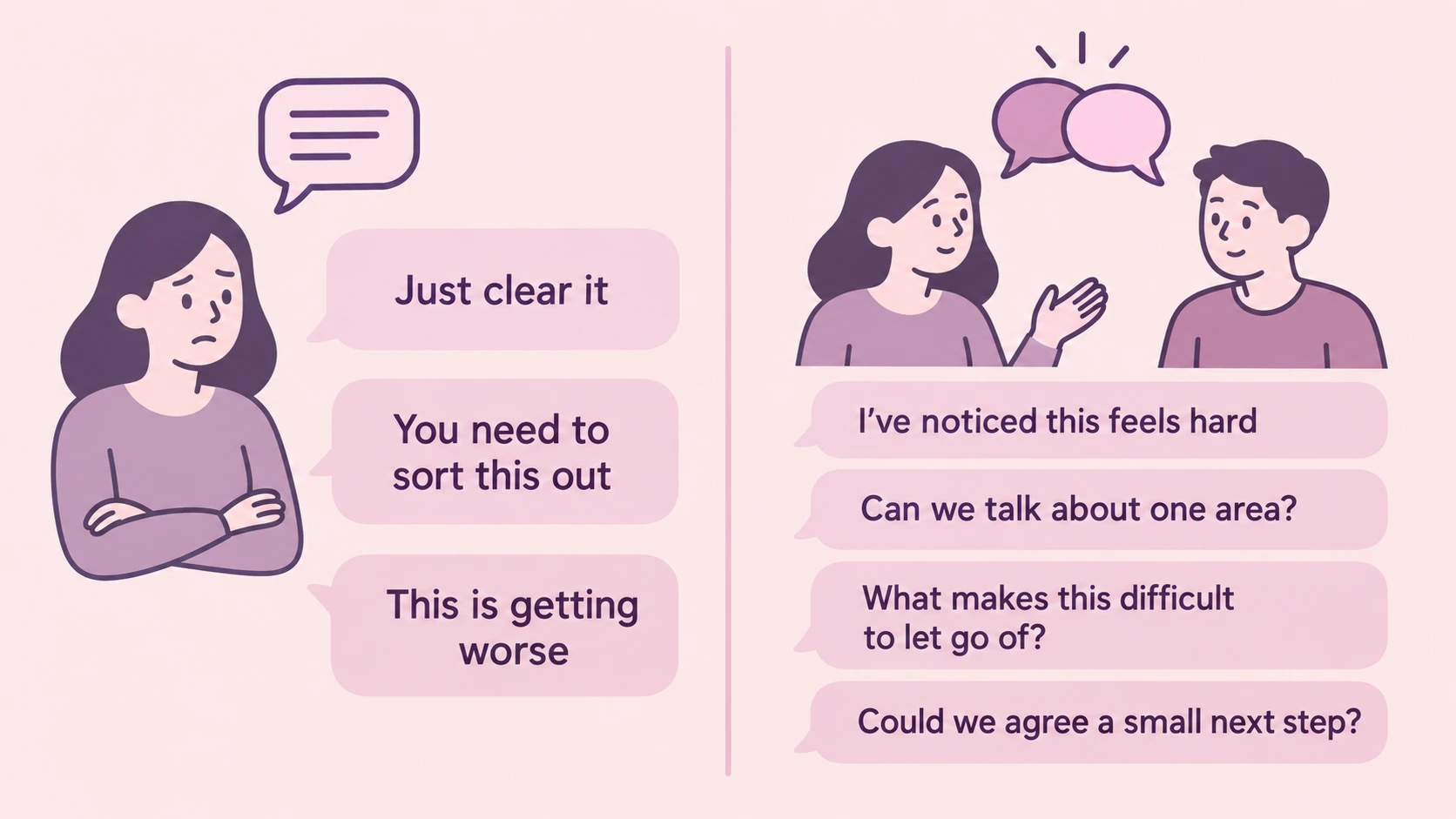
What a supportive conversation might look like

Imagine a woman who is worried about her father’s increasingly cluttered home.

She has repeatedly told him that he needs to throw things away.

Each conversation follows a similar pattern. She points out the amount of clutter, he explains why the possessions matter, she becomes frustrated and he eventually ends the discussion.

Over time, he becomes increasingly reluctant to let her help.

The next conversation can begin differently.

Rather than starting with what needs to be removed, she explains what she has noticed and asks how he feels about the situation.

She might say that she has noticed the dining table has become difficult to use and ask whether that bothers him too.

She can still express concern.

The difference is that the conversation becomes about understanding the problem and finding areas of agreement rather than deciding immediately what should be discarded.

The wording does not need to be perfect.

What matters is that concern can be expressed without immediately taking the decision away from the person.

infographic illustrating What a supportive conversation about hoarding might look like

What if they do not want help?

One of the hardest situations for relatives is recognising a problem while the other person does not want to address it.

Knowing how to help someone who is a hoarder does not mean knowing how to make them change before they are ready.

You cannot force someone to be ready

Repeated persuasion does not necessarily create motivation.

It can sometimes have the opposite effect.

If every conversation becomes another attempt to persuade someone to discard possessions or enter treatment, they may start avoiding the subject altogether.

This can be frustrating when the impact of hoarding feels obvious to everyone else.

But pressure is not the same as engagement.

Keep communication open where possible

It can help if the relationship contains conversations that are not entirely about hoarding.

Someone may already feel embarrassed, criticised or defensive.

If every interaction becomes another discussion about their home, possessions or behaviour, they may start withdrawing from the relationship itself.

Keeping communication open does not mean ignoring the problem.

It means making sure the person is still treated as more than the difficulty they are experiencing.

Our article on how to recognise and improve a hoarding problem looks more closely at recognising when collecting and saving possessions are beginning to interfere with everyday life.

Encourage professional support without issuing an ultimatum

The NHS guidance on hoarding disorder notes that friends and family are often the people who first recognise the problem and recommends encouraging the person to speak to their GP.

For a relative, that might mean offering information, explaining why you are concerned or asking whether they would consider talking to someone.

It does not require you to diagnose the person or convince them that they must agree with your interpretation of the problem.

Supporting someone without losing your own boundaries

Hoarding can have a significant effect on relatives and partners as well as the person experiencing the difficulty.

Being supportive does not mean that your own needs no longer matter.

You do not have to solve everything yourself

Family members can gradually find themselves taking responsibility for more and more of the problem.

They may organise possessions, manage appointments, make repeated attempts to clear areas or spend large amounts of time trying to persuade the person to change.

This can become exhausting.

You can care about someone without becoming responsible for every decision they make.

Professional treatment also depends on the person’s own involvement.

Shared homes can make boundaries particularly important

The situation can be more complicated when you live with the person who hoards.

Their possessions may affect spaces that you also need to use.

It is reasonable for both people to have needs and boundaries within a shared home.

The challenge is discussing those boundaries without treating every possession as something you are automatically entitled to remove.

Where possible, agreements about shared spaces are more collaborative when both people understand what is being asked and why.

Your relationship matters too

Repeated conflict about possessions can affect the entire relationship.

Partners may feel ignored or overwhelmed. Adult children may feel that they have become responsible for a parent’s home. Friends may stop visiting because they do not know what to say.

There is no requirement to accept unlimited strain in order to be supportive.

Being clear about what you can and cannot realistically do can help prevent support from becoming resentment.

infographic illustrating Supporting someone with hoarding without losing your own boundaries

How CBT can help with hoarding

CBT for hoarding looks beyond the visible amount of clutter.

The aim is to understand the processes that make acquiring, saving and discarding difficult for the individual.

Understanding why possessions are difficult to discard

A person may believe an item will become useful, worry that throwing it away is wasteful or fear they will lose an important memory.

Other possessions may feel connected with identity, responsibility or safety.

CBT can explore these meanings rather than assuming that the difficulty is simply a lack of organisation.

Working with avoidance and difficult decisions

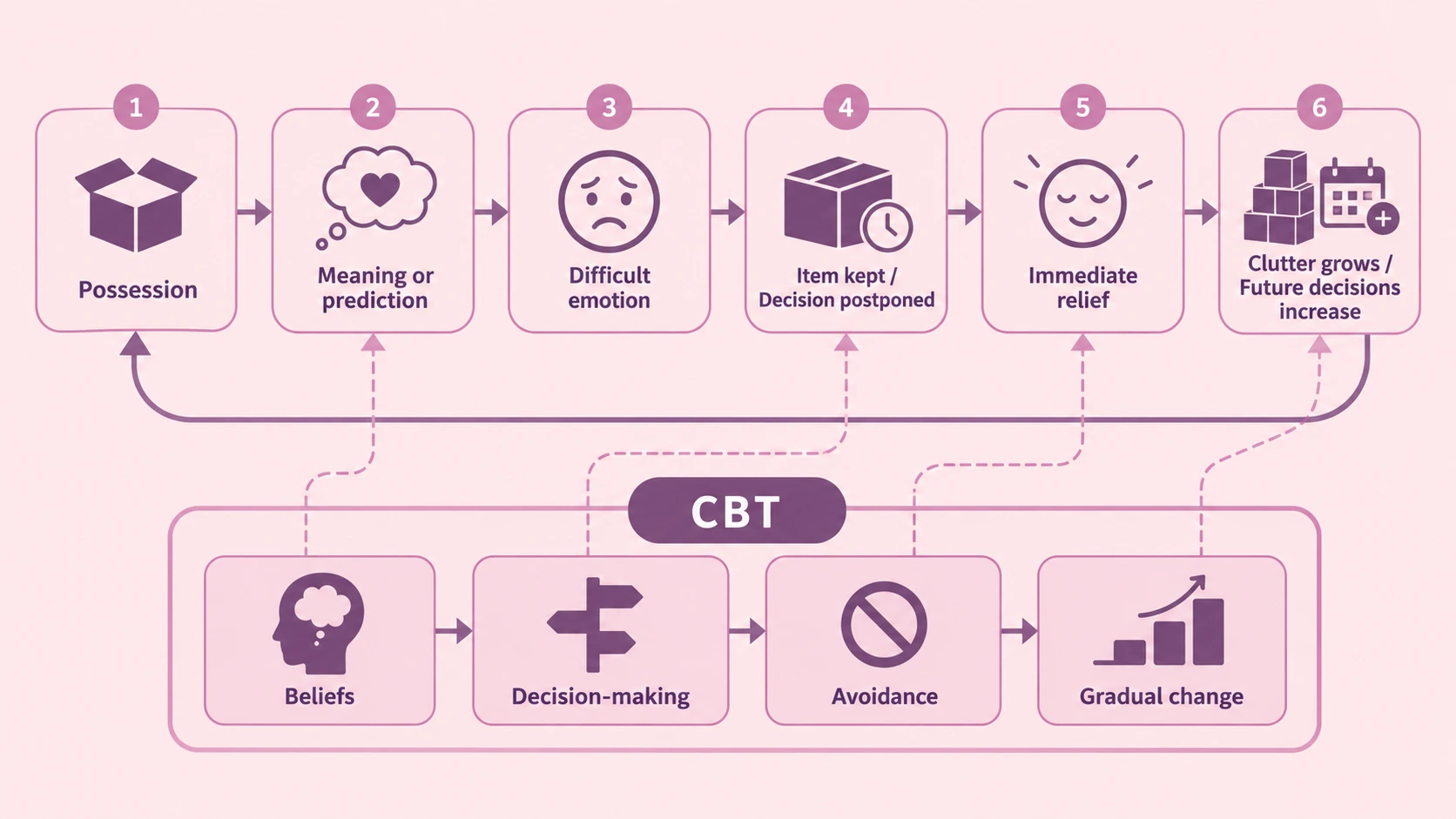
Deciding whether to keep or discard something can create significant discomfort.

Postponing the decision may bring immediate relief.

The item stays, the difficult choice disappears for the moment and anxiety falls.

But the same decision still exists later, often alongside many more possessions requiring similar decisions.

CBT can help identify this pattern and work with the thoughts, emotions and behaviours that maintain it.

Change remains collaborative

Treatment is not about another person arriving and deciding what should stay or go.

The individual remains involved in the process.

That is particularly important for someone who may already have experienced arguments, pressure or attempts by others to take control of their possessions.

Family members can sometimes play a supportive role, but the aim is not to turn them into the person responsible for treatment.

infographic illustrating How CBT can help with hoarding

Our Case Study

We have anonymised the following example for privacy reasons. Identifying details have been changed.

The problem David and his daughter were experiencing

David had been accumulating possessions for several years, and some rooms in his home had become difficult to use.

His daughter, Emma, was worried about him and regularly encouraged him to throw things away.

Their conversations increasingly became arguments.

David felt criticised and became reluctant to let Emma help with anything relating to the house. Emma felt increasingly responsible for fixing a situation that seemed to be getting worse.

The method used to understand and work with the problem

When David began CBT, the focus was not on immediately clearing his home.

Therapy looked at what particular possessions meant to him, why discarding decisions felt difficult and what happened when he postponed those decisions.

A pattern became clearer. Avoiding decisions brought relief in the short term, but it also meant more possessions remained and future decisions became increasingly difficult.

Emma’s role also changed.

Rather than deciding what David should throw away, she supported goals that he had agreed to and allowed him to remain involved in decisions about his own belongings.

The progress made

Over time, conversations about the home became less confrontational.

David became more able to make decisions about selected possessions without feeling that control was being taken away from him.

Emma also became clearer about what support she could realistically offer and what needed to remain David’s responsibility.

The home did not change overnight, but the way they approached the problem became more collaborative.

Final Thoughts

Knowing how to help a hoarder can be difficult when you can clearly see the effect the problem is having but the person you care about does not feel ready to make the same changes.

Trying to take control may appear to offer a quick solution, but hoarding involves more than the possessions themselves. The beliefs, emotions and decisions connected with saving and discarding also need to be understood.

Support is usually more constructive when it protects trust, keeps the person involved in decisions and recognises that relatives need boundaries too.

If someone you care about is struggling with hoarding and would like professional support, you can learn more about our hoarding help in Bristol and how CBT can help address the patterns behind acquiring, saving and difficulty discarding.

FAQs

Try to begin by listening rather than immediately focusing on what needs to be thrown away.

Ask what the person finds difficult, avoid moving possessions without permission and encourage professional support where appropriate.

You can offer support while still allowing the person to remain involved in decisions about their belongings.

Removing possessions without someone’s agreement can cause significant distress and damage trust.

It also does not address the beliefs, emotions and decision-making difficulties that may be maintaining the hoarding problem.

Support is generally more useful when changes are agreed with the person rather than imposed on them.

Try to describe what you have noticed without using insulting or judgemental language.

You can explain what concerns you, ask how they feel about the situation and find out whether there are changes they would like help with.

The goal is not to avoid the subject but to make it possible to discuss it without the conversation immediately becoming an argument.

You cannot force someone to engage with treatment simply because you believe they need it.

You can continue to express concern, provide information about support and keep communication open where possible.

It can also be important to maintain your own boundaries rather than taking responsibility for solving the entire problem yourself.

CBT can help someone understand the thoughts, emotions and behaviours connected with acquiring, saving and difficulty discarding.

Treatment may look at beliefs about possessions, avoidance of decisions and what happens emotionally when the person considers letting something go.

The aim is not simply to clear the home. It is to work with the patterns that make those decisions difficult.

Author Bio

James Hicks

Disclaimer

This page is for general information and education. It is not personalised advice, diagnosis, or a substitute for professional assessment.

CBT Bristol

Take the First Step Towards Change

NOSA CBT offers evidence-based therapy for OCD, hoarding help, phobias, health anxiety, social anxiety, PTSD, panic disorder, and generalised anxiety disorder. We also provide a specialist OCD clinic, professional CBT supervision training, and CBT training and teaching for mental health professionals.

Get in touch today to find out how we can help.