


CBT Thought Records Explained Step by Step

CBT Thought Records Explained Step by StepWhat we can help with?

CBT thought records are a practical way of slowing down anxious thinking so you can look more clearly at what happened, what went through your mind and how that interpretation affected the way you felt and responded.

When anxiety is high, the first explanation that comes to mind can feel convincing. A short message from a manager might quickly lead to the assumption that you have done something wrong. A delayed reply may leave you thinking that someone is upset with you. Before you have much information, your mind may already be trying to work out what has happened and how to make the uncertainty go away.

A thought record creates some space around that process. It helps separate the situation from the meaning you have given it, while also looking at the feelings and behaviours that follow. This fits within the wider approach explained in our CBT guide, where thoughts, emotions, physical sensations and behaviours are considered together rather than in isolation.

Key Takeaways

Thought records help separate what happened from the anxious interpretation that followed.

Strong emotions and physical sensations can make an anxious thought feel more certain than the available information suggests.

The purpose is not to replace a difficult thought with an unrealistically positive one.

A thought record can help you notice what you know, what you are assuming and whether another explanation is possible.

Repeated examples can reveal patterns in the situations, fears and coping responses linked to anxiety.

Thought records are most useful when they connect with a wider CBT understanding of what keeps the difficulty going.


What a thought record can look like in daily life?

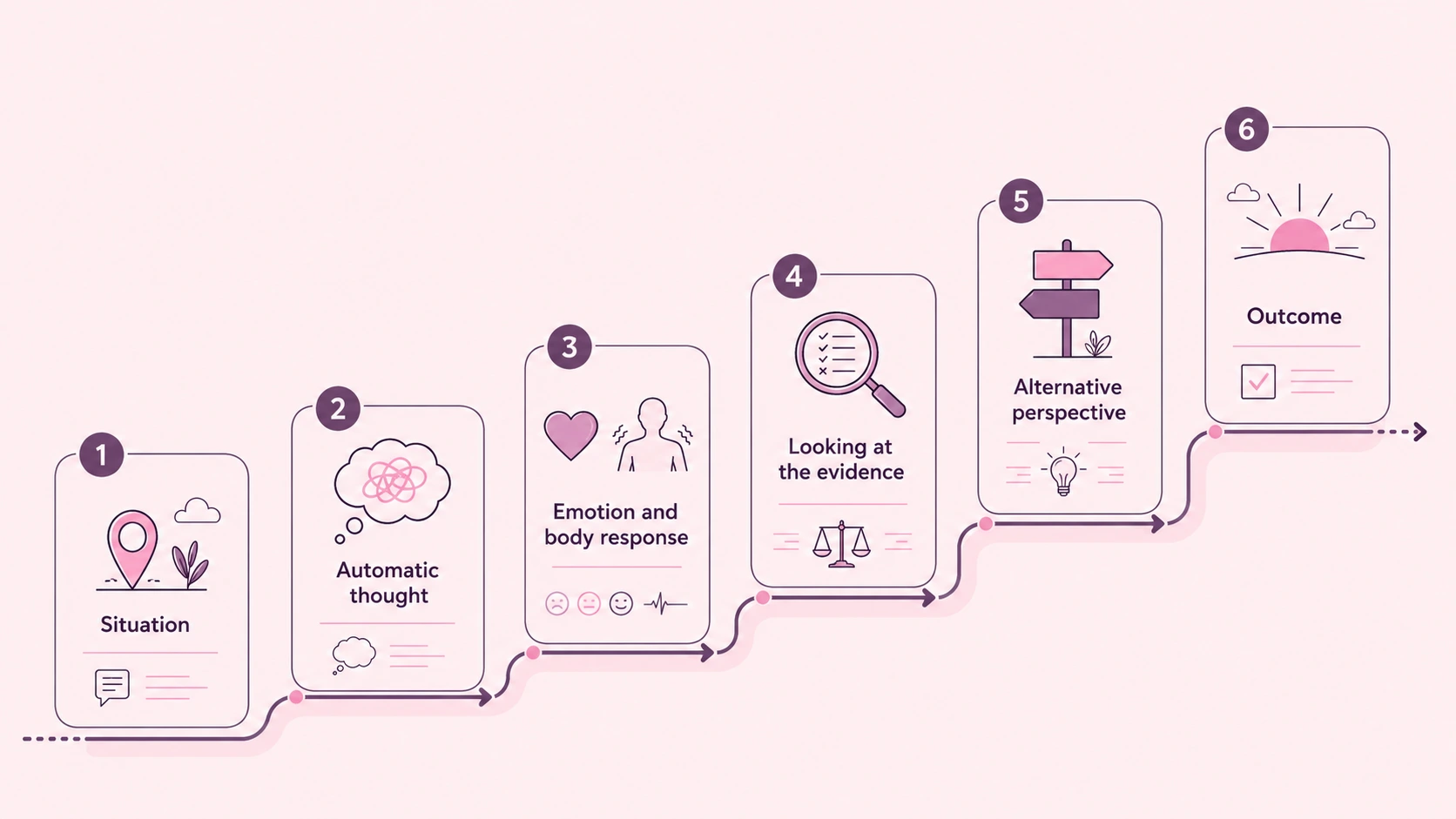
A thought record takes one situation and slows it down. Rather than treating the whole experience as a single anxious moment, it looks at what happened, what you thought it meant, how you felt and what you did next.

The NHS describes a thought record as a common CBT exercise that can help you examine thoughts and feelings about a situation, along with the information that seems to support or challenge those thoughts.

The situation does not need to be dramatic. Thought records are often useful because everyday uncertainty can trigger familiar patterns very quickly.

Anxious interpretations can happen quickly

Imagine your manager sends a brief message asking whether you can speak later that afternoon.

The situation is straightforward: your manager wants to have a conversation.

Your mind may add an interpretation almost immediately. You may assume that you have made a mistake, that your work has caused a problem or that the meeting will be difficult.

Those possibilities may feel realistic, but they are still possibilities. At that point, you do not yet know why the meeting has been arranged.

A thought record helps make that difference easier to see.

Thoughts, feelings and behaviour can become mixed together

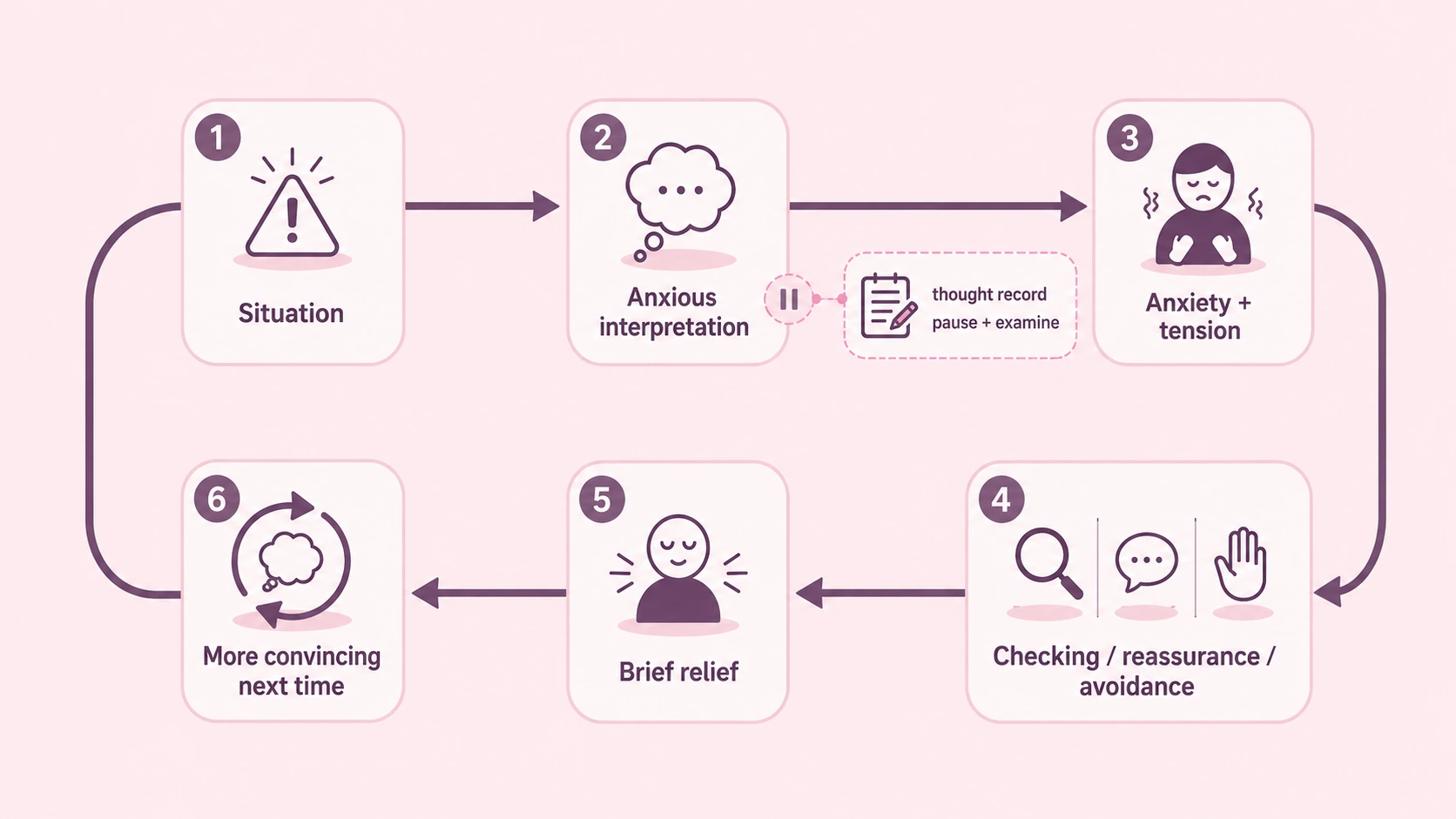
Once you have interpreted the meeting as a threat, anxiety may rise. You might feel tense, distracted or uncomfortable and find it harder to focus on anything else.

You may then start checking recent emails, reviewing completed work or thinking back through conversations to see whether you can find the problem. You might also ask a colleague whether they know what the meeting is about.

These responses are understandable. You are trying to reduce uncertainty and prepare yourself.

The difficulty is that the checking can keep your attention fixed on the feared explanation. What began as an uncertain meeting request starts to feel more and more like evidence that something must be wrong.

Infographic illustrating What a thought record can look like in daily life

Writing the sequence down can make the pattern clearer

A thought record separates these parts so you can look at them one at a time.

Instead of the situation, prediction, anxiety and checking blending together, you can see that your manager requested a meeting, your mind predicted a problem, anxiety followed, and you responded by searching for certainty.

This does not mean the thought is wrong. It means the thought can now be examined as an interpretation rather than treated as a confirmed fact.

Infographic illustrating Writing the sequence down can make the pattern clearer

Why anxious thoughts can feel so convincing

Anxious thoughts often feel powerful because they are accompanied by real emotional and physical changes.

If you suddenly feel tense or unsettled after an anxious thought, that reaction may seem to support the thought itself. The stronger the anxiety becomes, the easier it can be to assume that the feared explanation must have some truth behind it.

The BABCP explanation of CBT describes thoughts, emotions, behaviour and physical feelings as connected. This helps explain why changing one part of an anxious pattern can affect the others.

Feelings can start to seem like evidence

A strong feeling can sometimes be mistaken for information about what is actually happening.

Someone may feel very worried about having made a mistake and begin to treat the intensity of that worry as evidence that there must be a real problem. Another person may feel embarrassed after a conversation and assume that the other person noticed something embarrassing too.

The emotion itself is genuine. What it does not automatically tell you is whether your interpretation of the situation is accurate.

A thought record allows both parts to be present. You can acknowledge that you feel anxious while still looking at what you actually know.

Attention can narrow around the feared explanation

Anxiety can also affect what you notice.

If you are worried that your manager is unhappy with your work, recent mistakes may suddenly feel very important. You may remember a short email, a task you were unsure about or a conversation that did not go as smoothly as you wanted.

Other information can receive much less attention. Positive feedback, routine meetings and all the occasions when a short message meant nothing serious may fade into the background.

The result is that the feared explanation can start to look better supported than it really is.

Checking can strengthen the pattern

Checking may bring relief because it gives you the feeling that you are doing something about the uncertainty.

You might reread an email and feel calmer when you cannot find a mistake. You might ask someone for their view and feel reassured by their answer.

That relief can be short lived. Another possibility may appear, or you may begin to wonder whether you checked carefully enough.

Our article on CBT cycles explains how a coping response that reduces anxiety in the moment can sometimes become part of the pattern that keeps anxiety going.

Infographic illustrating Why anxious thoughts can feel so convincing

Thought records are not positive thinking

One common misunderstanding is that a thought record is designed to replace a negative thought with a positive one.

That is not the goal.

If you are worried about making a mistake during a presentation, telling yourself that the presentation will go perfectly may feel no more realistic than assuming it will be a disaster.

CBT is more interested in developing a view that takes account of the information available.

You might recognise that a mistake is possible, while also recognising that a small mistake would not automatically ruin the presentation. You may remember that people often recover from losing their place or saying something differently from how they planned.

The perspective is more balanced because it allows for uncertainty without assuming the worst outcome.

This is also why thought records are not about arguing with yourself until anxiety disappears. The aim is to understand how you are interpreting the situation and whether that interpretation is shaping what you do next.

A simple CBT thought record example

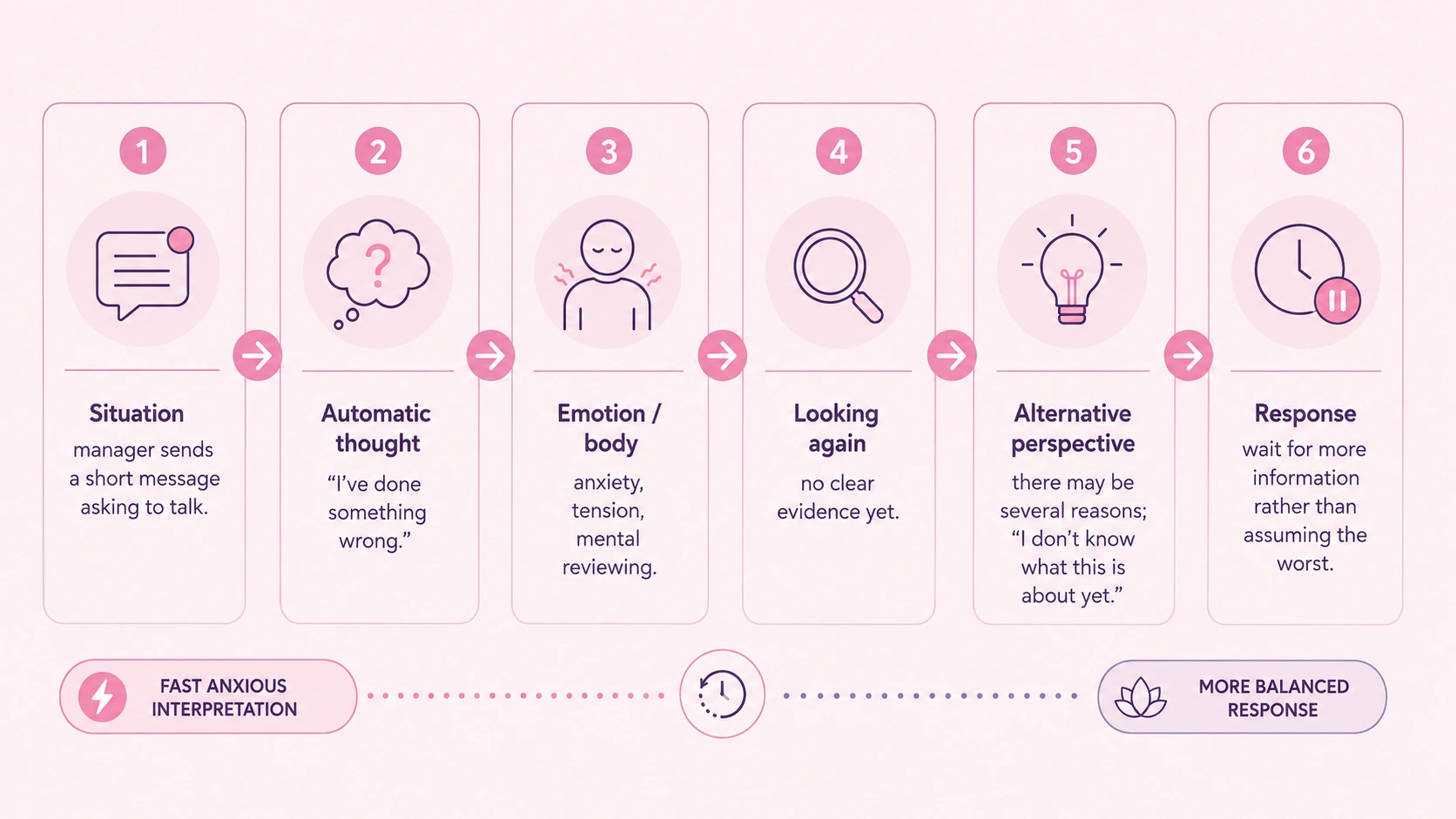
There are different ways to structure a thought record in CBT. Some versions are detailed, while others use only a few prompts. The exact layout is less important than slowing the experience down enough to see how the different parts connect.

The manager example might look like this:

The purpose of the example is not to prove that the meeting will go well.

It could involve a mistake or difficult feedback. It could also involve a routine question, a new piece of work or something unrelated to your concerns.

The change is that one feared possibility is no longer being treated as though it has already been confirmed.

Infographic illustrating A simple CBT thought record example

How CBT thought records help make anxious patterns clearer

Thought records can be useful on their own as a way of understanding a particular moment, but their wider value often becomes clearer when several examples are viewed together.

Different situations may start to show the same underlying fear.

A delayed email, a small mistake and an unexpected meeting may all trigger a fear of getting into trouble. A quiet response, a cancelled plan and a delayed message may all trigger a fear of having upset someone.

Once that pattern is visible, CBT can look beyond the individual situation.

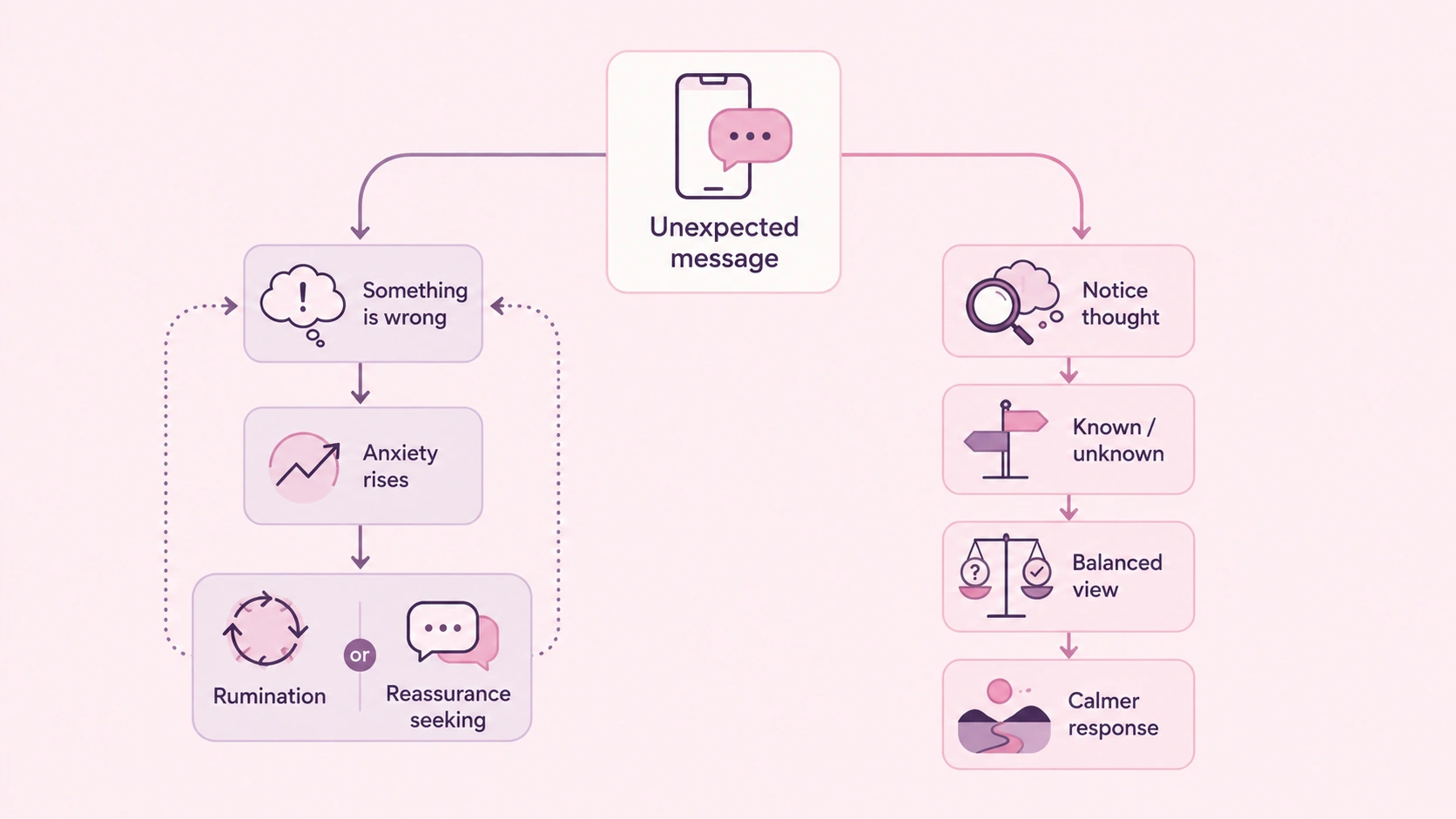
Separating what is known from what is assumed

One useful part of thought-record work is identifying where the facts end and the prediction begins.

If someone has not replied to a message, you know that you have not received a reply. You may then assume that the person is annoyed, disappointed or deliberately ignoring you.

The thought record does not ask you to prove that none of those explanations could be true.

It helps you recognise that the reason for the delayed reply is still unknown.

This can be especially useful when anxiety tends to fill gaps in information with the most threatening explanation.

Finding a balanced perspective

A balanced perspective does not need to make you feel completely calm.

It simply needs to fit the information better than the first anxious conclusion.

You might recognise that you are worried about a delayed reply while also acknowledging that there are several possible reasons for it. You do not need to decide which explanation is correct before carrying on with your day.

This can make the response more flexible. Instead of using the thought record to remove all doubt, you can use it to understand what your mind is doing when doubt appears.

Connecting the thought with the wider CBT pattern

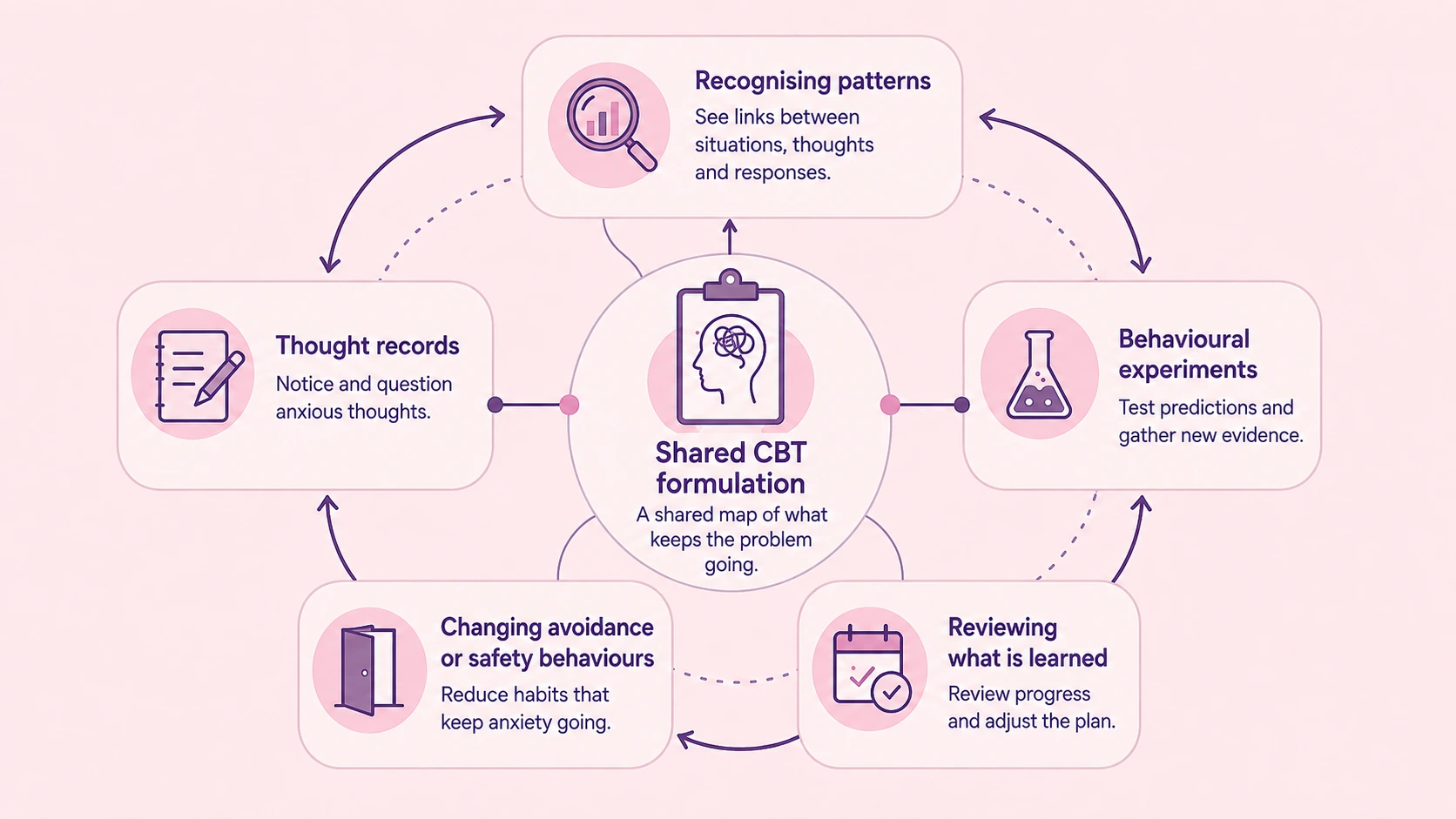
Several thought records can also help identify themes that feed into a wider CBT formulation.

A formulation looks at the triggers, meanings, emotions and coping behaviours connected with the difficulty. It can help explain why certain situations repeatedly produce similar fears and why particular responses, such as checking or reassurance, have become so familiar.

The NHS overview of CBT explains that therapy commonly involves looking at difficult situations and how they affect the way you think, feel and act, before working together on different ways of approaching them.

A thought record can help identify the prediction. The wider CBT work can then look at what happens when you respond to that prediction differently.

Infographic illustrating How CBT thought records help make anxious patterns clearer

When thought records can become another form of checking

Thought records are intended to help you understand a pattern. They can become less useful if they turn into another way of trying to achieve certainty.

Someone who finds uncertainty difficult may spend a long time reviewing the same record, looking for more evidence or trying to create the perfect alternative explanation. They may return to it whenever anxiety rises because they want the written answer to make the doubt disappear.

At that point, the process can begin to resemble checking or reassurance.

The issue is not that the thought record itself is a problem. It is how it is being used.

You also do not need to analyse every anxious thought that appears. Many thoughts come and go without changing what you do. Thought records tend to be more useful when a thought is part of a repeated pattern that affects your behaviour, takes up time or keeps leading back to the same fear.

Sometimes the person already understands that their prediction may be exaggerated, but their behaviour has not changed. In that situation, more written analysis may add little. CBT may instead focus on what happens when checking, avoidance or another coping behaviour is reduced.

Our Case Study

We have anonymised the following example for privacy reasons. Identifying details have been changed.

The problem the client had when they first contacted NOSA

One client came to NOSA because anxiety about making mistakes at work was taking up more and more of their day.

An unexpected email, question from a colleague or meeting request could quickly lead to the thought that they had done something wrong. They would then reread emails, check completed work and mentally review conversations.

These responses sometimes reduced the anxiety briefly, but another uncertainty would soon trigger the same pattern.

The method used to understand and work with the problem

In therapy, we used thought records to separate what had actually happened from what the client feared it meant.

A manager asking for a conversation was the situation. The belief that a serious mistake had been made was the interpretation.

Across several examples, it became clear that uncertainty often led the client to assume something had gone wrong. The thought records helped make that pattern easier to recognise, while the wider CBT work focused on reducing the checking and mental reviewing that followed.

The progress made

Over time, the client began noticing these anxious interpretations earlier.

Unclear emails and unexpected conversations could still trigger worry, but they were less likely to lead to prolonged checking or reviewing.

The client became more able to recognise when they did not yet have enough information and continue with their day rather than immediately trying to resolve the uncertainty.

Final Thoughts

Anxious thinking can happen so quickly that a situation and your interpretation of it begin to feel like the same thing. When strong emotions, checking or reassurance follow, that first interpretation can become even harder to question.

Thought records help slow the sequence down so you can see what happened, what your mind predicted and how you responded. They are not about forcing positive thoughts or proving that everything will be fine.

Used as part of a wider CBT approach, CBT thought records can help you recognise repeated anxiety patterns and give you more choice about what happens after an anxious thought appears.

FAQs

Thought records are a structured CBT method for looking at a difficult situation, the thoughts that appeared and the feelings and behaviours that followed. They can help you separate what happened from the meaning your mind gave to it and consider whether other explanations may also fit.

They can be useful when anxious interpretations are an important part of the problem. A thought record may help you notice repeated predictions about mistakes, judgement, uncertainty, danger or not being able to cope, especially when those predictions affect what you do next.

Formats vary, but they often include the situation, the automatic thought, the emotions that followed, information connected with the thought and a more balanced perspective. Some versions also look at the behaviour that followed and whether your response changes after reviewing the situation.

No. The purpose is not to turn every difficult thought into a positive statement. The aim is to look at the situation more fully and develop a perspective that is realistic, balanced and based on the information available.

It can if you repeatedly use it to prove that a feared outcome will not happen or keep reviewing it until you feel certain. In CBT, the purpose is to understand the pattern rather than create complete certainty, so how the thought record is being used matters.

Author Bio

James Hicks

Disclaimer

This page is for general information and education. It is not personalised advice, diagnosis, or a substitute for professional assessment.

CBT Bristol

Take the First Step Towards Change

NOSA CBT offers evidence-based therapy for OCD, hoarding help, phobias, health anxiety, social anxiety, PTSD, panic disorder, and generalised anxiety disorder. We also provide a specialist OCD clinic, professional CBT supervision training, and CBT training and teaching for mental health professionals.

Get in touch today to find out how we can help.