
Panic disorder and how CBT helps break the cycle

a graphic illustrating Panic Disorder and how CBT can helpWhat we can help with?

Panic disorder is not just about having occasional panic attacks. It usually involves repeated panic episodes, strong fear of future attacks, and changes in behaviour that begin to shrink everyday life.

This page explains panic disorder in clear, non-technical language, including how panic is understood in CBT, what often keeps the cycle going, and what assessment and therapy usually focus on. If you are ready to explore support, we can help you through our cognitive therapy for panic disorder, which outlines how we work with panic and agoraphobia using CBT.

What Is Panic Disorder?

What is panic disorder?

Panic disorder involves repeated panic attacks alongside ongoing fear about what the attacks mean and when the next one might happen. Over time, this fear can lead to avoidance, self-monitoring, and changes in behaviour that begin to shape everyday life.

The NHS describes panic disorder as involving recurring and unexpected panic attacks, often alongside ongoing worry about having more attacks. Their panic disorder overview also notes that people may begin avoiding situations because they fear another attack.

What is a panic attack?

A panic attack is a sudden surge of intense fear with strong physical sensations such as a racing heart, dizziness, trembling, breathlessness, chest discomfort, or a feeling of losing control. Panic attacks can happen in different contexts, and many people will experience one at some point without developing a longer-term panic problem.

Panic attacks vs panic disorder

A panic attack is an episode. Panic disorder is the wider pattern that develops when the attacks become something a person begins to fear, monitor, and organise life around. This difference matters because the problem is no longer only the panic itself, but the cycle built around trying to prevent it.

What does a panic attack feel like

Panic often feels immediate, intense, and convincing. People commonly describe it as if something serious is happening in the body right now, even when there is no external danger.

Common symptoms of panic disorder

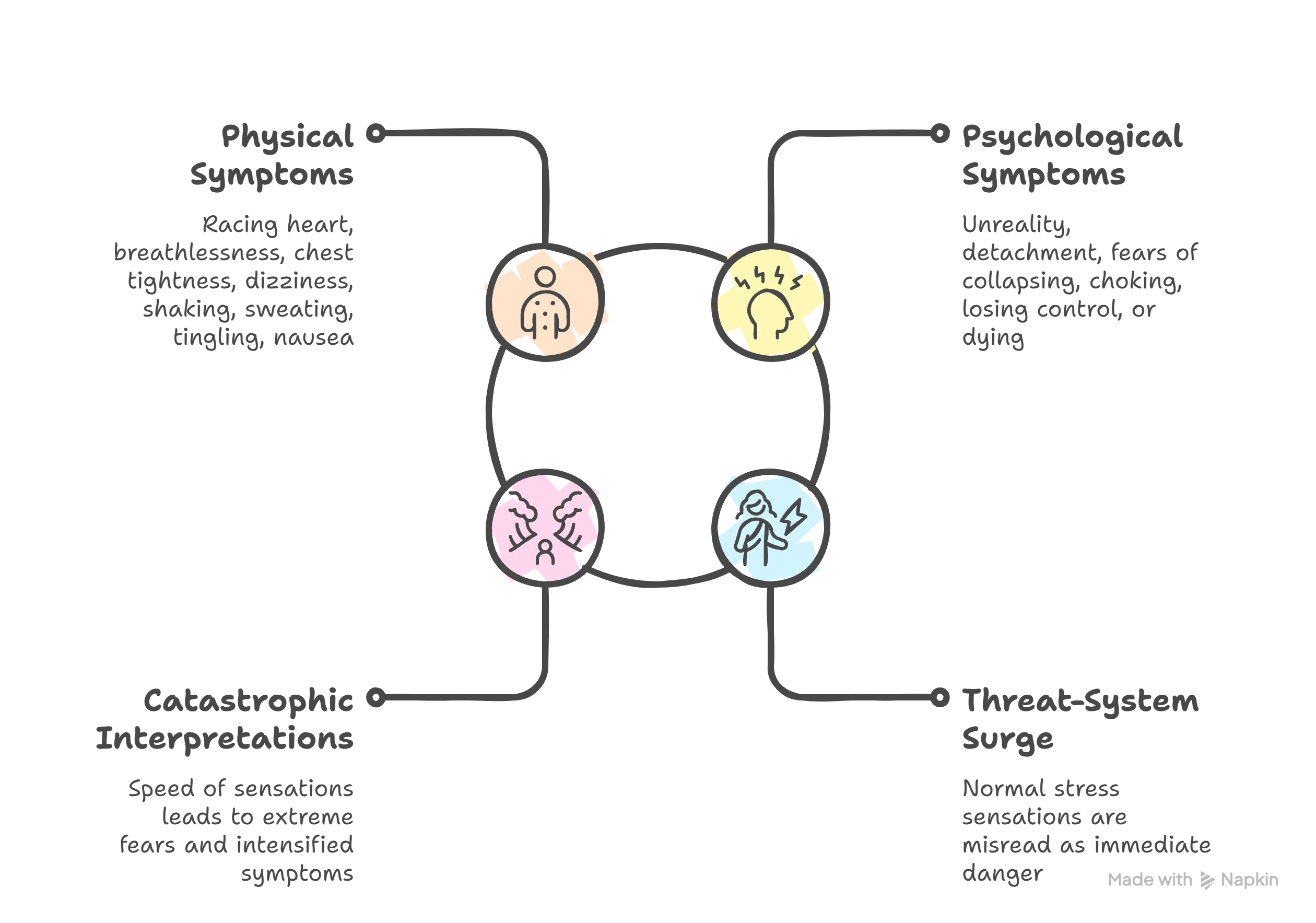
Symptoms during panic can include a pounding or racing heart, breathlessness, chest tightness, dizziness, shaking, sweating, tingling, nausea, and a sense of unreality. Some people feel detached from themselves or their surroundings. Others feel certain they are about to collapse, choke, lose control, or die.

Why panic feels so frightening

Part of what makes panic so distressing is speed. The body changes quickly, and the mind often tries to explain those changes in the most dangerous possible way. If a fast heartbeat is interpreted as a sign of a heart problem, or dizziness is interpreted as a sign of fainting, fear rises even further.

The fight, flight, or freeze response

Panic is closely linked to the body’s threat system. The NHS lists symptoms such as a racing heartbeat, feeling faint or dizzy, sweating, trembling, and shortness of breath as common features of a panic attack in its guide to anxiety, fear and panic. In panic, these normal threat sensations can be misread as signs that something terrible is about to happen.

Can a panic attack cause you to pass out?

Many people fear they will faint during panic, especially if they feel dizzy or lightheaded. This fear is understandable because panic can create strong physical sensations, but the meaning attached to those sensations often becomes part of the cycle. For a fuller explanation, you can read our blog on can a panic attack cause you to pass out?.

What does a panic attack feel like visual selection 1

The cognitive characteristics of panic disorder

CBT pays close attention to the thinking patterns that make panic feel dangerous and urgent. These patterns are usually fast, repetitive, and strongly linked to body sensations.

Catastrophic misinterpretation of bodily sensations

A core feature of panic is catastrophic misinterpretation. Ordinary changes in the body, such as a faster heartbeat or feeling warm, can be read as evidence of immediate danger.

Hypervigilance to physical symptoms

Many people with panic become highly alert to sensations in the body. Attention narrows onto breathing, heartbeat, dizziness, balance, or chest feelings, which can make those sensations feel stronger and more significant.

Fear of fear itself

Over time, the person may not only fear collapse, illness, or embarrassment. They may begin to fear panic itself. This is why panic disorder can become a cycle of fearing the next episode as much as the sensations during it.

Overestimating danger and underestimating coping ability

Panic often involves two linked beliefs: that something terrible is highly likely, and that it would be impossible to cope with if it happened. CBT looks at how both beliefs feed the cycle.

The panic cycle in CBT

In CBT, panic is usually understood as a self-reinforcing cycle. It often begins with a body sensation, a thought, or a context that is interpreted as threatening.

Body sensations and perceived threat

A small change in the body might be noticed first: a skipped heartbeat, dizziness, heat, tightness in the chest, or a feeling of breathlessness. These sensations are not neutral once the person has begun to fear them.

Catastrophic thoughts and rising fear

The next step is usually meaning. The sensation is read as dangerous, perhaps as a sign of a heart problem, passing out, going mad, or losing control in public. Fear rises rapidly because the mind treats the sensation as evidence.

How panic escalates into a cycle

As fear rises, the body produces more threat sensations. Those new sensations then appear to confirm the original fear. The person feels more convinced that something serious is happening, which further increases panic.

Fear of future panic attacks

Once this pattern has happened a few times, panic can start earlier. The person may begin to fear certain places, body states, or situations where panic has happened before. Anticipation then becomes part of the cycle.

The panic cycle in CBT visual selection 1 scaled

What keeps panic disorder going

Panic does not continue only because of the original attacks. It is often maintained by what happens afterwards and by the strategies used to try to stay safe.

Anticipatory anxiety

Many people with panic spend a lot of time anticipating another attack. This can make the threat system more reactive long before any panic sensations appear.

Avoidance

Avoidance can include places, activities, travel, exercise, queues, meetings, or being alone. It brings short-term relief, but it can also strengthen the belief that those situations are dangerous.

Safety behaviours

Safety behaviours are the things people do to reduce the chance of panic or to feel more protected if it happens. They can include sitting near exits, carrying water or medication for reassurance, staying close to others, or keeping strict rules around movement and travel.

Self-monitoring and scanning for symptoms

When attention is locked onto the body, normal sensations are more likely to be noticed and interpreted as threats. This can make panic feel easier to trigger.

Classical conditioning and panic disorder

After repeated panic episodes, certain places, sensations, or situations can become associated with danger. The cue itself then starts to trigger fear, even before a full panic response develops.

Interoceptive fear and bodily sensations

Panic disorder often involves fear of internal sensations, not only fear of external places. This is one reason panic can feel so difficult to predict and control.

Panic disorder and avoidance

Avoidance is often one of the biggest reasons panic begins to affect daily life. It can be obvious, but it can also be subtle.

Avoidance of places and situations

People may begin avoiding public transport, traffic, shops, lifts, meetings, crowds, or anywhere they feel escape might be difficult. This avoidance is often driven by fear of having panic, where it would feel hard to leave.

Avoidance of bodily sensations

Some people also begin avoiding sensations linked with panic, such as exercise, caffeine, heat, exertion, or even strong emotions. The goal is usually to reduce the chance of triggering panic.

The impact of avoidance on daily life

Over time, life can become organised around staying safe rather than living freely. Travel, work, relationships, and independence can all be affected. This can show up clearly in situations such as driving, where panic triggers can quickly narrow confidence and freedom. Our blog on CBT for driving anxiety explores that overlap in more detail.

Panic disorder and agoraphobia

Panic and agoraphobia often overlap, but they are not identical. Agoraphobia usually involves fear of being in places where escape might feel difficult or where help might not be available if panic happens.

How panic disorder and agoraphobia overlap

For many people, repeated panic attacks lead to avoidance of places associated with panic. That pattern can gradually expand until everyday environments start to feel unsafe.

Fear of being unable to escape

A central concern is often not the place itself, but what might happen there. The fear may be about not being able to leave quickly, not getting help, or feeling trapped in front of other people.

Why do some people begin to avoid public places?

Public places, travel, queues, and open or enclosed spaces can become difficult because they seem to increase the consequences of panic. The person may feel there would be no easy way out if panic started.

Is agoraphobia a disability?

Questions about disability, function, and everyday impact often come up when agoraphobia begins to restrict work, travel, or independence. For a fuller discussion of that question, you can read our blog debating whether agoraphobia is a disability.

Panic disorder and agoraphobia visual selection 1 scaled

Panic disorder vs other anxiety problems

Panic shares features with other anxiety problems, but the pattern is not the same in every case. A clear distinction helps therapy stay focused.

Panic disorder vs general anxiety

General anxiety is often more diffuse, involving ongoing worry across different areas of life. Panic disorder is more tightly centred on panic attacks, feared sensations, and the meaning attached to those sensations.

Panic disorder vs health anxiety

Health anxiety also involves fear about the body and serious illness, but it is often broader and more persistent across symptoms and diseases. In panic disorder, the fear is usually tied more directly to acute sensations and the belief that immediate disaster is happening now.

Panic disorder vs heart problems or medical concerns

Because panic can involve chest pain, breathlessness, dizziness, and a racing heart, it can be confused with medical problems. This page is not a diagnostic guide, and physical symptoms should always be understood in the proper medical context, but in panic disorder, the pattern often includes recurrent attacks, fear of future attacks, and behavioural changes built around avoiding panic.

What causes panic disorder

There is rarely one single cause. Panic disorder usually develops through a combination of sensitivity, learning, stress, and repeated experiences.

Biological sensitivity to anxiety

Some people are more sensitive to anxiety sensations than others. They may notice changes in the body more quickly and experience them as more intense or alarming.

Stress and life events

Periods of stress can raise the overall level of arousal in the nervous system. When the body is already more alert, panic sensations may feel more likely and more threatening.

Learned associations and fear conditioning

If panic has happened in a certain place, situation, or body state, the mind may begin linking that cue with danger. Those associations can become strong even if the original trigger is no longer present.

Temperament and threat sensitivity

Some people are more threat-sensitive by temperament. This does not mean panic disorder is fixed or inevitable. It means the threat system may be more easily activated and more likely to search for danger.

How panic disorder develops over time

What often begins as a few frightening panic episodes can gradually become a broader pattern of anticipation, avoidance, self-monitoring, and reduced confidence. The disorder develops not only because attacks happen, but because of how the person learns to relate to them.

How panic disorder affects daily life

Panic can have a wide impact even between attacks. Many people describe the condition as exhausting because so much energy goes into scanning, preparing, and avoiding.

Work, travel, and everyday responsibilities

Travel may become more difficult. Commuting, driving, attending meetings, shopping, or being alone may all feel more complicated once panic is factored into daily decisions.

Social life and relationships

People sometimes begin to depend on others for reassurance, company, or practical support in situations that used to feel manageable. This can place strain on relationships and increase feelings of frustration or guilt.

Confidence, shame, and embarrassment

Panic often affects confidence because it can feel unpredictable and humiliating. Many people feel embarrassed about being seen panicking, even though the experience is more common than they assume.

Feeling misunderstood

One of the hardest parts of panic can be that others do not always understand how real and physical it feels. From the outside, avoidance can look exaggerated. From the inside, it can feel necessary.

How panic disorder affects daily life visual selection 1

What a CBT assessment usually explores

Assessment in CBT is not only about confirming that panic is present. It is about understanding the cycle clearly enough to guide treatment.

First panic experiences

Therapists often ask when the panic began, what the first memorable episodes were like, and what was happening around that time. This helps build a timeline and identify important learning experiences.

Triggers and feared sensations

Assessment usually explores whether the main fear is linked to certain places, body sensations, activities, or situations. This helps clarify what sets the panic cycle off.

Feared outcomes

A key part of assessment is understanding what the person thinks will happen during panic. The feared outcome may be physical, social, or psychological, such as collapse, losing control, humiliation, or not being able to escape.

Avoidance and safety behaviours

Therapists also look closely at what the person does to feel safer. These patterns are often central to understanding what keeps panic going.

Impact on daily life

The wider effect on work, travel, relationships, routines, and confidence is important too. This shows how much space panic is taking up in everyday life.

How CBT understands panic disorder

CBT approaches panic by looking at the interaction between sensations, meanings, fear, and coping responses. The focus is on what keeps the cycle active in the present.

The CBT model of panic disorder

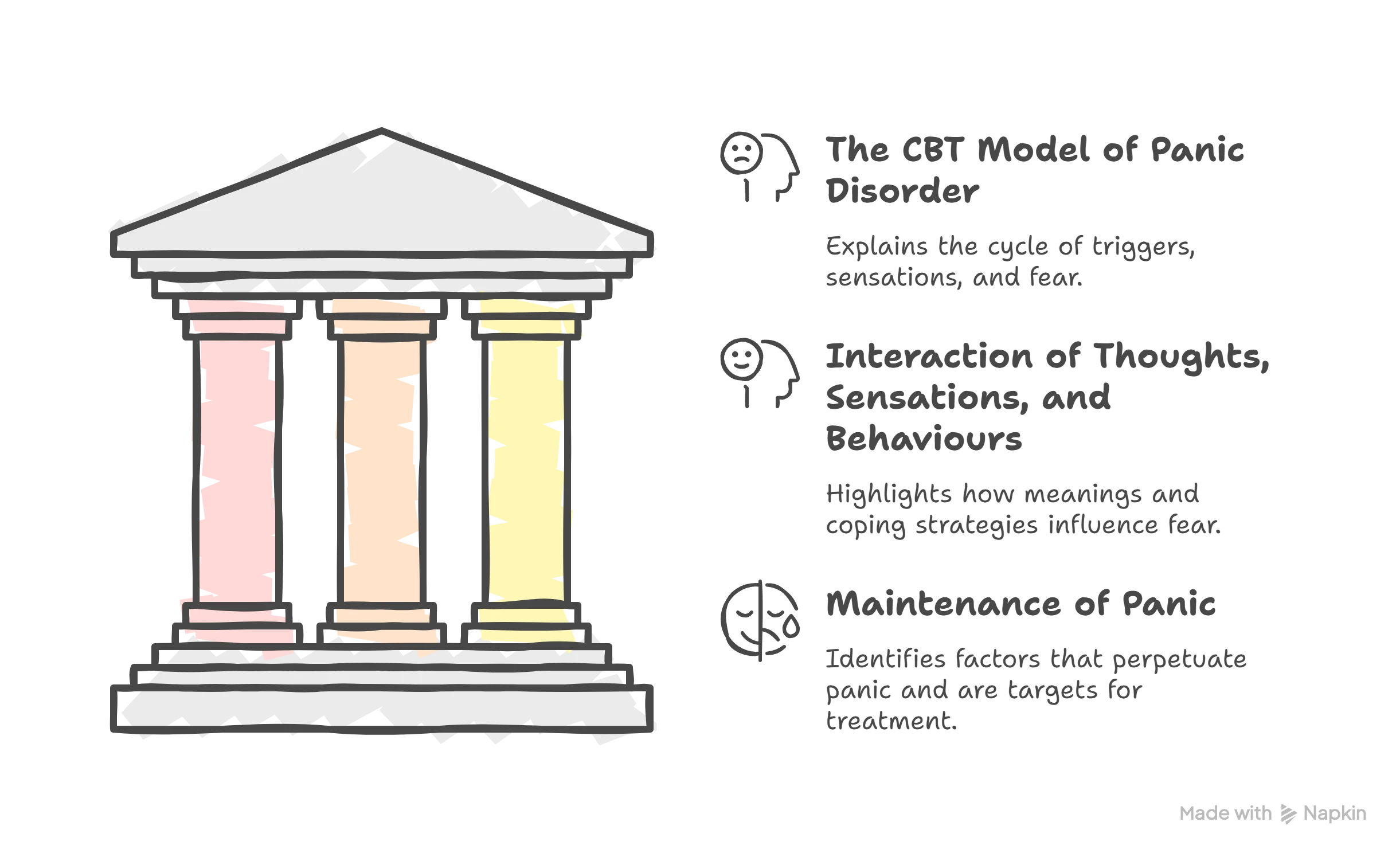
The CBT model usually starts with a trigger, which may be external or internal. A sensation is noticed, interpreted as dangerous, and followed by a surge of fear. That fear then increases body sensations, which seem to confirm the danger.

How thoughts, sensations, and behaviours interact

Thoughts and body sensations do not operate separately. The meaning attached to a sensation affects emotion, and the behaviours used to cope affect whether the fear gets updated or reinforced.

What maintains panic from a CBT perspective

From a CBT perspective, panic is often maintained by catastrophic interpretation, hypervigilance, avoidance, safety behaviours, and fear of fear itself. Therapy focuses on understanding and changing that pattern.

How CBT understands panic disorder visual selection 1

How CBT for panic disorder works

CBT for panic disorder is usually structured, collaborative, and guided by formulation. The aim is not simply to talk about panic, but to understand the cycle accurately and reduce the patterns that keep it powerful.

Understanding the panic cycle

A major part of therapy is developing a shared understanding of how panic works for that individual person. This includes what is noticed first, what meaning is attached to it, what happens next, and what responses bring short-term relief.

Identifying feared sensations and meanings

Therapy often explores which sensations are most feared and what those sensations are believed to mean. This is important because different people panic about different outcomes, even if the physical sensations look similar.

Reducing maintaining patterns

CBT usually pays attention to behaviours that keep panic going, such as avoidance, checking, reassurance, or rigid “safety” rules. The focus is on changing the cycle in a way that supports new learning.

Exposure in CBT for panic disorder

Where exposure is relevant, it is used within a therapeutic framework and guided by formulation. It is not about forcing someone into panic for its own sake. The purpose is to create conditions where feared predictions can lose some of their power.

Panic disorder treatment outcomes

NICE guidance on panic disorder states that CBT should be used as a psychological intervention for moderate to severe panic disorder. In practice, outcomes depend on many factors, including formulation, engagement, and how strongly maintaining patterns are embedded.

Is panic disorder long-term?

For some people, panic responses occur relatively quickly once the cycle is understood clearly and maintenance behaviours begin to shift. For others, especially where panic and agoraphobia have become deeply linked, the work may take longer. Duration is better understood through formulation than through a fixed timetable.

Final thoughts

Panic can feel sudden and frightening, but from a CBT perspective, it is not random or impossible to understand. Panic disorder usually makes more sense when the cycle is mapped clearly, including the sensations, meanings, fears, and behaviours that keep it going.

FAQs

A panic attack is a sudden surge of intense fear and physical symptoms. Panic disorder usually involves repeated attacks, ongoing fear of future attacks, and behaviour changes built around trying to prevent or control them.

Panic activates the body’s threat system, which can create strong sensations such as a racing heart, dizziness, shaking, and breathlessness. These sensations are real, and the meaning attached to them often makes the fear escalate further.

Yes, it can. When panic becomes linked with places where escape feels difficult or help feels unavailable, some people begin to avoid those situations, and agoraphobic patterns can develop.

CBT focuses on the cycle linking body sensations, catastrophic interpretation, fear, and maintaining behaviours such as avoidance or safety behaviours. Therapy is usually guided by a shared formulation of that cycle.

CBT is commonly recommended for panic disorder in UK guidance and is often used to understand and reduce the factors that keep panic going. The exact course of therapy depends on the person’s formulation, goals, and the impact of panic on daily life.

Author Bio

James Hicks

Disclaimer

This page is for general information and education. It is not personalised advice, diagnosis, or a substitute for professional assessment.

CBT Bristol

Take the First Step Towards Change

NOSA CBT offers evidence-based therapy for OCD, hoarding help, phobias, health anxiety, social anxiety, PTSD, panic disorder, and generalised anxiety disorder. We also provide a specialist OCD clinic, professional CBT supervision training, and CBT training and teaching for mental health professionals.

Get in touch today to find out how we can help.