

PTSD Memory Loss and Why Memory Can Feel Different After Trauma

PTSD Memory Loss and Why Memory Can Feel Different After TraumaWhat we can help with?

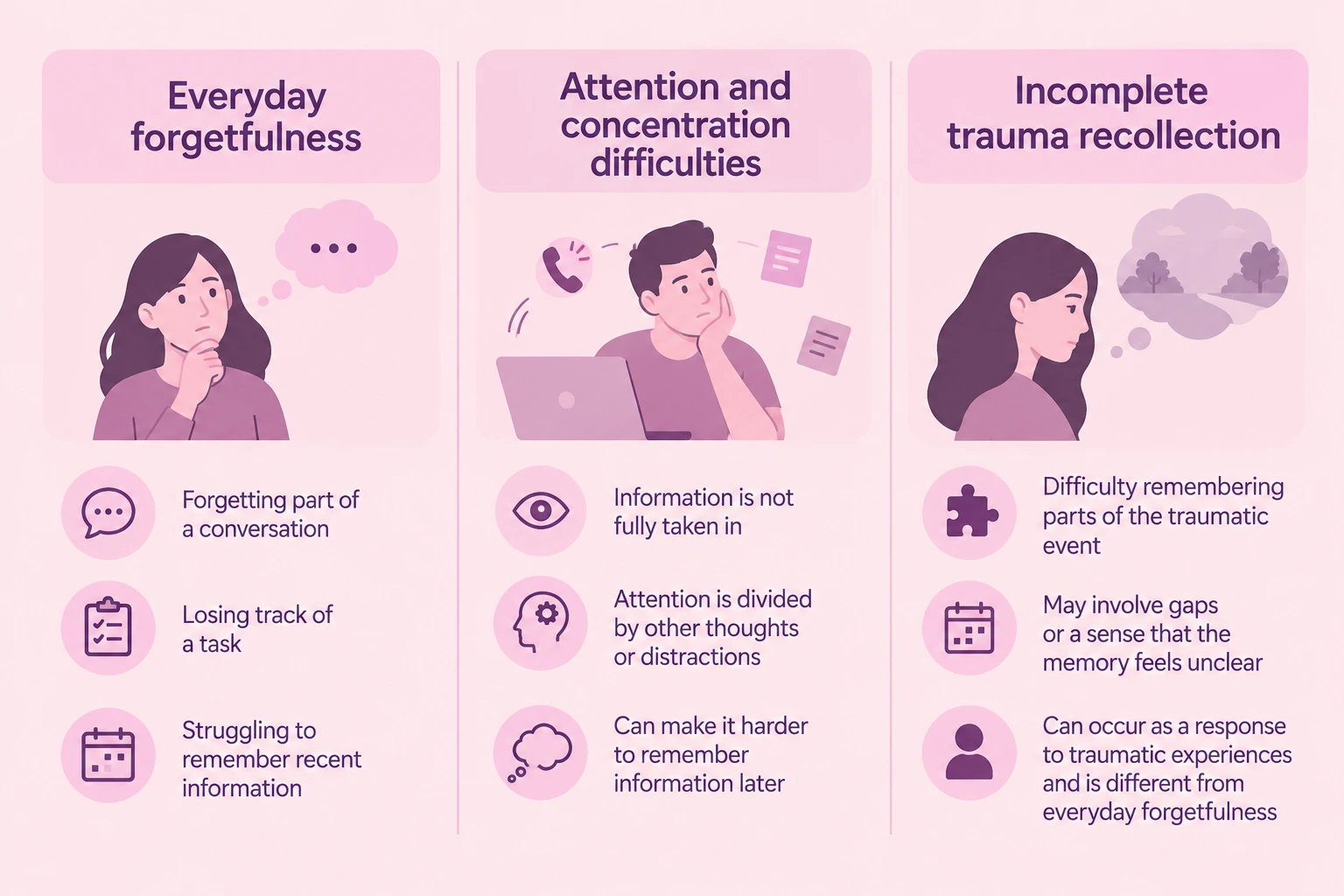
PTSD memory loss can mean several different things. You might notice everyday forgetfulness, find it harder to concentrate on conversations or tasks, or have difficulty recalling parts of the traumatic event itself.

These experiences can be unsettling, particularly if your memory felt more reliable before the trauma. However, they do not all reflect the same process, and memory difficulties alone cannot tell you that PTSD is the cause.

PTSD can affect attention, concentration and the way traumatic memories are experienced. Stress, tiredness and other difficulties can also affect how well information is taken in and remembered.

Our guide to understanding PTSD explains the wider pattern of PTSD symptoms and how they can affect everyday life. In this article, we focus specifically on memory, attention and the difference between everyday forgetfulness and incomplete trauma recollection.

Key Takeaways

Memory difficulties alongside PTSD can include everyday forgetfulness, concentration problems and incomplete recollection of the traumatic event.

Difficulty remembering something does not always mean that information was stored and then lost. Sometimes attention was divided when the information was first presented.

Hypervigilance, intrusive memories, poor sleep and mental exhaustion can all make concentration more difficult.

Vivid fragments of a traumatic memory can exist alongside details that feel unclear or incomplete.

Memory problems have many possible causes, so new or worsening difficulties should not automatically be attributed to PTSD.

Trauma-focused CBT works with trauma memories and their present-day meanings. It is not designed to recover a complete hidden record of past events.

What PTSD memory loss can mean

The phrase “memory loss” covers several different experiences.

Someone may be struggling to remember recent conversations, losing track of everyday tasks or finding it harder to take in information. Someone else may be referring specifically to gaps in their recollection of the traumatic event.

These experiences can overlap, but it is important not to treat them as the same thing.

A common question is, can PTSD cause memory loss? PTSD can be associated with difficulties involving attention, concentration and aspects of memory, but the phrase “memory loss” can describe several different experiences and does not identify the cause by itself.

The NHS guidance on PTSD includes difficulty fully remembering the traumatic event among possible PTSD symptoms. It also describes sleep difficulties and hypervigilance, where someone may feel highly anxious and continually alert to possible danger.

Research has also found differences in some types of memory performance among people with PTSD. A 2026 systematic review and meta-analysis comparing trauma-exposed adults with and without PTSD found poorer performance on average in verbal episodic memory and working memory among the PTSD group. The studies varied considerably, however, so this does not mean that everyone with PTSD will experience the same memory difficulties.

Everyday forgetfulness is different from a gap in the trauma memory

Forgetting part of a conversation you had this morning is not the same as finding parts of a traumatic event difficult to recall.

Everyday forgetfulness may involve attention, concentration and working memory. You might walk into a room and forget why you went there, lose your place during a task or struggle to remember instructions you were given a few minutes earlier.

A gap in a trauma memory refers specifically to difficulty recalling aspects of the traumatic event.

Both experiences may be described as memory problems, but understanding the difference matters.

infographic illustrating What PTSD memory loss can mean

Memory is closely connected with attention

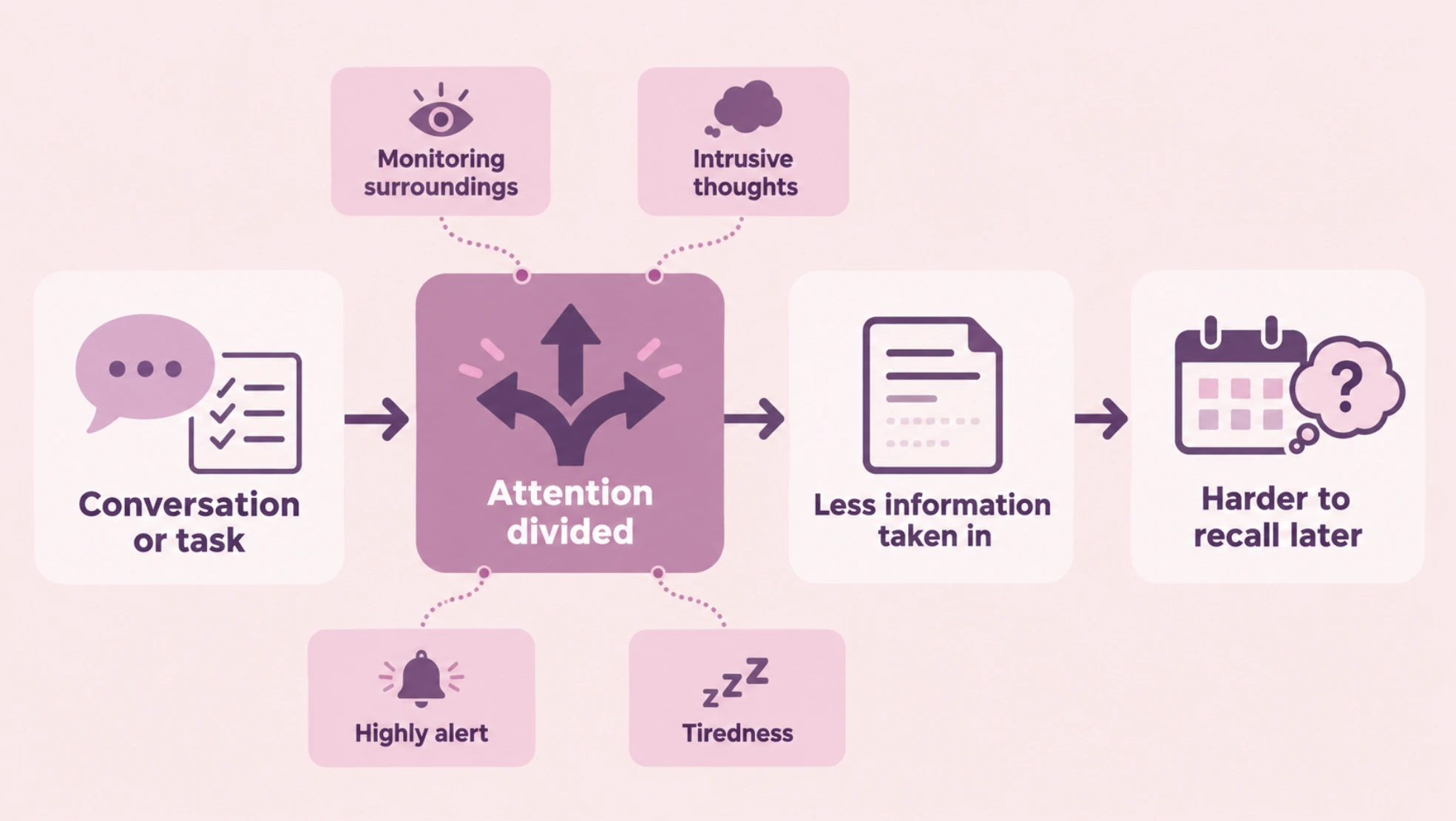
Before information can be remembered later, you first need to take it in.

Cambridge University Hospitals explains this through the process of encoding. If attention is disrupted when you are listening, reading or completing a task, less information may be properly taken in, making it harder to recall afterwards.

This can make an attention problem feel like a memory problem.

Imagine someone gives you several instructions while part of your attention is focused on a noise outside the room. Later, you may struggle to remember everything they said.

It can feel as though you have forgotten the information, when some of it may never have received your full attention in the first place.

infographic illustrating how Memory is closely connected with attention

Why PTSD can make everyday memory feel less reliable

PTSD can place considerable demands on attention.

Part of your mind may be following a conversation or trying to complete a task while another part is monitoring for danger, responding to a trauma reminder or dealing with an intrusive memory.

Over time, this can make everyday memory feel less dependable.

Memory problems with PTSD can therefore involve more than simply forgetting information. Difficulties with attention, intrusive symptoms, heightened alertness and tiredness may all influence how clearly everyday information is taken in and recalled.

Hypervigilance can compete for attention

Hypervigilance describes a state of being particularly alert to possible threats.

You might notice exits when entering a room, pay close attention to people around you, react strongly to sudden sounds or continually monitor whether something feels safe.

This heightened awareness can make sense after a frightening experience. The difficulty is that attention is limited.

If part of your attention is continually scanning the environment, it may be harder to focus fully on an ordinary conversation, work task or piece of information.

You may later remember only parts of what happened.

Intrusive symptoms can interrupt concentration

PTSD can also involve intrusive memories, images, sensations or thoughts connected with the trauma.

These experiences can pull attention away from the present.

You might be reading a document when a trauma-related thought appears. By the time your attention returns to the page, you realise you have read several paragraphs without taking them in.

A similar thing can happen during meetings or conversations.

The resulting gap may feel like forgetfulness, but the interruption to concentration is also important.

Poor sleep and exhaustion can add to the difficulty

Sleep problems are common with PTSD. The NHS includes difficulty sleeping among possible symptoms, alongside nightmares and other intrusive experiences.

A difficult night can make sustained attention harder the following day.

If poor sleep, heightened alertness and intrusive symptoms are all present at the same time, it may become harder to concentrate consistently.

This is one reason it can be misleading to think of PTSD memory loss as one simple problem with one simple cause.

What everyday memory problems can look like

Memory difficulties often become noticeable during very ordinary situations.

That can make them particularly worrying because the person may start wondering why things they previously managed without much thought now feel harder.

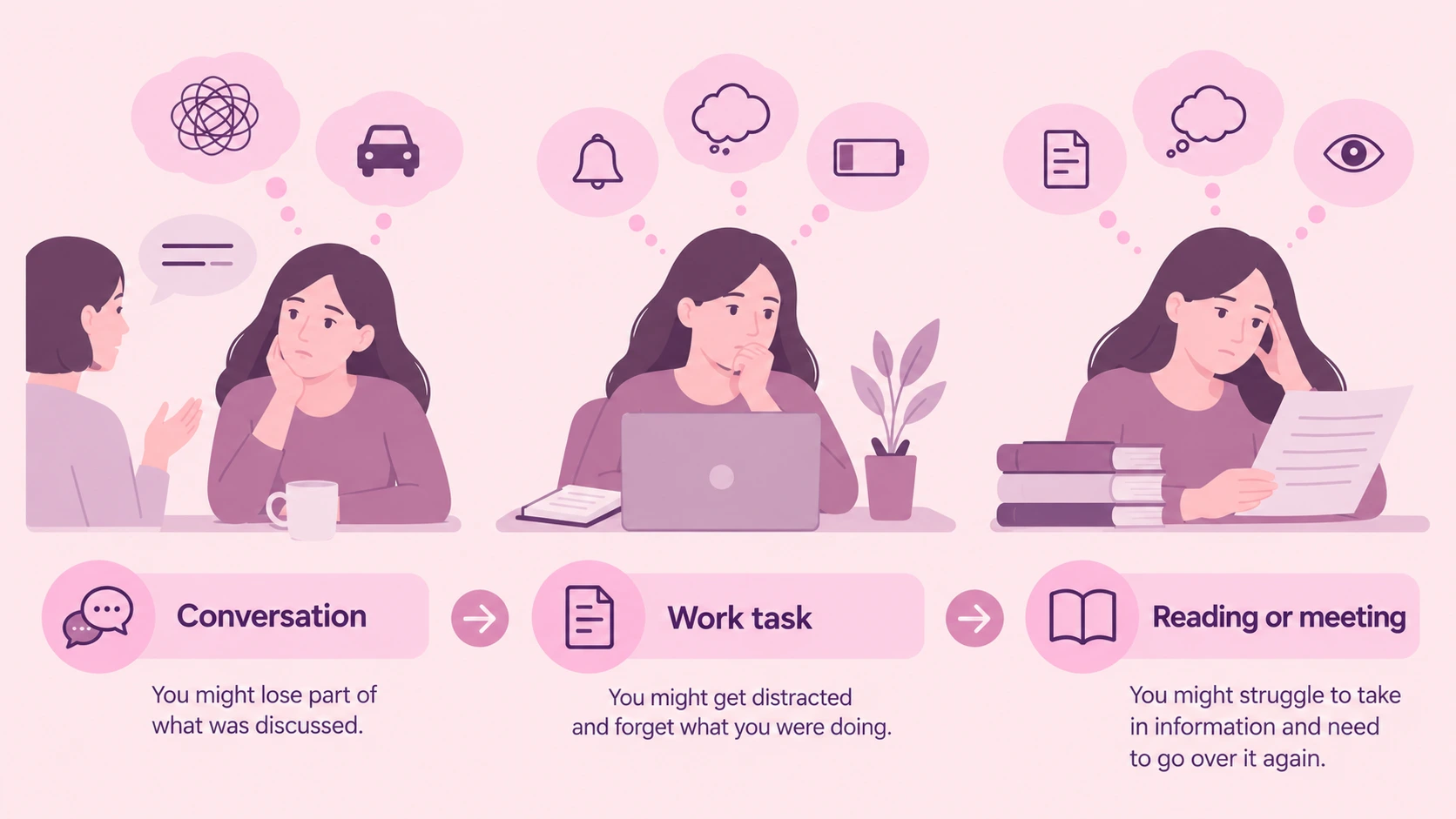
Losing parts of a conversation

Imagine talking with a colleague about something that needs to be completed later that afternoon.

You follow the beginning of the conversation, but then notice a sudden noise nearby. Your attention shifts towards it and you become more alert to what is happening around you.

A few minutes later, the conversation ends.

When you try to remember exactly what your colleague asked you to do, some of the details are unclear.

It is easy to interpret this as “my memory is getting worse”. Looking at the whole situation, however, your attention was divided while the information was being given.

Losing track of tasks

A similar pattern can occur while working through everyday activities.

You may start writing an email, become distracted by a trauma-related thought and then return to the screen unsure what you intended to say next.

Or you may move from one task to another and later realise that the first one was never finished.

When this happens repeatedly, it can begin to undermine confidence in your memory.

Finding information harder to take in

Reading and meetings can become frustrating for the same reason.

You might read the same paragraph several times before it seems to register, or leave a meeting knowing that you were present but unable to remember all the discussion.

This does not mean memory concerns should be dismissed. It does mean that attention, stress and concentration are useful parts of the picture to consider.

infographic illustrating What everyday memory problems can look like

Trauma memories can work differently from everyday memories

Memory difficulties relating directly to a traumatic event need to be discussed separately from everyday forgetfulness.

PTSD can involve powerful, unwanted recollections of the trauma. At the same time, some people may find parts of the event difficult to remember.

Incomplete recollection can occur in PTSD

The NHS recognises not being able to fully remember the traumatic event as one possible PTSD symptom.

This does not mean that everyone with PTSD will have gaps in their trauma memory.

It also does not mean that difficulty recalling an event proves that someone has PTSD. Assessment considers the wider pattern of symptoms and their effect on everyday life.

Vivid memories and missing details can exist together

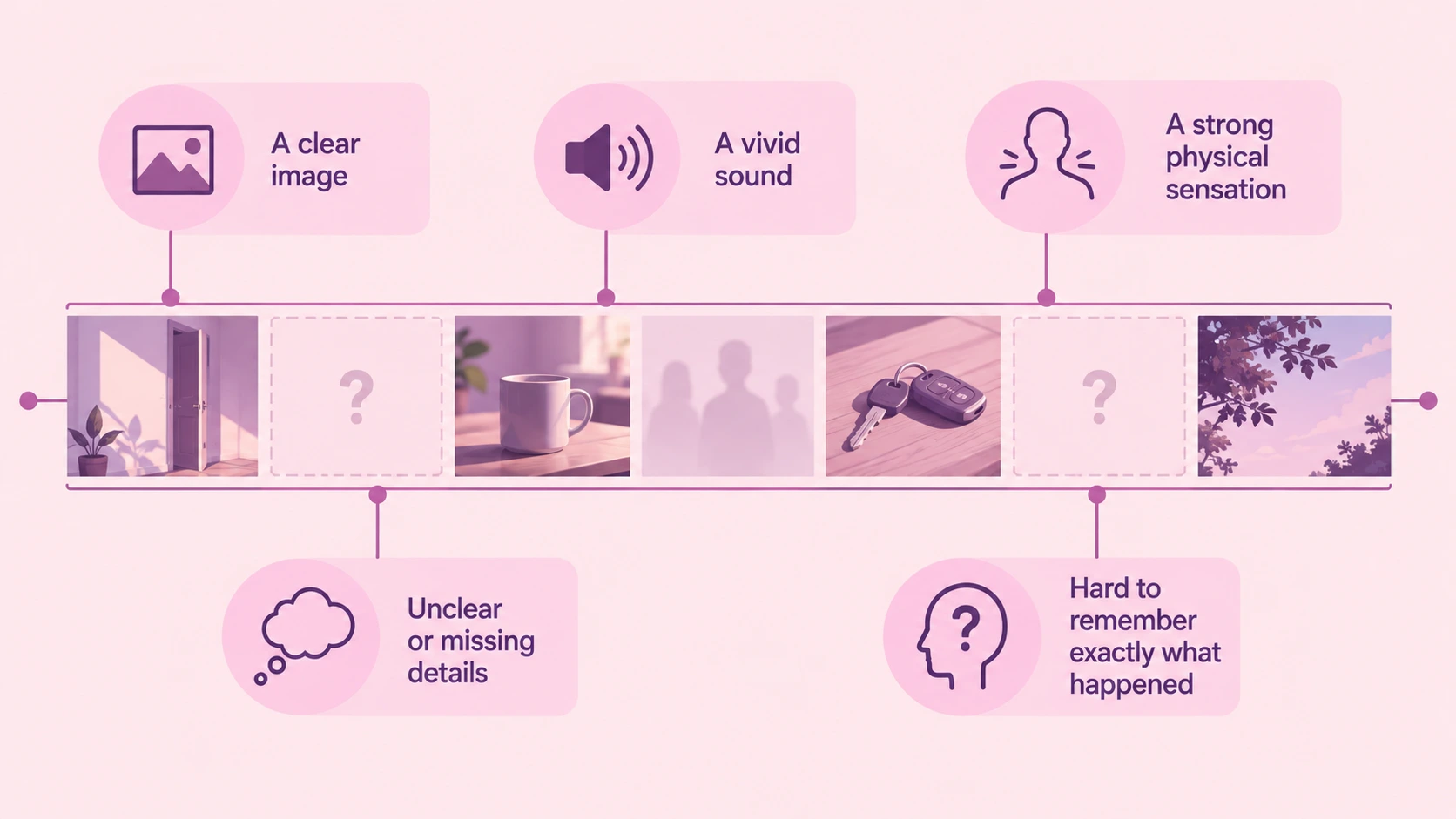
Trauma memories can sometimes feel confusing because some parts may be extremely vivid while other details remain unclear.

A person might remember a particular image, sound or bodily sensation very strongly but struggle to place other parts of the experience into a clear sequence.

The existence of vivid fragments does not mean every detail of an event will be remembered accurately or completely.

Likewise, an unclear detail does not tell us what happened in the missing part.

That boundary is important when discussing trauma and memory.

infographic illustrating how Trauma memories can work differently from everyday memories

Therapy is not about recovering a complete hidden record

Trauma-focused therapy may involve talking about and processing memories of what happened, but the goal is not to uncover a perfectly complete record of the past.

Memory is not a recording that can simply be played back.

Trauma-focused CBT instead works with the memories that are available, the meanings attached to the trauma and the way the experience continues to affect the person in the present.

Therapy should not promise that missing memories can be recovered or treated as proof of events that cannot otherwise be recalled.

Why memory problems should not automatically be blamed on PTSD

If you already have PTSD, it can be tempting to assume every problem with memory or concentration must come from it.

That may not always be the case.

Memory difficulties can have several causes

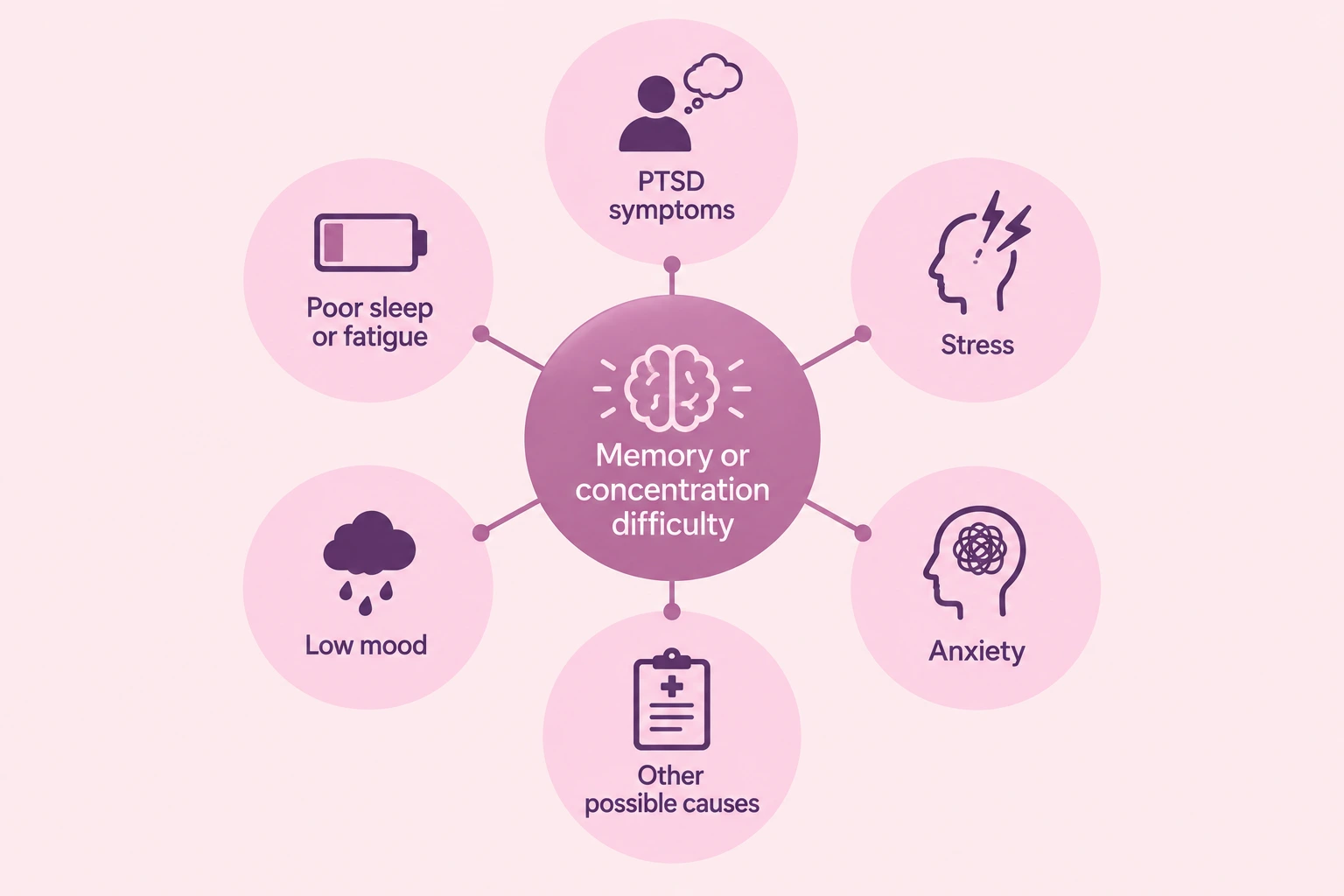
Cambridge University Hospitals notes that memory and attention problems can be affected by factors including stress, anxiety, depression and fatigue, as well as neurological conditions and other causes.

Poor sleep can also make attention more difficult.

This means that similar experiences can arise for different reasons.

Someone who forgets appointments, loses track of conversations or struggles to concentrate cannot determine the cause from those symptoms alone.

infographic illustrating Why memory problems should not automatically be blamed on PTSD

When memory changes deserve separate assessment

Memory difficulties are worth discussing with a healthcare professional if they are significantly different from what is normal for you, are progressively getting worse or are affecting activities you previously managed.

This is particularly important when the change is unexplained.

The purpose is not to assume that something serious is wrong. It is to avoid assuming that PTSD explains a memory change without considering the wider picture.

Our article on PTSD or anxiety and how to tell the difference also explains why symptoms need to be understood as part of a wider pattern rather than used individually to identify a condition.

How CBT understands memory problems alongside PTSD

CBT for PTSD looks at more than whether someone remembers or forgets particular information.

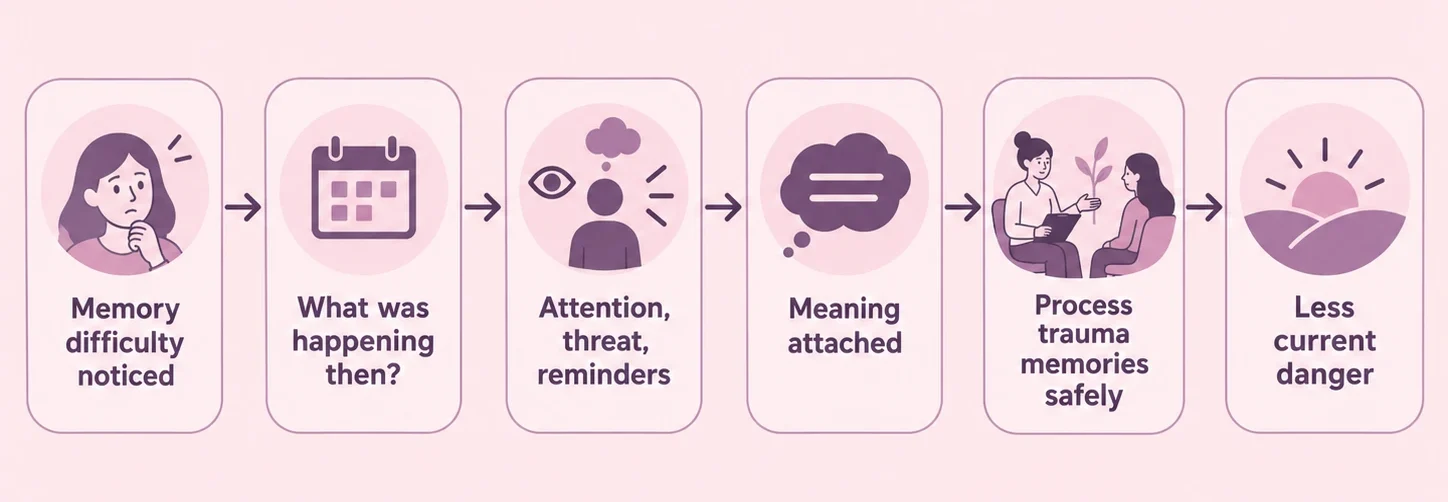
Therapy considers what happens when memories, trauma reminders and a sense of present danger interact.

It can also explore the meaning the person has started attaching to everyday difficulties.

Looking at what is happening around the memory difficulty

Suppose someone repeatedly forgets parts of conversations at work.

Rather than beginning with the assumption that their memory is damaged, therapy can look more closely at what happens during those conversations.

Was their attention focused on the other person?

Were they monitoring the room?

Did something remind them of the trauma?

Were they exhausted after a difficult night?

Did an intrusive memory appear halfway through the conversation?

Looking at the context can make a confusing experience easier to understand.

The meaning attached to forgetfulness matters too

Memory lapses can become frightening when they are interpreted as evidence that something is permanently wrong.

One forgotten detail may then lead to increased monitoring of memory.

The person may begin checking whether they can remember conversations, repeatedly reviewing what happened or becoming anxious whenever a word or detail does not immediately come to mind.

That anxiety can place even more demands on attention.

CBT can therefore consider both the original difficulty and what the person has begun to believe it means.

Working with trauma memories safely

Trauma-focused CBT is one of the treatments used for PTSD.

It can involve carefully processing trauma memories, working with emotions connected with what happened, examining trauma-related meanings and reducing avoidance.

The aim is not to make someone produce details that they cannot remember.

Instead, therapy works with the person’s existing experience and understanding of the trauma.

Reducing the sense of present danger

A traumatic event happened in the past, but reminders can sometimes make the threat feel current.

Someone may therefore respond to a sound, image, thought or physical sensation as though danger is happening again now.

Trauma-focused CBT can help the person understand these responses and work with beliefs and behaviours that continue to create a sense of present threat.

For more information about the approach we use, our PTSD therapy in Bristol page explains how trauma-focused CBT can be used within treatment.

infographic illustrating How CBT understands memory problems alongside PTSD

Our Case Study

We have anonymised the following example for privacy reasons. Identifying details have been changed.

The problem Jane had when she first contacted NOSA

Jane came to NOSA with PTSD and was becoming increasingly worried about her memory.

At work, she sometimes lost track of conversations, had to reread information and forgot what she had planned to do next.

She had started interpreting these experiences as evidence that her memory was deteriorating.

The method used to understand and work with the problem

During therapy, we looked at when Jane’s memory difficulties were most noticeable.

A pattern emerged. She was more likely to lose information when she was tired, monitoring her surroundings or distracted by trauma-related thoughts.

We separated these everyday attention difficulties from questions about the trauma memory itself.

Trauma-focused work also addressed Jane’s belief that the difficulties meant she had been permanently damaged by what had happened.

The progress made

Over time, Jane became better able to recognise when her attention was being pulled towards threat or trauma reminders.

Everyday lapses still happened, but they felt less alarming.

She became less likely to treat each forgotten detail as evidence that her memory was failing and more able to understand the wider context in which the difficulty occurred.

Final Thoughts

PTSD memory loss can describe several experiences that may feel similar from the outside but are important to separate.

Everyday forgetfulness may be influenced by attention and concentration. Trauma memories can also contain vivid elements alongside details that are incomplete or difficult to recall. Neither experience should automatically be used to explain every memory difficulty.

Understanding the difference can make these experiences less confusing and help identify what needs further attention. If memory changes are new, worsening, or significantly affecting daily life, it is important not to assume PTSD is the cause and to seek appropriate assessment.

If you are struggling with PTSD or C-PTSD and would like professional support, you can learn more about our trauma therapy in Bristol and how we use trauma-focused CBT to help people move forward.

FAQs

PTSD can be associated with memory and concentration difficulties, and some people with PTSD have difficulty fully recalling parts of the traumatic event. Research has also found differences in some types of memory performance among groups of people with PTSD.
However, “memory loss” covers many different experiences. Memory difficulties can have other causes, so they should not be used by themselves to determine whether PTSD is responsible.

Several parts of PTSD can make concentration more difficult. Attention may be drawn towards possible threats, intrusive memories or trauma reminders, while poor sleep and fatigue can create additional difficulties.
If information is not fully taken in when it is presented, it can be harder to remember later. This can sometimes feel like a memory problem even when attention is an important part of what happened.

Difficulty fully recalling the traumatic event can occur as part of PTSD, but it is not experienced by everyone.
A person may also have vivid memories of certain parts of an event while other details are unclear. Memory gaps alone cannot establish that someone has PTSD or reveal what happened during anything that cannot be recalled.

It is not possible to predict someone’s individual outcome from the presence of memory difficulties alone.
Memory and concentration can be influenced by several factors, including PTSD symptoms, stress, sleep and fatigue. If memory problems are getting progressively worse or affecting everyday functioning, they should be assessed rather than assumed to be a permanent effect of PTSD.

Trauma-focused CBT can help with PTSD by working with trauma memories, trauma-related meanings, avoidance and the continuing sense of threat.
Where everyday memory difficulties are part of the picture, therapy can also help someone understand what is happening around them, such as whether attention is being drawn towards threat or intrusive experiences.
CBT is not a method for recovering a complete set of missing memories.

Author Bio

James Hicks

Disclaimer

This page is for general information and education. It is not personalised advice, diagnosis, or a substitute for professional assessment.

CBT Bristol

Take the First Step Towards Change

NOSA CBT offers evidence-based therapy for OCD, hoarding help, phobias, health anxiety, social anxiety, PTSD, panic disorder, and generalised anxiety disorder. We also provide a specialist OCD clinic, professional CBT supervision training, and CBT training and teaching for mental health professionals.

Get in touch today to find out how we can help.